Westinghouse and McMaster University Collaborate on eVinci® Microreactor
Westinghouse and McMaster University Collaborate on eVinci® Microreactor
Memorandum of Understanding and Master Services Agreement to Bring Microreactor Technology Closer to Commercialization
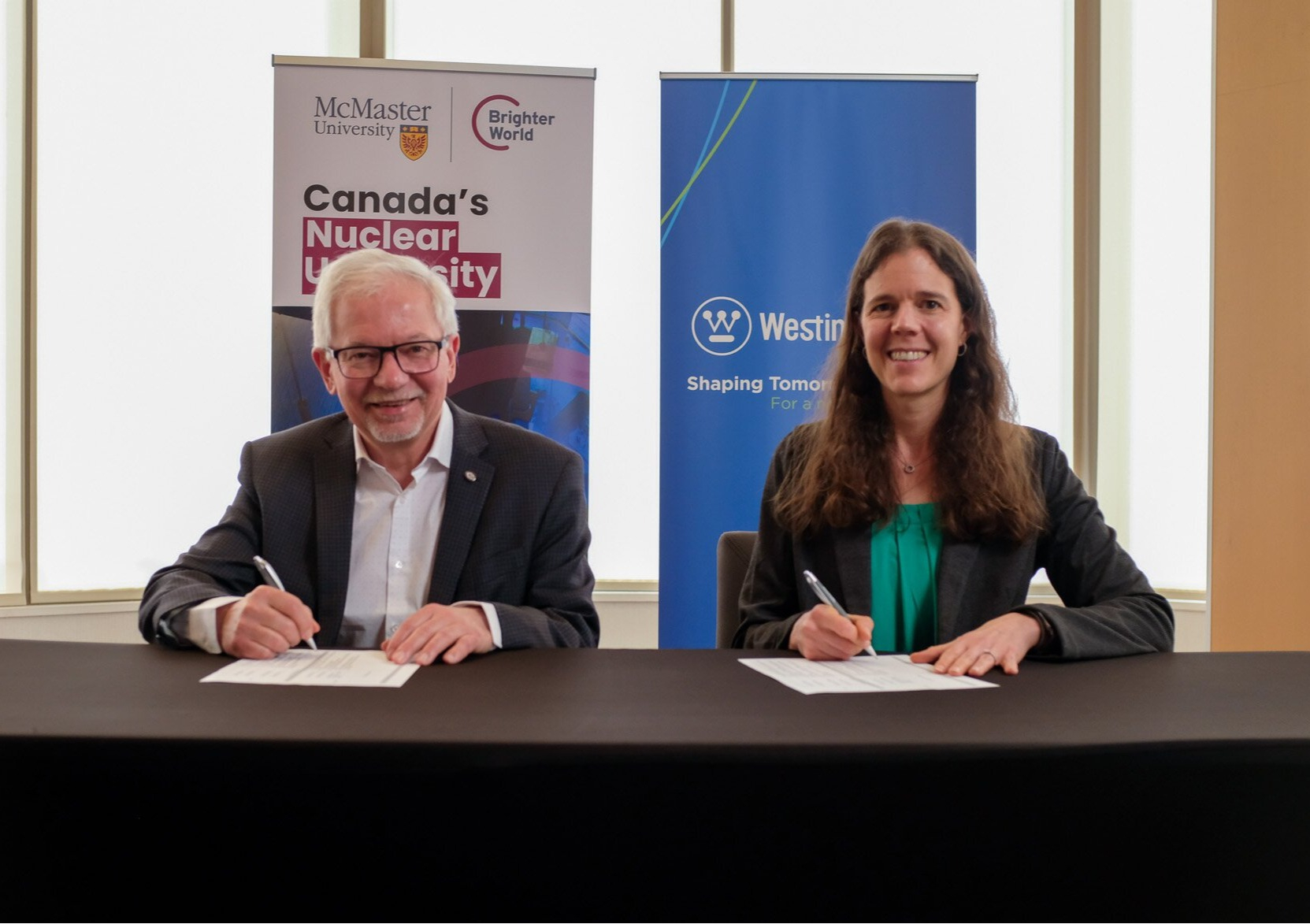
BURLINGTON, Ontario--(BUSINESS WIRE)--Westinghouse Electric Company and McMaster University announced the signing of a Memorandum of Understanding (MoU) and a Master Services Agreement (MSA) supporting research and development (R&D) of the eVinci® microreactor.
Under the agreements, McMaster and Westinghouse will continue collaborating on significant R&D scopes to move the eVinci technology towards commercialization. In addition, the MSA will allow for an extended research collaboration that includes material irradiation and examination studies.
“We’re proud to partner with Westinghouse and contribute our research expertise and world-class suite of nuclear facilities in support of their eVinci microreactor program. As Canada’s Nuclear University, McMaster is committed to working alongside our industry partners to advance materials and energy solutions for a cleaner world,” says Andy Knights, McMaster’s Vice-President, Research (acting).
McMaster is currently expanding its reactor testing capabilities through the development of a high-temperature irradiated test rig, which will enable Westinghouse to gather key testing data to support design confirmation and subsequent licensing approval of the eVinci microreactor.
“McMaster University is a strong Canadian research partner, offering years of valuable experience and insights from operating its research reactor that can be applied to our microreactor technology,” said Jon Ball, President of Westinghouse eVinci Technologies. “By broadening our collaboration and leveraging McMaster’s unique capabilities we can further accelerate the commercialization of our eVinci microreactor.”
This technical collaboration builds on a partnership started in 2022. McMaster has already completed a material properties literature review along with corresponding material handbooks to inform engineering design and determine future testing needs.
These microreactor research agreements support McMaster’s vision for a net-zero campus and research into the possible applications of renewable heat and power for remote deployments.
The eVinci microreactor builds on decades of industry-leading Westinghouse innovation to bring carbon-free, safe and scalable energy wherever it is needed for a variety of applications, including providing reliable electricity and heating for data centers, the oil and gas industry, mining operations, remote communities, universities, industrial centers, and defense facilities, and soon the lunar surface and beyond. The resilient eVinci microreactor has very few moving parts, working essentially as a battery, providing the versatility for power systems ranging from several kilowatts to 5 megawatts of electricity, delivered 24 hours a day, 7 days a week for eight-plus years without refueling. The technology is factory-built and assembled before it is shipped in a container.
Westinghouse Electric Company is shaping the future of carbon-free energy by providing safe, innovative nuclear and other clean power technologies and services globally. Westinghouse supplied the world’s first commercial pressurized water reactor in 1957 and the company’s technology is the basis for nearly one-half of the world's operating nuclear plants. Over 135 years of innovation makes Westinghouse the preferred partner for advanced technologies covering the complete nuclear energy life cycle. For more information, visit www.westinghousenuclear.com and follow us on Facebook, LinkedIn and X.
Located in Hamilton, Ontario, McMaster University is among Canada’s most research-intensive universities, and the nation’s preeminent academic nuclear research institution. The McMaster campus houses a unique suite of world class nuclear research facilities anchored by the McMaster Nuclear Reactor – a multi-purpose research reactor that provides neutrons for medical isotope production and scientific research. McMaster University’s nuclear research facilities enable discoveries in medicine, clean energy, nuclear safety, materials and environmental science, while providing cancer treatments for more than 70,000 patients every year. For more information, visit nuclear.mcmaster.ca.
Contacts