Kioxia Announces High-Capacity KIOXIA LC9 Series 122.88 TB NVMe SSD for AI Applications
Kioxia Announces High-Capacity KIOXIA LC9 Series 122.88 TB NVMe SSD for AI Applications
New Enterprise SSD Utilizing 2 Tb QLC Die to be Showcased at Upcoming Conferences
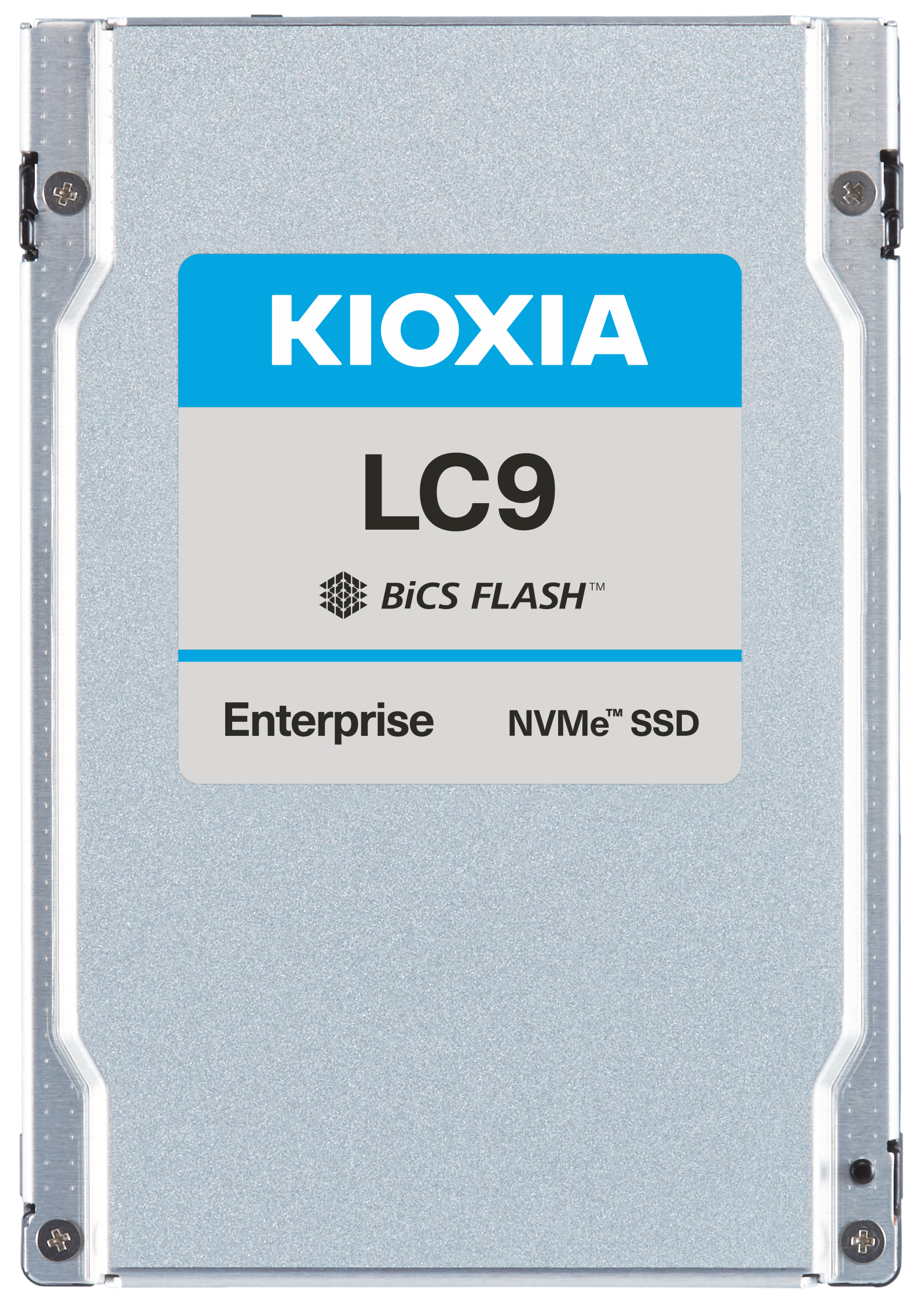
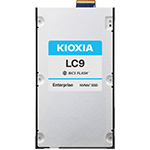
TOKYO--(BUSINESS WIRE)--Kioxia Corporation, a world leader in memory solutions, today announced the development of its new KIOXIA LC9 Series 122.88 terabyte (TB) NVMe™ SSD in a 2.5-inch form factor – the first SSD built with the company’s BiCS FLASH™ generation 8 3D flash memory technology 2 terabit (Tb) QLC die. The KIOXIA LC9 Series, which is under development, will be showcased at various upcoming conferences from this month.
As AI systems become increasingly sophisticated and data volumes continue to grow, enterprises require storage solutions that can keep pace with the complex demands of modern workloads. High-capacity drives are critical for certain phases of the AI process, including large language models (LLMs), training and storing vast datasets, vector databases and the rapid retrieval of information for inference and fine-tuning. Designed for generative AI applications, the new enterprise-class KIOXIA drive is built for high capacity and provides a PCIe® 5.0 interface with dual-port capability for fault tolerance or connectivity to multiple compute systems. These high-capacity QLC-based SSDs are suitable for deploying in hybrid cloud and multi-cloud systems. High-capacity SSDs feed training and inference data to AI server systems via these cloud configurations.
This new KIOXIA SSD complements the recently announced KIOXIA AiSAQ™ technology, which enhances scalable RAG (Retrieval Augmented Generation) performance by storing vector database elements on SSDs instead of costly, limited DRAM. Additionally, it improves system and rack-level efficiency with higher storage density and lower power consumption per TB compared to lower-capacity SSDs.
KIOXIA LC9 Series SSD highlights include:
- Dual-port 2.5-inch SSD form factor, 122.88 TB capacity, 0.3 DWPD endurance.
- NVMe™ 2.0, NVMe-MI™ and PCIe® 5.0 specification-compliant (up to 128 gigatransfers per second Gen5 single x4, dual x2 performance capable).
- Features KIOXIA 2 Tb QLC BiCS FLASH™ generation 8 3D flash memory with CBA (CMOS directly Bonded to Array) technology, which contributes to making high capacity, high performance and power efficient products.
Notes
*2.5-inch indicates the form factor of the SSD and not its physical size.
*Definition of capacity: Kioxia Corporation defines a gigabyte (GB) as 1,000,000,000 bytes and a terabyte (TB) as 1,000,000,000,000 bytes. A computer operating system, however, reports storage capacity using powers of 2 for the definition of 1GB = 2^30 bytes = 1,073,741,824 bytes and 1TB = 2^40 bytes = 1,099,511,627,776 bytes and therefore shows less storage capacity. Available storage capacity (including examples of various media files) will vary based on file size, formatting, settings, software and operating system, and/or pre-installed software applications, or media content. Actual formatted capacity may vary.
*DWPD: Drive Write Per Day. One full drive write per day means the drive can be written and re-written to full capacity once a day every day for five years, the stated product warranty period. Actual results may vary due to system configuration, usage and other factors.
*NVMe and NVMe-MI are registered or unregistered trademarks of NVM Express, Inc. in the United States and other countries.
*PCIe is a registered trademark of PCI-SIG.
*Other company names, product names and service names may be trademarks of third-party companies.
About Kioxia
Kioxia is a world leader in memory solutions, dedicated to the development, production and sale of flash memory and solid-state drives (SSDs). In April 2017, its predecessor Toshiba Memory was spun off from Toshiba Corporation, the company that invented NAND flash memory in 1987. Kioxia is committed to uplifting the world with “memory” by offering products, services and systems that create choice for customers and memory-based value for society. Kioxia's innovative 3D flash memory technology, BiCS FLASH™, is shaping the future of storage in high-density applications, including advanced smartphones, PCs, automotive systems, data centers and generative AI systems.
Customer Inquiries:
Kioxia Group
Global Sales Offices
https://www.kioxia.com/en-jp/business/buy/global-sales.html
*Information in this document, including product prices and specifications, content of services and contact information, is correct on the date of the announcement but is subject to change without prior notice.
Contacts
Media Inquiries:
Kioxia Corporation
Sales Strategic Planning Division
Koji Takahata
Tel: +81-3-6478-2404