World’s Foremost Security Experts in Critical and Emerging Technologies Bolster Leadership of Global Tech Security Commission
World’s Foremost Security Experts in Critical and Emerging Technologies Bolster Leadership of Global Tech Security Commission
High-Tech Leaders to Develop and Implement the Global Tech Security Strategy to Safeguard Freedom
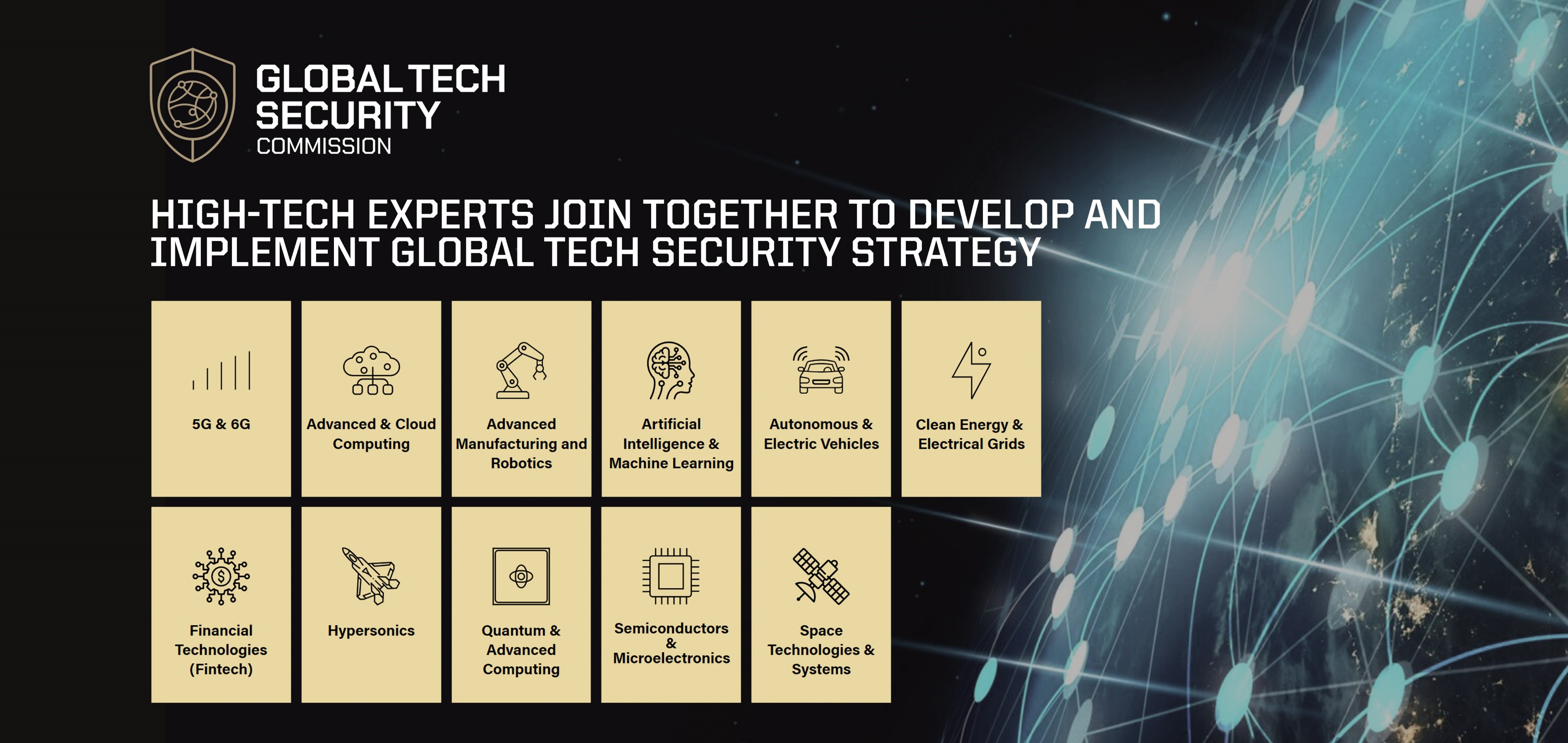
WASHINGTON--(BUSINESS WIRE)--Today, the Global Tech Security Commission (GTSC), a worldwide network of multi-sector leaders developing the definitive Global Tech Security Strategy to safeguard freedom from techno-authoritarian threats, named 11 of the world’s foremost security experts in critical and emerging technologies as Tech Sector Commissioners. Their expertise spans technology sectors critical to freedom, prosperity and international security, including 5G and 6G; advanced manufacturing and robotics; artificial intelligence (AI) and machine learning; autonomous and electric vehicles; clean energy and electrical grids; cloud computing; financial technologies; hypersonics; quantum and advanced computing; semiconductors; and space technologies and systems.
The new Technology Commissioners are:
- 5G and 6G: Robert Spalding, Retired U.S. Air Force (USAF) Brigadier General; Former Defense Attaché to China; Former Senior Director for Strategic Planning, National Security Council, White House; Founder and CEO, SEMPRE.ai
- Advanced Manufacturing and Robotics: Tom Lupfer, Founder and President, Clarity Design Inc.
- Artificial Intelligence and Machine Learning: David Spirk, Former Chief Data Officer, U.S. Department of Defense, U.S. Special Operations Command; Senior Counselor, Palantir
- Autonomous and Electric Vehicles: Matt Blunt, 54th Governor of Missouri; President of the American Automotive Policy Council; Former Naval Officer
- Clean Energy and Electrical Grids: Frank Fannon, Former Assistant Secretary of State for Energy Resources
- Cloud Computing: Marcus Jadotte, Vice President, Government Affairs and Public Policy, Cloud, Google; Former Assistant Secretary of Commerce for Industry & Analysis, International Trade Administration
- Financial Technologies: Erik Bethel, Former U.S. Executive Director, World Bank
- Hypersonics: Daniel DeLaurentis, Professor of Aeronautics and Astronautics, Purdue University; Chief Scientist for Department of Defense’s Systems Engineering Research Center
- Quantum and Advanced Computing: Jake Taylor, Former Assistant Director for Quantum Information Science and founding Director of the National Quantum Coordination Office, White House Office of Science and Technology Policy
- Semiconductors: Thomas Sonderman, CEO, SkyWater Technology Foundry
- Space Technologies and Systems: Dan Goldin, Longest-Serving Former NASA Administrator (‘92 to ‘01)
“The strategic importance of space and near-space technologies for the U.S. cannot be overstated, as it is impossible to envision U.S. national security and economic prosperity without a commitment to ensuring access to space,” said Dan Goldin, Commissioner for Space Technologies and Systems. “If we fail to lead all aspects of space, including satellite communications, reconnaissance, surveillance, natural resource exploration and acquisition, zero-gravity manufacturing, earth observation, lunar and cislunar exploration and operations, planetary exploration and operations and astrophysical observations, the result would have dire implications for many U.S. and industries—such as commercial, financial services, health care, and media—as well as military operations.”
“As the U.S. auto industry continues to drive the truly transformational technologies in electric vehicles and automated driving, we must work diligently, across sectors to ensure that these new technologies are properly safeguarded,” said Matt Blunt, Commissioner for Autonomous and Electric Vehicles. “The work of the Global Tech Security Commission will be a catalyst in bringing U.S. technology leaders together to not only guard against existing threats to our cutting-edge technology, but also formulate proactive strategies to combat adversarial threats to America’s future technological leadership.”
“The U.S. cannot assume any advantage in the AI arms race,” said David Spirk, Commissioner for AI and Machine Learning. “To keep up with pacing threats including China, Washington must both accelerate the innovation pipeline and build end-user confidence in AI through robust testing and validation offered by the private sector. Failure to do so would put the U.S. at a severe disadvantage.”
For more information on GTSC Tech Commissioners, including quotes and biographies, visit https://globaltechsecurity.com/.
About the Global Tech Security Commission
The Global Tech Security Commission aims to unite allied nations, harness private sector innovation and establish a Global Trusted Tech Network to foster and safeguard trusted technologies. Its mission involves devising holistic offensive and defensive strategies for tech sectors deemed crucial for national security by the White House and incorporating them into a Global Tech Security Strategy.
The GTSC consolidates transatlantic and Indo-Pacific allies against growing worldwide authoritarianism on critical tech issues. It is formed of an international group comprising experts in critical tech sectors, countries and strategic sectors leading expert advisory councils. Co-chairs Keith Krach, former U.S. Under Secretary of State and DocuSign CEO, and Kersti Kaljulaid, former President of Estonia and Chair of the Three Seas Initiative, lead the Commission.
For updates on the GTSC, visit globaltechsecurity.com. Media inquiries should be directed to KrachInstitute_press@prf.org.
Contacts
Evelyn Swan
evelyn@rokksolutions.com