Exploding STI Rates Need Attention Now
Exploding STI Rates Need Attention Now
Protest, march, and full-page LA Times ad demand LA County action to stop spread of sexually transmitted infections
***See Full-Page Ad Here***
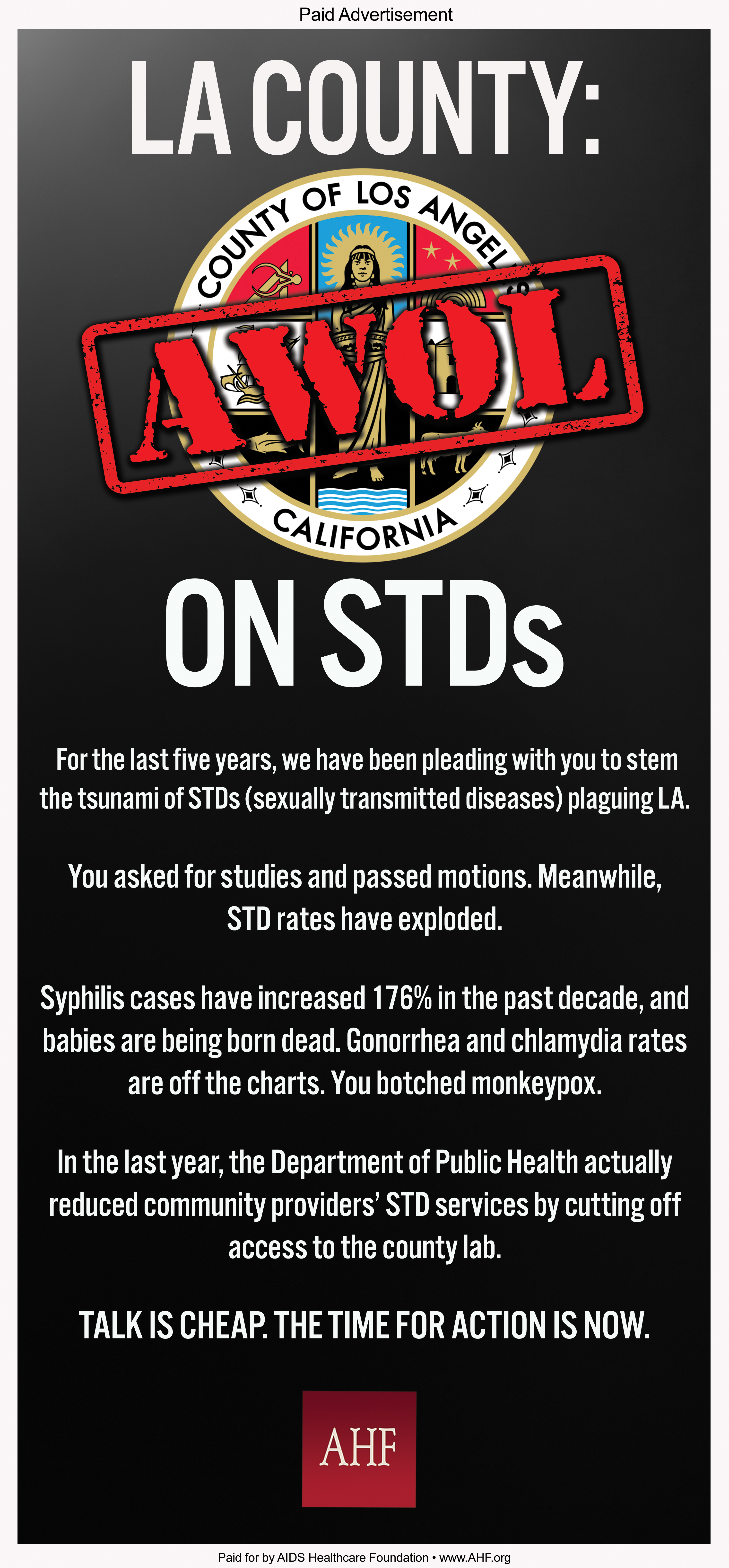
LOS ANGELES--(BUSINESS WIRE)--Because sexually transmitted infection (STI) rates continue to skyrocket in Los Angeles County and officials are dragging their feet on allocating resources to address the crisis, AIDS Healthcare Foundation (AHF), the world’s largest HIV healthcare provider, will protest, march, and testify on Monday, June 26th. AHF is calling on the Los Angeles County Department of Public Health and the County Board of Supervisors to do more to stop the spread of STIs. A corresponding full-page advertisement in the Los Angeles Times will run on Sunday, June 25th, showing LA County has been “AWOL on STDs” and must act now.
WHAT: |
Protest and march to demand more LA County resources to fight STIs |
|||
WHEN: |
Monday, June 26th starting at 12:20 PM |
|||
WHERE: |
Los Angeles County Dept. of Public Health Administration building
|
|||
|
12:20 PM: Arrive at LA County Department of Public Health Admin building: 313 N. Figueroa St. (at Temple) |
|||
|
12:30 PM: March to LAC Board of Supervisors: 550 W. Temple St. |
|||
|
12:50 PM: Protest outside LAC Board of Supervisors meeting |
|||
|
1:00 PM: LAC Board of Supervisors meeting begins |
According to the CDC, “Reported cases of the sexually transmitted infections (STIs) chlamydia, gonorrhea, and syphilis all increased between 2020 and 2021 – reaching a total of more than 2.5 million reported cases – according to CDC’s final surveillance data.” The CDC also noted, “To reverse this trend, CDC is calling for more groups from local, healthcare, industry, and public health sectors to contribute to STI prevention and innovation efforts.”
AHF’s Public Health Division created a one-sheet reference guide on the Board of Supervisors and L.A. County’s Department of Public Health’s actions on STIs. The document covers November 2017 through May 2023. To view AHF’s “STI Action Timeline” click here.
About AHF
AIDS Healthcare Foundation (AHF), the world’s largest HIV/AIDS healthcare organization, provides cutting-edge medicine and advocacy to more than 1.75 million individuals in 45 countries in the US, Africa, Latin America/Caribbean, the Asia/Pacific Region, and Eastern Europe. To learn more about AHF, visit us online at AIDShealth.org, find us on Facebook, follow us on Instagram and Twitter, and subscribe to our Ahfter Hours podcast.
Contacts
Ged Kenslea, AHF Senior Communications Director
323.791.5526
ged.kenslea@ahf.org