New Study Finds Automation Adds $195 Billion to Monthly Business Revenue in the U.S. and £14 Billion in the UK
New Study Finds Automation Adds $195 Billion to Monthly Business Revenue in the U.S. and £14 Billion in the UK
The impact of automation: revenues up 5-7%, employment up 4-7%, long-term productivity up 15% – according to research from Centre for Economics and Business Research and SnapLogic
SAN MATEO, Calif. & LONDON--(BUSINESS WIRE)--SnapLogic, provider of the #1 Intelligent Integration Platform, today released first of its kind research into the economic impact of automation. The study – ‘Automation: Past, Present, and Future - A Driving Force for Economic Growth’ – looks at the growing adoption of automation and its role in bolstering business revenues, creating jobs, increasing productivity, and strengthening economic resilience.
The new research finds that investments in automation are directly linked to increased business revenues (up 5-7%), job growth (up 4-7%), and long-term productivity (up 15%). Spurred on by the pandemic, the adoption of automation is accelerating, with companies in the U.S. and UK spending 8-13% of their annual revenues on automation-related technologies.
The new research was conducted by the Centre for Economics and Business Research (Cebr), in conjunction with SnapLogic. Download the complete report here and read the summary infographic here.
Automation Boosts Revenue and Economic Resilience
The research reveals that those businesses who invested in automation saw a marked increase in revenues. In addition, the research indicates that the more a country employs automation, the better equipped it is to deal with worldwide economic disruptions, such as a recession or the recent COVID-19 pandemic.
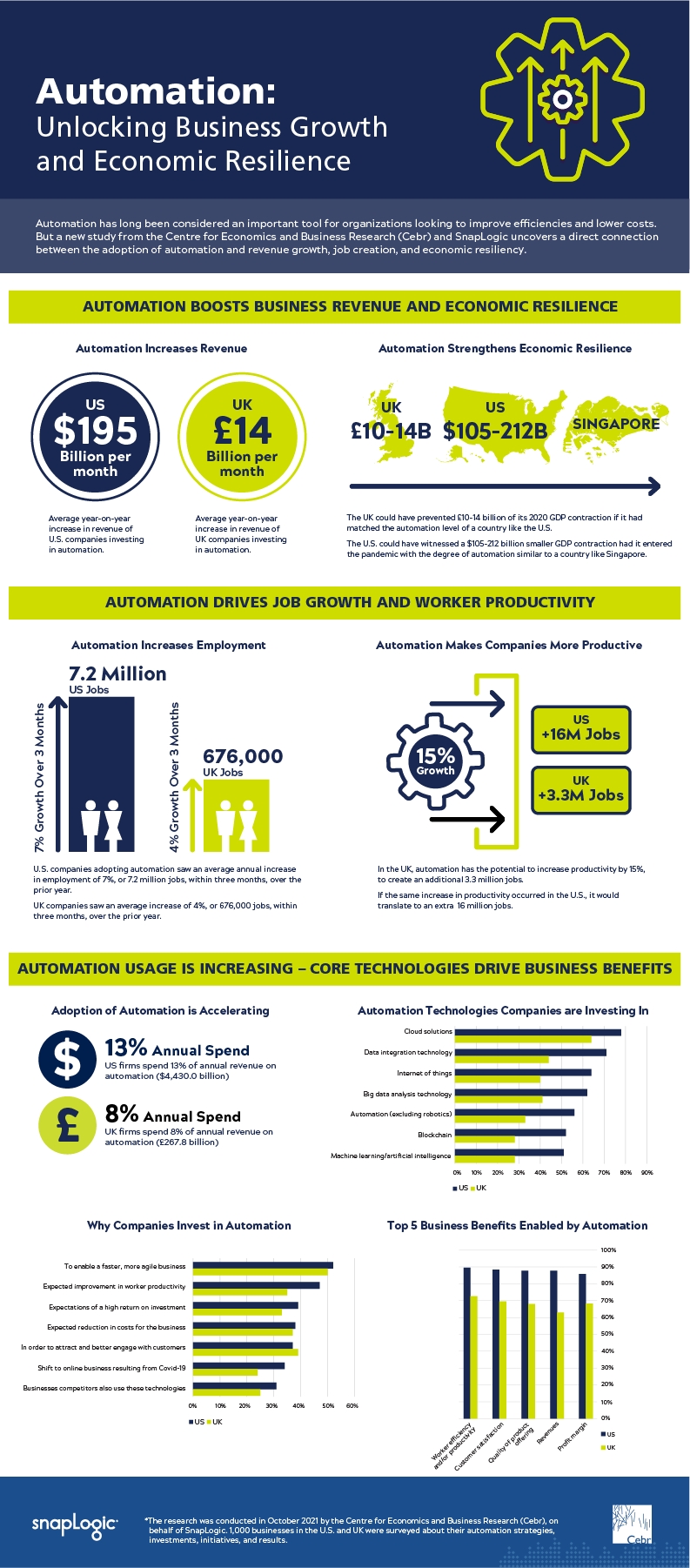
- Increased Revenue - Within three months of investment, U.S. companies witnessed an average year-on-year increase in revenue of 7%, or an extra $195 billion per month, according to the study. UK companies saw an average increase of 5%, or £14 billion each month.
-
Economic Resilience - Analysis suggests that during the COVID-19 crisis, countries with greater adoption of automation were better equipped to deal with the disruption.
- The UK could have prevented £10-14 billion of its 2020 GDP contraction if it had matched the automation level of a country like the U.S.
- Meanwhile, the U.S. could have witnessed a $105-212 billion smaller GDP contraction had it entered the pandemic with the degree of automation similar to a country like Singapore.
Automation Drives Job Growth and Worker Productivity
The report showcases a relationship between automation, job growth, and worker productivity. Despite some claims that automation can limit opportunities for employees, the results tell a different story:
- Employment Growth - U.S. companies adopting automation-related technologies saw an average annual increase in employment of 7%, equating to a total of 7.2 million jobs, within three months (compared to one year earlier). UK companies saw an average increase of 4%, estimated to amount to 676,000 jobs in total.
- Improved Productivity - In the UK, automation has the potential to increase productivity by 15% in the long-term, with notable benefits in industries such as transportation, healthcare, and social work. This translates into the potential to create up to 3.3 million additional jobs. If the same increase in productivity occurred in the U.S., it would support the creation of approximately 16 million jobs.
Automation Usage is Increasing, Supported by Core Technologies
The popularity of automation continues to accelerate in both the U.S. and UK. According to the report, U.S. companies spent an average of 13% of their annual revenue (amounting to $4.4 trillion) on automation-related technologies, while in the UK there was an average spend of 8%, or £268 billion in total.
This increased automation spending was focused on certain core technologies:
- Cloud Computing - Adoption of cloud solutions led the way, with 78% of U.S. and 64% of UK companies investing in the cloud to help improve and automate their companies.
- Data Integration - Data integration was the next most popular technology implemented, with 71% of U.S. companies and 44% of UK companies relying on it as a part of their automation strategy.
- Internet of Things (IoT) - IoT was rated the third most adopted automation technology, with 64% of firms in the U.S and 40% in the UK looking to expand their IoT projects to power automation.
- Big Data Analysis - Meanwhile, the analysis and use of big data was part of the automation strategy enacted by 62% of companies in the U.S. and 41% in the UK.
Companies also had clear business goals for moving forward with automation adoption:
- Boost Speed and Agility - At least half of U.S. (52%) and UK (50%) companies identified the need to improve business speed and agility as the top reason for adopting automation.
- Increase Worker Productivity - The idea that automation can help lift worker productivity was the next highest adoption driver in the U.S., identified by 47% of the companies in the country and 35% of those in the UK.
- Reduce Costs - 38% of U.S. companies and 37% of those in the UK invested in automation to reduce business costs.
- Improve Customer Engagement - A higher proportion of U.S. firms (39%) said their investment in automation technologies was motivated by an expected improvement in customer engagement, compared to 37% of UK firms.
“Our new research confirms a significant positive relationship between automation and economic resilience," said Josie Dent, Managing Economist at Cebr. "The adoption of automation, spurred on by the recent pandemic, has helped organizations shield themselves from disruption and quickly position themselves for accelerated growth. Automation has also led to job creation and greater worker productivity, a significant contrast to the economic picture seen in the period following the global financial crisis.”
“This first of its kind report from Cebr demonstrates the power of automation to help businesses navigate widespread disruption, and shows how it can be used as a tool to accelerate growth in a post-pandemic age,” said Gaurav Dhillon, CEO at SnapLogic. “Businesses today need to equip themselves with enterprise automation technologies that will allow them to quickly adapt and execute business strategies in a rapidly changing world.”
For this study, Cebr surveyed 1,000 businesses in the U.S. and UK about their automation strategies, initiatives, and results. The full study includes case studies of how Siemens Digital Industries, Browns Shoes, SnackNation, SCG Logistics, and others implemented automation technologies within their organizations.
About the Centre for Economics and Business Research
The Centre for Economics and Business Research is an independent consultancy with a reputation for sound business advice based on thorough and insightful research. Since 1992, Cebr has been at the forefront of business and public interest research. They provide analysis, forecasts, and strategic advice to major UK and multinational companies, financial institutions, government departments and agencies and trade bodies. For further information about Cebr, please visit www.cebr.com.
About SnapLogic
SnapLogic powers the automated enterprise. The company’s self-service, AI-powered integration platform helps organizations connect applications and data sources, automate common workflows and business processes, and deliver exceptional experiences for customers, partners, and employees. Thousands of enterprises around the world rely on the SnapLogic platform to integrate, automate, and transform their business. Learn more at snaplogic.com.
Connect with SnapLogic via our Blog, Twitter, Facebook, or LinkedIn.
Contacts
Scott Behles
SnapLogic
scott.behles@snaplogic.com
+1 415-571-4462
Cameron Burke
Kaizo for SnapLogic
snaplogic@kaizo.co.uk
+44 (0)203 176 4700
Jeff Drew
Guyer Group for SnapLogic
snaplogic@guyergroup.com
+1 617-233-5109