Feinstein Researchers Develop New Method to Observe Vagal Fibers Activation During Vagus Nerve Stimulation
Feinstein Researchers Develop New Method to Observe Vagal Fibers Activation During Vagus Nerve Stimulation
MANHASSET, N.Y.--(BUSINESS WIRE)--Researchers at The Feinstein Institutes for Medical Research have developed a way to observe the effects of vagus nerve stimulation (VNS) – the act of electrically stimulating one of the body’s main nerves – by non-invasively measuring bodily responses, including neck muscle activity, heart rate (HR) and breathing. After validation, this methodology could be used in humans.
The emerging field of bioelectronic medicine has produced breakthroughs in VNS, tested as a potential treatment for heart failure, rheumatoid arthritis, lupus, among other conditions. This method of observation will allow researchers to tailor stimulation therapy to target nerve fibers in individual subjects.
One of the drawbacks of current VNS methods is that it is used bluntly, delivering energy to the vagus without targeting specific fibers. In some patients, this results in off-target effects and sub-optimal therapy. Approaches to understand nerve fiber activation require recording nerve compound action potentials through a second electrode, placed near the stimulating electrode – an option that is not clinically feasible even in animal experiments. Now, a team at the Feinstein Institutes has developed an effective alternative approach.
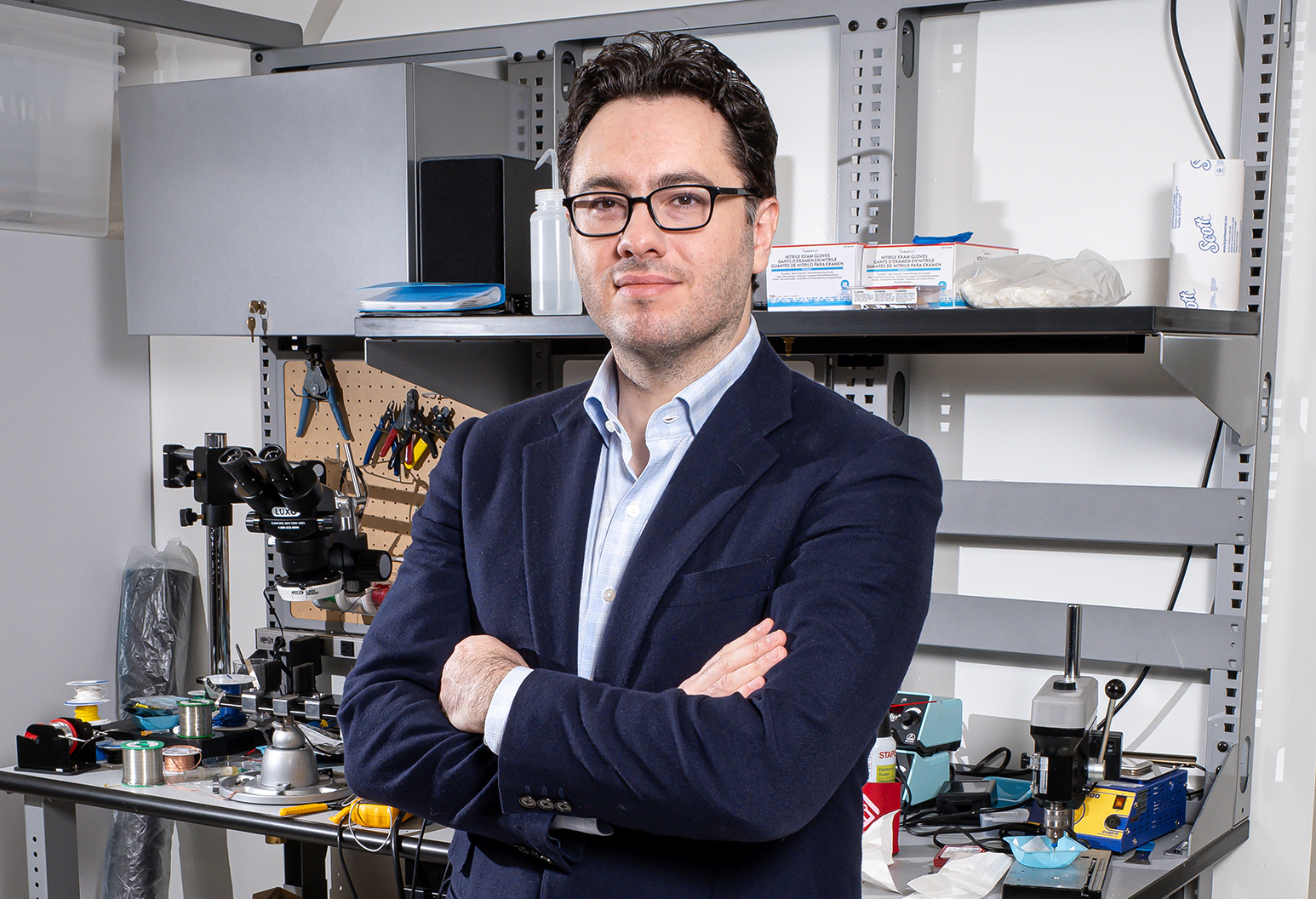
In this new research, a team led by Stavros Zanos, MD, PhD, an assistant professor in the Institute of Bioelectronic Medicine at Feinstein, determined physiological responses that are correlated with the activation of vagal fibers by VNS, thereby avoiding the need to directly record the nerve action potentials themselves. The results, published in the journal Brain Stimulation, provided quantitative formulas in the form of mathematical models to calculate activation of different types of vagal fibers simply by looking at neck muscle activity, heart rate and breathing.
“To calibrate stimulation parameters, target specific fibers in individual patients and better understand the effects that VNS has on the body, we need to be able to peek into the activity of the vagus nerve and to do so in a non-invasive manner to make it usable in human subjects,” said Dr. Zanos. “Our methods allow us to estimate vagal fiber activity via non-invasive physiological measurements. This will help clinicians tailor neurostimulation therapies in individual patients using these quantitative tools.”
Investigators delivered VNS in rats and recorded nerve activity elicited by stimulation. They noted a robust relationship between activation of A, B and C vagal fibers (fibers with different sizes and functions) and certain physiological responses. They found that A fibers were related mainly to neck muscle activation, B fibers to mainly heart rate response, and C fibers to breathing changes. Using that data, they developed equations that allow estimation of vagal fiber activity by measuring, non-invasively, these responses – a roadmap that could help health care providers calibrate vagal nerve stimulation for more focused, effective, and safe therapy regimes in a patient-specific manner.
“Dr. Zanos’ research brings us one step closer to the clinical realization of targeted bioelectronic therapies,” said Kevin J. Tracey, MD, president and CEO of the Feinstein Institutes. “His work will allow us to better measure and tailor bioelectronic medicine therapies to treat some of the most devastating and common diseases on an individual patient basis.”
About the Feinstein Institutes
The Feinstein Institutes for Medical Research is the research arm of Northwell Health, the largest health care provider and private employer in New York State. Home to 50 research labs, 3,000 clinical research studies and 5,000 researchers and staff, the Feinstein Institutes raises the standard of medical innovation through its five institutes of behavioral science, bioelectronic medicine, cancer, health innovations and outcomes, and molecular medicine. We make breakthroughs in genetics, oncology, brain research, mental health, autoimmunity, and are the global scientific leader in bioelectronic medicine – a new field of science that has the potential to revolutionize medicine. For more information about how we produce knowledge to cure disease, visit http://feinstein.northwell.edu and follow us on LinkedIn.
Contacts
Matthew Libassi
516-465-8325
mlibassi@northwell.edu