New Research Finds Job Seekers Are 8x More Likely Than Talent Leaders to Rate an Interview Process Poorly
New Research Finds Job Seekers Are 8x More Likely Than Talent Leaders to Rate an Interview Process Poorly
Textio and Kyle & Co’s new report found candidates want more consistency and communication in hiring but they’re getting wrongly accused of fraud and ghosted instead
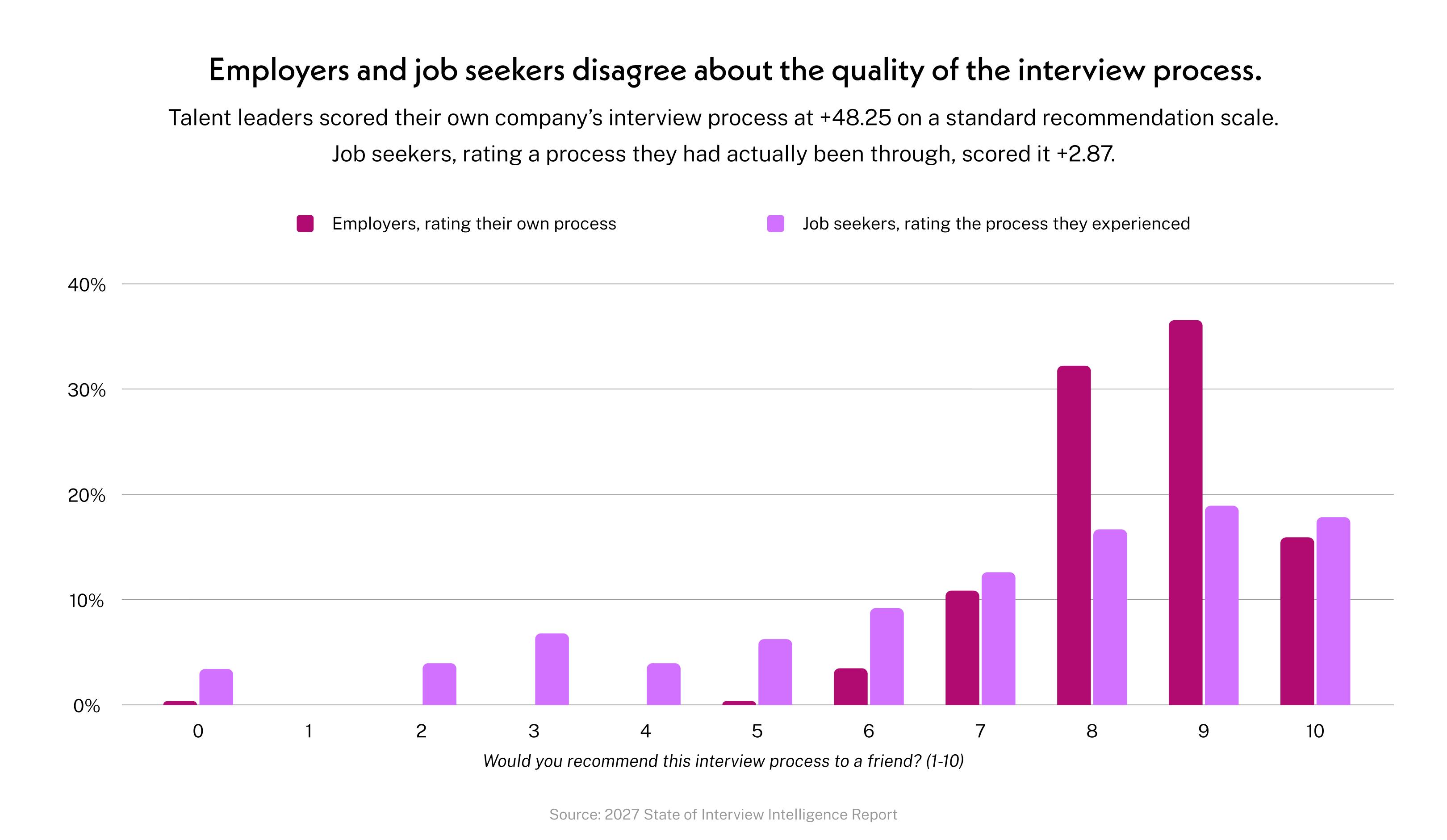
SAN FRANCISCO--(BUSINESS WIRE)--New research released today from Textio and Kyle & Co has found job seekers are 8x more likely than talent leaders to rate an interview process poorly. In a survey of talent leaders and job seekers, employers scored their own company’s interview process at +48.25 on a standard recommendation scale. Candidates were asked to rate the process they had just been through and scored it +2.87, the very bottom of a passable employer brand.
You can’t train away fraud or write a better interview guide to address all of the rising challenges and expectations being placed on talent teams. You need tools to safely automate more of the process and help teams hire the best (real) people.
Share
A bad interview process doesn't just weaken employer brand perception, it puts revenue at risk. 35% of job seekers say a bad interview experience would stop them from buying from the company or reapplying to future roles.
A good hiring process comes down to doing a few things consistently well. Two-thirds of candidates say a high-quality hiring process comes down to how fair and consistent it felt, and how well the company communicated during it. Fewer than 6% say it’s whether they got the job.
"The way the hiring process is run has not kept pace with the volume of applications, cheating, fraud, and information overload that recruiting teams are dealing with. It also hasn't evolved to surface clear evidence about who can actually do the job," said Colleen Gallagher, CEO of Textio. “You can’t train away fraud or write a better interview guide to address all of the rising challenges and expectations being placed on talent teams. Recruiting is the new front door for security risks and lost revenue. You need tools to safely automate more of the process and help teams hire the best (real) people.”
Key findings from the report include:
Employers and job seekers disagree about the quality of the interview process
- Employers score their own company’s process +48.25; candidates score the process they went through +2.87
- 48% of candidates say their most recent interview process felt at least partly improvised; 7% say the interview process felt totally improvised
Candidates largely judge a hiring process by how it was run, not if they got the job
- Two-thirds say what matters most is how fair and consistent it felt, and how well the company communicated; fewer than 6% say it is whether they got the job
- 90% of organizations say ghosting at their company is rare or never happens, 57% of job seekers say it's happened to them
- 81% of talent leaders say rejected finalists always or usually receive substantive, personalized feedback; 57% got a templated line, no feedback, or no reply at all
Employers are confident they can spot cheating, candidates say they're catching the wrong people
- Talent leaders rate their interviewers 8.1 out of 10 at detecting live AI assistance during an interview
- 39% of job seekers say they have been wrongly suspected of cheating or misrepresenting themselves
A bad interview process costs companies customers, not just candidates
- 35% say they would stop buying from the company and never reapply
- More than half of job seekers say they would never apply to that company again
“Eighty-five percent of employers already record interviews, and candidates still can't tell you how they were judged,” said Matt Charney, Principal Analyst, Kyle & Co. “The market bought transcription and called it intelligence. What talent teams actually need is the ability to turn a conversation into structured, comparable evidence that holds up in a debrief, gets shared back to the candidate, and can be checked against how the hire actually performed. That's the difference between a recording and a record. Our data says the organizations doing that are three times more likely to know whether their interviews work at all. Most companies have never asked.”
Get a copy of this report and learn more about what to do with these findings by visiting lavalier.ai/report.
About Textio
Textio is a leader in building tools that help high-growth companies recruit and give feedback to high-performing teams. The company’s latest innovation is Lavalier, an interview intelligence platform that helps recruiting teams raise their hiring bar with structured interviews that gather hiring evidence. Founded in 2014, people leaders at companies like Bloomberg, Cisco, Johnson & Johnson, Samsung, Spotify, and more choose Textio to help them attract and develop top talent. Textio has been named to Fast Company’s World’s Most Innovative Companies list several times, in addition to TIME’s Top WorkTech Companies, Fortune Impact 20, Forbes AI 50, and CNBC Disruptor 50.
Contacts
Media Contact
Rachel Fukaya
VP of Marketing and Communications, Textio
rachelf@textio.com
(831) 229-5761