As AI Reshapes the SOC Career Ladder, Satisfaction Rises for 91%, but Entry Gets Harder for Nearly Half
As AI Reshapes the SOC Career Ladder, Satisfaction Rises for 91%, but Entry Gets Harder for Nearly Half
New Swimlane research underscores a paradox: while AI detection and response is essential to giving defenders an edge, one in four security pros say AI limits their skill development.
News Highlights
- AI Is Improving SOC Work, but the Benefits Are Uneven: Sixty-two percent of respondents say AI has improved their skill development, while 88% report higher job satisfaction. Yet nearly one in four (24%) say AI has limited their ability to build security skills, even though 91% of that group still report greater job satisfaction.
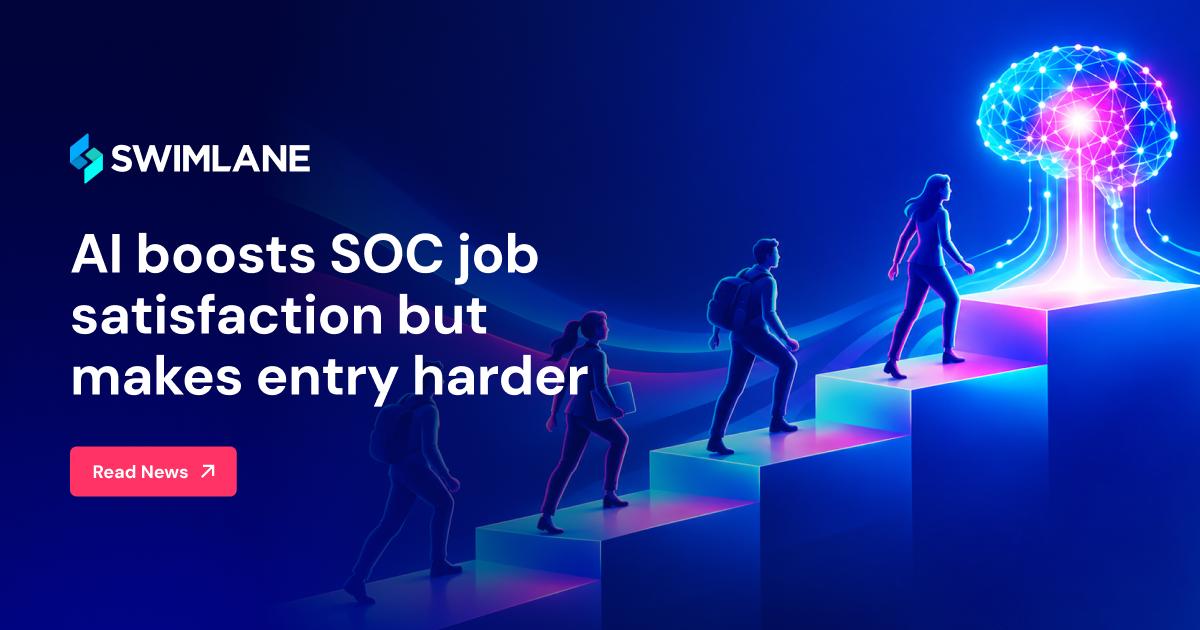
- AI Is Rewriting the SOC Career Ladder: Nearly half of respondents (47%) expect AI to make cybersecurity harder to enter, while 41% anticipate new roles centered on AI oversight, validation and orchestration. The findings point to a workforce model in which entry-level analysts will be expected to exercise judgment and manage automated work earlier in their careers.
- Human Judgment Remains Essential as AI Adoption Expands: Ninety-two percent of respondents are confident they can recognize an incorrect or incomplete AI recommendation, while 48% say they rely on their own judgment when AI conflicts with available evidence or could affect critical systems. As AI assumes more investigative work, analysts are increasingly responsible for validating evidence, handling exceptions and making higher-impact decisions.
DENVER--(BUSINESS WIRE)--Swimlane, the leader in agentic AI automation for every security function, today released new research revealing a paradox at the center of AI adoption in security operations: the technology is making work more satisfying for many analysts while potentially making the profession harder to enter. Based on a survey of 500 security professionals and leaders at U.S. and U.K. organizations using AI, The New SOC Career Ladder examines how greater capacity, changing responsibilities and new oversight demands are reshaping the security workforce.
The security industry has largely focused on whether AI can help teams manage rising workloads and reduce repetitive work. Swimlane’s findings shift the question to what happens after AI begins to deliver that relief. Respondents report greater capacity and higher job satisfaction, but they also expect the career ladder to change as AI oversight grows and entry-level requirements rise.
“AI is giving security teams more capacity and changing what analysts spend their time on,” said Cody Cornell, co-founder and CEO of Swimlane. “The challenge is that routine work has also been one of the ways analysts learn the fundamentals. As more of that work is automated, organizations need to rethink training and career paths so people still develop the judgment to know when AI is right and when it is not.”
Key Takeaways
- Job Satisfaction Remains High Even When Skill Development Suffers: Nearly one in four respondents (24%) say AI has limited their ability to develop security skills. Among that group, 91% still say AI has increased their job satisfaction. That is nearly identical to the 92% among respondents who say AI has improved their skill development.
- Security Pros Expect AI to Make the SOC Harder to Enter: Nearly half (47%) expect AI to create a steeper path into the profession. That includes 37% who anticipate higher requirements for entry-level roles and 10% who expect fewer opportunities for junior analysts to gain foundational experience. Meanwhile, 41% expect new specialized roles focused on AI oversight, validation and orchestration. Just 1% expect the SOC career path to remain largely unchanged.
- Leaders Report a More Advanced AI Transition Than Practitioners: Among leaders, 74% report extensive AI deployment across multiple security functions, compared with 49% of practitioners. Leaders are also more likely to report that analyst roles have been formally redesigned around higher-value work, at 46% compared with 28% of practitioners.
- Human Judgment Takes Priority When the Stakes Rise: When asked where they would be most likely to rely on their own judgment, 48% point to situations in which an AI recommendation conflicts with available evidence or acting on it could disrupt business operations or critical systems. Overall, 92% are confident they could identify an incorrect or incomplete AI recommendation.
More AI Requires Clearer Human Control
High confidence in AI cannot replace clear controls. As organizations give AI a larger role in security operations, they need governance that defines where human approval is required and preserves a complete record of AI-driven decisions and actions.
“The issue is not whether analysts should trust AI. It is whether they have enough information to decide when to trust it,” said Mike Lyborg, CISO of Swimlane. “Security teams need to see how a recommendation was reached, understand what action will follow and be able to step in before a consequential decision is made. AI may be taking on more work in the SOC, but accountability still belongs with people.”
Key Resources
- Download the full report: The New SOC Career Ladder: How AI Is Reshaping the Security Operations Workforce
- Sign up for our upcoming live webinar on October 21, 2026 at 11:00 am ET
Methodology
The survey was conducted among 500 security operations professionals and leaders at companies with at least 500 employees in the United States and the United Kingdom. The interviews were conducted online by Sapio Research under the guidance of Swimlane between August and September 2026, using an email invitation and an online survey. Percentages have been rounded to the nearest whole number throughout the report. As a result, individual figures may not sum exactly to 100%.
About Swimlane
At Swimlane, we believe the convergence of agentic AI and automation can solve the most challenging security, compliance and IT/OT operations problems. With Swimlane, enterprises and MSSPs benefit from the world’s first and only AI automation platform for every security function. Only Swimlane gives you the scale and flexibility to unify security teams, tools and telemetry, ensuring today’s SecOps are always a step ahead of tomorrow’s threats.
Learn more: swimlane.com