Hello Robot Receives NIH Phase IIB Grant in Partnership With University of Illinois Urbana-Champaign
Hello Robot Receives NIH Phase IIB Grant in Partnership With University of Illinois Urbana-Champaign
Project will advance Stretch’s ability to support older adults with cognitive impairment
CHAMPAIGN, Ill. & MARTINEZ, Calif.--(BUSINESS WIRE)--Hello Robot today announced that it has received a Phase IIB Small Business Innovation Research grant from the National Institute on Aging, part of the National Institutes of Health, to advance the use of its Stretch mobile manipulator robot in supporting older adults with mild cognitive impairment and early Alzheimer’s dementia.
The project, titled “Stretching their Reach: Robotic Support for Older Individuals with Mild Cognitive Impairment and Early Alzheimer’s Dementia,” will explore how Stretch can assist older adults, family care partners, and professional care staff.
Share
The University of Illinois Urbana-Champaign is Hello Robot’s research partner on this project.
The project, titled “Stretching their Reach: Robotic Support for Older Individuals with Mild Cognitive Impairment and Early Alzheimer’s Dementia,” will explore how Stretch can assist older adults, family care partners, and professional care staff across three key areas: cognitive assistance, social engagement, and safety management.
The award totals nearly $3 million over three years. The funds will significantly advance the commercialization of Stretch to ready it for in-home use for older adults as well as for use in-care settings.
Dr. Aaron Edsinger, CEO and co-founder of Hello Robot, and Dr. Wendy A. Rogers of the University of Illinois Urbana-Champaign are the project’s principal investigators. Rogers is a Shahid and Ann Carlson Khan Professor of Applied Health Sciences, whose primary appointment is within the Department of Health and Kinesiology.
Co-investigators include Dr. Charlie Kemp, CTO and co-founder of Hello Robot, and Dr. Raksha Mudar and Dr. Harshal Mahajan at the University of Illinois Urbana-Champaign.
The research will draw on the university’s McKechnie Family LIFE Home, where Rogers serves as director and Mahajan as assistant director of research. This unique research facility enables researchers to develop and evaluate technologies in a home environment, helping bridge the gap between laboratory innovation and everyday use. The work reflects the applied science approach Rogers leads, bringing researchers, older adults, and care partners together to shape practical tools that support independence and quality of life.
“Our interdisciplinary research team at Illinois will develop the implementation protocols to explore long-term use of Stretch in homes and care settings, with initial testing taking place in the LIFE Home. Dr. Mudar’s expertise in neurocognitive health and Dr. Mahajan’s knowledge of rehabilitation science will be invaluable,” said Rogers.
“A robot’s value isn’t how complicated the task is. It’s how much agency that task gives someone,” said Edsinger. “This research will help us understand how Stretch can provide useful, trustworthy assistance while supporting family members and professional caregivers to help their loved ones and clients live more independently.”
“The real question isn’t what robots can do. It’s who they help. Recent advances in physical AI create promising new opportunities for Stretch to benefit people. Hello Robot is thrilled to partner with the University of Illinois to better understand how Stretch can use AI to meaningfully benefit older adults and their care partners,” said Kemp.
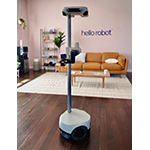
Stretch is a mobile manipulator robot designed to operate in everyday environments. It combines a compact mobile base, lightweight telescoping arm, artificial intelligence, and intuitive user interfaces to support a broad range of activities.
The project will make use of Stretch 4, Hello Robot’s newest model which was introduced in May. Researchers at Hello Robot and the University of Illinois will use advances in AI-powered language, planning, perception, and voice interaction to expand Stretch’s capabilities in three areas:
- Cognitive assistance, including reminders, activity guidance and help locating everyday objects
- Social engagement, including initiating interactions and helping people stay connected
- Safety management, including support for routines involving mobility, hydration and other daily needs
Dr. Rogers is the author of Designing Robots to Improve Quality of Life for Older Adults, along with Dr. Tracy L. Mitzner. The foreword to the book was written by Hello Robot co-founder and CTO Dr. Charlie Kemp, and one chapter is devoted to the collaboration of this team.
The United States is currently in the midst of the largest surge of retirement-age Americans in U.S. history, with more than 11,000 Americans turning 65 every day. Globally, the number of people aged 65 or older is projected to more than double, from 761 million in 2021 to 1.6 billion by 2050. At the same time, the caregiving workforce is in crisis, with nearly 9.7 million direct caregiving job openings (including new jobs and vacancies) that need to be filled by 2034 and a turnover rate as high as 77 percent.
About the Project
The three-year Phase IIB project began on September 22, 2026, and is expected to continue through May 2029. The project builds on earlier NIH-funded research conducted by Hello Robot and the University of Illinois Urbana-Champaign. During the previous phase, the team used participatory design research to refine Stretch’s capabilities for older adults with cognitive and physical impairments. The researchers also worked with ClarkLindsey Life Plan Community, operated by Lindsey Communities, to evaluate Stretch in naturalistic settings and identify the most promising applications for further development.
The new project will include participatory design research with 60 older adults, care partners, and professional care staff. Researchers will examine how Stretch can be integrated into everyday life to support independence and reduce demands on caregivers. Lindsey Communities will continue as a core research partner.
The team will conduct extended evaluations in homes and care settings. Home evaluations will involve older adults with mild cognitive impairment or mild dementia and their care partners. Evaluations in care settings will involve professional care staff using Stretch over an eight-week period.
Researchers will assess Stretch’s effectiveness, usability, reliability, trust, acceptance and ability to operate safely around older adults. The project will identify the practical requirements for deploying assistive robots in homes and professional care environments.
The ultimate goal is to create a reliable, context-aware and commercially viable assistive robot that can increase autonomy and improve quality of life for older adults while providing meaningful support to their families and professional caregivers.
About Hello Robot
Hello Robot is a robotics company dedicated to developing practical, safe, and accessible robots for people. Hello Robot was founded in 2017 by veteran roboticists Aaron Edsinger and Charlie Kemp, who collectively bring more than 50 years of experience from Massachusetts Institute of Technology, Google, and Georgia Institute of Technology. Their flagship robotic platform, Stretch, is one of the world's most popular open-source platforms for mobile manipulation, designed to operate safely shoulder-to-shoulder with people in homes, workplaces, and care settings. To learn more, visit www.hello-robot.com.
About the University of Illinois Urbana-Champaign Research Team
The Illinois research team brings expertise in aging, cognition, neurocognitive health, human factors, and rehabilitation, as well as design and evaluation of technologies for use in homes and care environments. Research will include work at the university’s McKechnie Family LIFE Home, a state-of-the-art facility for developing and evaluating technologies designed to support independent living and quality of life.
Funding Acknowledgment
Research reported in this press release is supported by the National Institute on Aging of the National Institutes of Health under Award Number R44AG072982. The content is solely the responsibility of the authors and does not necessarily represent the official views of the National Institutes of Health.
Contacts
Media contacts
Tim Smith
Element Public Relations, for Hello Robot
media@hello-robot.com
Vince Lara-Cinisomo
University of Illinois Urbana-Champaign
vinlara@illinois.edu