Falling Rates of Insurance Claim Denials Fail to Drive Better Financial Performance for Hospitals, Health Systems and Medical Practices, According to a Kodiak Solutions Analysis
Falling Rates of Insurance Claim Denials Fail to Drive Better Financial Performance for Hospitals, Health Systems and Medical Practices, According to a Kodiak Solutions Analysis
Post-payment actions by insurers offset progress on insurance claims denials for medical provider organizations, Kodiak analysis finds
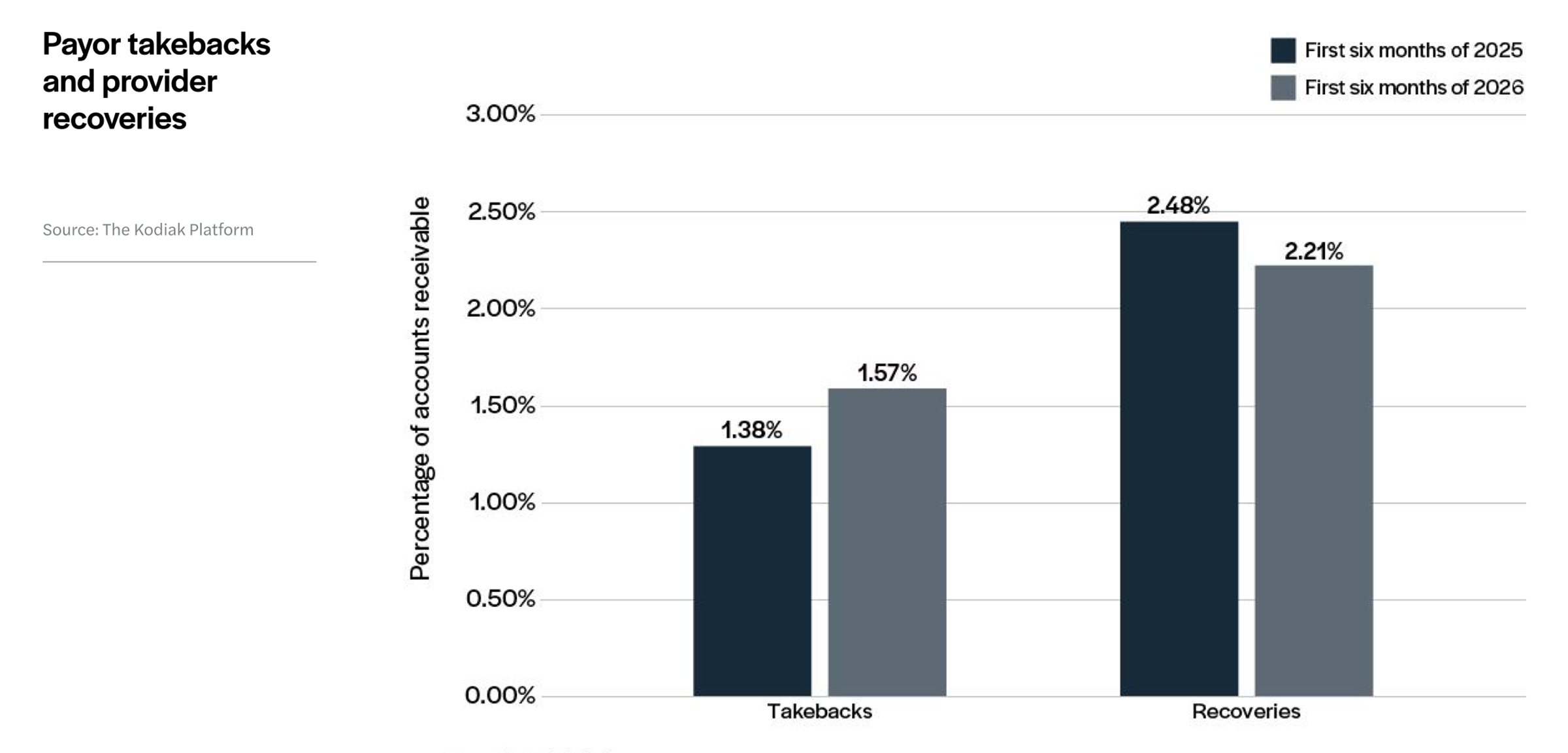
Across every payor and patient setting Kodiak Solutions analyzed, insurers clawed back more payments to medical providers as a percentage of accounts receivable in the first half of 2026 than the same period in 2025. At the same time, health systems and physician practices recovered fewer dollars when appealing payments in 2026's first two quarters compared with the first half of 2025.
INDIANAPOLIS--(BUSINESS WIRE)--The constant tug of war between health systems and health insurers over medical claims doesn’t end when insurers transmit payments, as proprietary data from the Kodiak Platform show.
“What this analysis really drives home is the need to take a holistic view of the revenue cycle and measure performance in all phases, and for all payors, rather than focusing on just one or two aspects of RCM.” -- Matt Szaflarski, VP, Kodiak Solutions
Share
An analysis comparing trends from the first six months of 2026 with the first half of 2025 shows that hospitals, health systems and medical practices have made progress reducing both initial and final denial rates with payors as a whole, Kodiak Platform data show. Yet, the data also show that these gains did not translate into improved cash flow for provider organizations.
KEY TAKEAWAYS
- An analysis of medical claims from more than 2,300 hospitals and 375,000 physicians on the Kodiak Platform finds that providers reduced initial and final claims denial rates in the first half of 2026 compared with 2025’s first half.
- Yet, the Kodiak Solutions analysis also found that lower denials did not lead to improved cash performance for hospitals, health systems and medical practices.
- Kodiak found that insurers are offsetting lower denials by recouping more money through takebacks, or actions to claw back money from claims that the insurer already has paid.
- The data analysis illustrates the need to look holistically at revenue cycle and measure results by the final revenue yield from claims, rather than focusing too narrowly on one or two aspects of revenue cycle management.
Insurers recoup money after paying medical claims
The problem comes after claims are paid: Kodiak’s analysis of claims and financial data from more than 2,300 hospitals and 375,000 physicians finds that insurers are clawing back an increased percentage of already-paid claims, equal to 1.57% of accounts receivable in the first half of 2026, compared with 1.38% in the first half of 2025—a 13.8% increase in takebacks.
The trend of increasing takebacks held across every payor and patient setting Kodiak analyzed.
In addition, providers are gaining fewer dollars when they appeal the payments from insurers. Data on the Kodiak Platform show they recovered 2.21% of accounts receivable after claims were paid during the first half of 2026, compared with 2.48% in 2025’s first half—a 12.2% decrease in recoveries.
Medical providers have to work hard to collect from insurers
Kodiak’s analysis also reveals substantial differences in how insurers offering Medicare Advantage plans handle claims compared with traditional Medicare. Even as they operate under the same coverage rules, insurers operating Medicare Advantage plans have higher initial and final denial rates, and more than double the percentage of takebacks compared with traditional Medicare.
The data show similar performance on claims submitted to commercial insurance plans—in many cases, operated by companies that also run Medicare Advantage plans. The initial denial rate for commercial claims fell when comparing the first half of 2026 with the same period in 2025. On the other hand, the final denial rate increased 9.1%, to 2.89% of accounts receivable for the first half of 2026, and commercial takebacks increased 12%, to 2.25% of accounts receivable in the first six months of this year.
“What this analysis really drives home is the need to take a holistic view of the revenue cycle and measure performance in all phases, and for all payors, rather than focusing on just one or two aspects of revenue cycle management,” said Matt Szaflarski, Vice President, Revenue Cycle Intelligence for Kodiak. “Revenue cycle leaders must ask themselves three questions: How much did we collect? How hard did we have to work to collect those funds? And, crucially, how much of what we collected did we keep?”
For more, download the full report, "Unyielding Denials."
About Kodiak Solutions
Kodiak Solutions is a leading technology and tech-enabled services company that simplifies complex business problems for healthcare provider organizations. Over the past two decades, our team created and developed our proprietary net revenue reporting solution, Revenue Cycle Analytics. Kodiak also provides a broad suite of software and services in support of CFOs looking for solutions in financial reporting, reimbursement, revenue cycle, risk and compliance, and unclaimed property. Kodiak’s 450 employees engage with more than 2,300 hospitals and 350,000 practice-based physicians, across all 50 states, and serve as the unclaimed property outsourcing provider of choice for more than 2,000 companies. To learn more, visit Kodiak’s website.
Contacts
For Media:
Vince Galloro
(312) 625-2137
vince.galloro@sunrisehlth.com