Darling Consulting Group Launches the Deposit Retention Index™ (DRI)
Darling Consulting Group Launches the Deposit Retention Index™ (DRI)
New Monthly Benchmark Reveals Shift in Deposit Behavior and Incomplete Post-Pandemic Normalization
NEWBURYPORT, Mass.--(BUSINESS WIRE)--Darling Consulting Group, Inc., a national consulting firm offering integrated balance sheet strategy, risk management, and data analytics services for banks and credit unions, today announced the launch of the DCG Deposit Retention Index™ (DRI), a new monthly benchmark designed to track the stability of deposit relationships across the banking industry.
The DRI answers a question that lagging quarterly public data often misses. Not simply how many deposits exist or how balances change, but how stable are deposit relationships?
Share
As the banking industry evolves through technological innovation (including artificial intelligence, fintech, stablecoins, and tokenized deposits) and the largest generational wealth transfer in U.S. history, financial institution liquidity, and specifically deposit relationship behavior, remains a central industry issue.
Customers (including households, businesses, and municipalities) can move money faster than ever before, yet the industry has lacked a consistent benchmark to monitor how deposit relationships are changing over time.
The DRI is a monthly measure capturing the rolling retention of existing deposit relationships for individual institutions, as well as related behavior patterns/trends for geographic regions and the banking industry in the aggregate. As a consistent industry benchmark, it helps bankers, economists, analysts, media, and industry watchers compare, monitor, and track deposit relationship activity to better understand changing liquidity and competitive dynamics.
“The DRI answers a question that lagging quarterly public data often misses,” said Justin Bakst, DCG Executive Director of Products & Solutions, “Not simply how many deposits exist or how balances change, but how stable are deposit relationships?, thus providing a direct read on the competitive dynamics of the industry’s depository markets.” Importantly, the DRI normalizes for the noise resulting from growth associated with new relationships, focusing on existing deposit relationship stickiness.
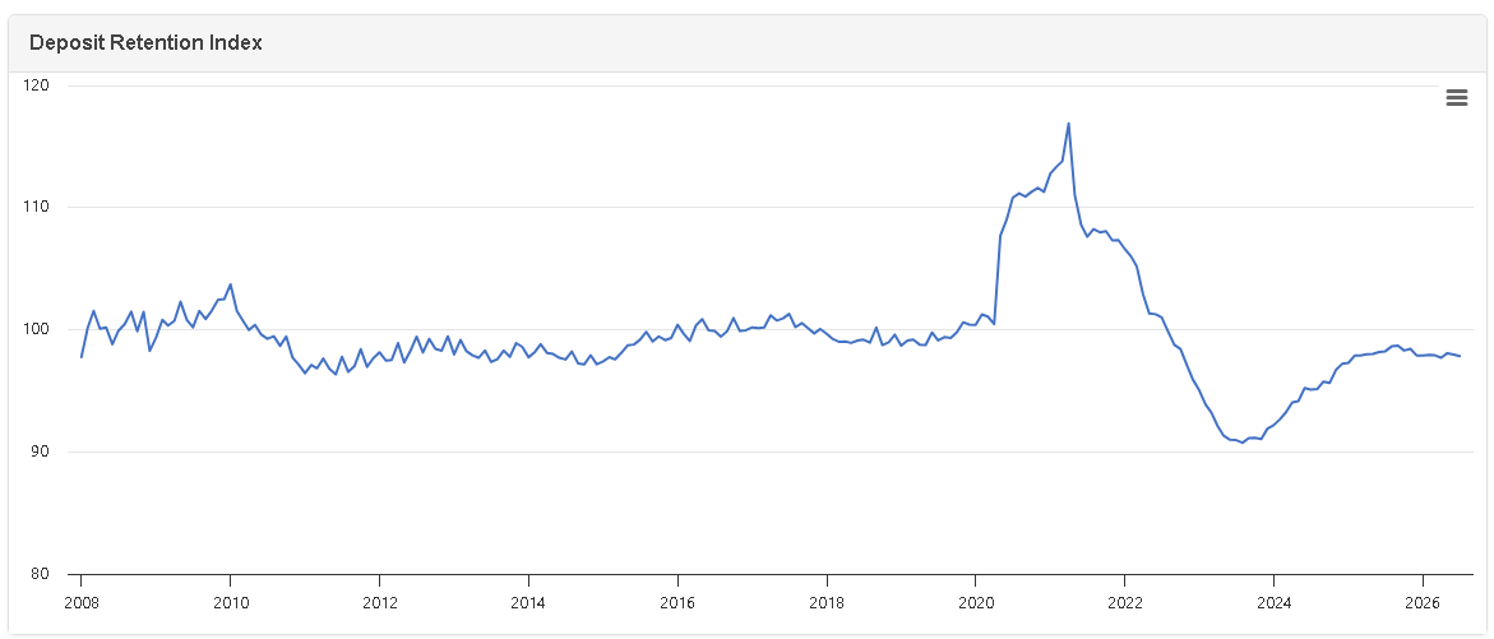
The DRI highlights a clear shift in deposit behavior across the banking industry. The Index begins before the Great Recession hovering around 100%, meaning that in aggregate, banks retained the deposit dollars held in existing customer relationships over the preceding 12 months.
From 2010 to 2011, as the economy struggled, the DRI fell to 96%, indicating that more deposit dollars were leaving existing bank relationships than staying or being added by existing relationships. After that, the Index remained relatively stable from 2011 to 2020, holding close to 100% and reflecting a long period of deposit stickiness.
During the pandemic, the DRI surged to 114% as government stimulus, excess liquidity, and ultra-low interest rates drove a significant increase in balances within existing customer relationships.
That trend reversed sharply in 2023, when the Index fell to 90% amid rapidly rising interest rates, bank failures, and intense competition for deposits. The decline reflects a broad shift away from the unusual deposit stickiness of 2020 and 2021 toward a more competitive environment, where customers were more willing to move funds in response to higher rates on a broader set of alternatives.
Today, the DRI has stabilized at approximately 98% but remains below its long-term average. This suggests the industry may be facing a lasting change in liquidity behavior, with deposit relationships potentially less stable than they were before the pandemic.
“Importantly, the normalization is incomplete; the industry has not returned to the old deposit regime. Even after the post-peak decline, retention remains below long-term averages,” said Jonathon Weiner, PhD, DCG Chief Data Scientist.
“With its focus on deposit retention, the DRI can serve as a leading indicator for liquidity conditions that often move ahead of slower, quarterly public reporting cycles,” added Bakst. “Deposit levels may appear stable even while churn increases beneath the surface, as funds migrate across institutions or move outside the banking system in response to economic changes.”
About the DRI
DCG’s monthly Deposit Retention Index™ (DRI) is a measure of what percentage of deposit relationship dollars banks and credit unions retain compared with the same point one year earlier. By focusing on relationships that existed one year earlier, it is not affected by growth associated with new relationships. Readings above 100% indicate that deposit relationship dollars are expanding. Readings below 100% indicate net contraction in deposit relationship dollars relative to the prior year.
DCG built the DRI from account-level, longitudinal data across 300+ financial institutions spanning all 50 states and representing a broad mix of charters and business models, including community banks, credit unions, regional banks, internet banks, de novos, and rural and urban institutions. In aggregate, the dataset encompasses more than $750 billion in deposits and more than five billion account records, offering a high-frequency view into real-world depositor behavior. Over time, minor historical revisions are to be expected as new institutions are added to the dataset.
This robust account level dataset not only enables DCG to aggregate the results to produce a single national retention figure that is comparable over time, but it also enables segmentation of the DRI by customer type, relationship size, institution type, institution size, geography, etc.
About Darling Consulting Group
For over 40 years, DCG’s only business has been to help banks and credit unions manage balance sheets and risk effectively. DCG provides independent consulting and software services, including asset/liability management, model risk management and validation, deposit analytics, loan analytics, liquidity analytics, and credit stress testing, bringing clarity to the complex. Learn more at DarlingConsulting.com.
The DRI is a proprietary benchmark developed by DCG using anonymized deposit relationship data from participating financial institutions. Results are based on DCG’s methodology and available data at the time of publication. Historical values may differ as additional institutions are added or data quality reviews are completed. The DRI is provided for informational purposes only and should not be construed as investment, accounting, legal, regulatory, or financial advice. Users should conduct their own analysis and consult appropriate professional advisors before making business or investment decisions.
Contacts
Amanda Smith
Darling Consulting Group, Inc.
asmith@darlingconsulting.com
978-499-8039