78% of US Consumers Will Walk Away From a Brand Over Data Misuse. No Federal Law Sets the Floor.
78% of US Consumers Will Walk Away From a Brand Over Data Misuse. No Federal Law Sets the Floor.
66% have already walked. Half will pay more for brands that are transparent about AI and data. New Usercentrics research finds trust is now the deciding factor in a market where the legal default puts the burden on the consumer, not the brand.
NEW YORK--(BUSINESS WIRE)--In the United States, data privacy is no longer a future concern. It is driving purchasing decisions now, and consumers are acting without waiting for regulators to catch up.
Only 39% of American consumers trust government services with their data, the lowest of any market in the study.
Share
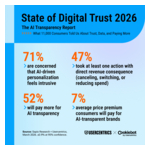
78% of US consumers say they would stop using a service after their data was misused. 66% already have stopped using a company over privacy concerns. The findings come from the second annual State of Digital Trust 2026 Report, commissioned by Usercentrics, the data privacy technology company whose portfolio includes Cookiebot™ CMP. The research was conducted by Sapio Research across 11,000 consumers in seven markets.
The US stands apart from the other six markets on a single measure that shapes all the others. Only 39% of American consumers trust government services with their data, the lowest of any market in the study. With no federal privacy standard to close that gap, and a legal default that puts the work on the individual, trust doesn't flow down from institutions. It sits entirely with brands to design the moment a consumer is asked to make a choice.
Consumers are behaving accordingly. In the US:
- 88% have taken active steps to protect their personal data
- 74% are cautious about sharing data with US companies specifically
- 53% now reject or customize cookie settings rather than accepting broadly, up from a majority that clicked "accept all" three years ago
- 75% find AI-driven personalization intrusive, joint highest of any market
What is the commercial upside?
The same distrust that drives consumers away creates an opening for brands that earn trust directly. Half (50%) of US consumers will pay more for a brand that is transparent about how it uses AI with their data.
The audience most willing to spend is the one paying closest attention to how brands handle data. Privacy-aware consumers are nearly three times more likely to be comfortable with personalization than consumers who are not, 53% versus 19% globally.
47% of American consumers do not yet know they have data privacy rights. Brands that surface and explain those rights build a form of trust competitors cannot easily copy.
"Every brand is now the last line of defense for the customer data it holds, whether it planned to be or not," said Tilman Harmeling, Strategy & Market Intelligence, Usercentrics. "That puts the responsibility, and the opportunity, entirely on brands. The ones that treat transparency as a commercial strategy, not a compliance task, will earn trust that their competitors can't easily win back."
What's driving the shift in US consumer data privacy in 2026?
Three forces have accelerated US consumer decision-making on data and AI in the past year.
AI has moved from answering questions to taking actions. Agentic AI now accesses financial accounts, calendars, and customer records on behalf of users, raising the stakes of data misuse in ways consumers feel directly.
Privacy regulation is expanding, but the default still favors collection over consent. More than twenty US states now operate distinct privacy laws, led by California's CCPA, with no federal standard to unify them. For businesses, compliance demand tied to state-level enforcement is now a direct driver of commercial inquiries, as brands move to meet obligations that shift by state line. For consumers, it means the protection they receive depends on where they happen to live.
Consumers have crossed from passive acceptance into active decision-making. In the US, discomfort with personal data being used to train AI has slightly declined, from 66% to 65%, the only market to move in that direction. This likely reflects early normalization rather than growing comfort. High-stakes uses still carry a higher trust burden: 71% of Americans still want a human for healthcare interactions, and 68% for financial advice.
The gap between brands that treat privacy as compliance and those that treat it as strategy is widening. 2026 is the year that gap starts showing up in revenue.
Read the full State of Digital Trust 2026 report here.
About the research
The State of Digital Trust 2026 is the second annual study commissioned by Usercentrics and conducted by Sapio Research. The survey polled 11,000 consumers across seven markets: the UK, USA, Germany, Spain, Italy, the Netherlands, and Sweden. Fieldwork was conducted in March 2026. Sweden joins the study for the first time this year; year-on-year comparisons exclude Swedish data.
About Usercentrics
Usercentrics is a leading data privacy technology company that helps businesses collect, manage, and activate consented data with confidence. Trusted by 2.4 million websites and apps across 195 countries, the company processes more than 8.8 billion user consents every month. Through its platform — spanning consent management, server-side tracking, and AI connectivity and data access governance — Usercentrics gives businesses the compliance infrastructure to grow, innovate, and operate responsibly in an AI-first world. Learn more at usercentrics.com.
Contacts
Press contact: pr@usercentrics.com