

IHPC Urges Department of Education to Align Student Loan Accountability with America's Healthcare Workforce Needs
IHPC Urges Department of Education to Align Student Loan Accountability with America's Healthcare Workforce Needs
Consortium warns that earnings-based accountability rules could restrict access to prevention-focused healthcare professions
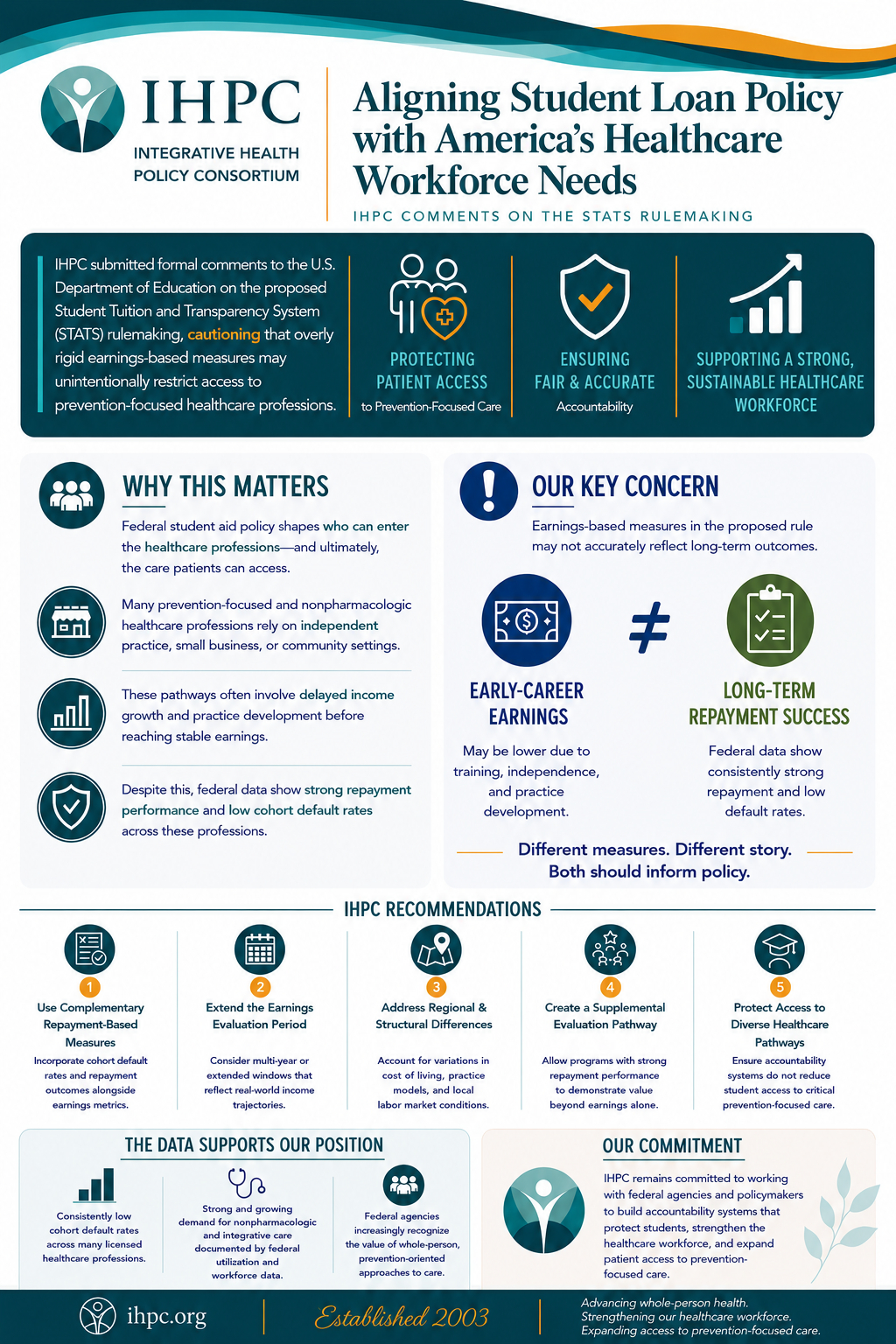
Infographic summarizing the Integrative Health Policy Consortium's recommendations to the U.S. Department of Education regarding the proposed Student Tuition and Transparency System (STATS) rulemaking. The infographic highlights IHPC's concerns about earnings-based accountability measures and outlines recommendations to align student loan policy with America's long-term healthcare workforce needs.
WASHINGTON--(BUSINESS WIRE)--The Integrative Health Policy Consortium (IHPC) has submitted formal comments to the U.S. Department of Education regarding the proposed Student Tuition and Transparency System (STATS) rulemaking, warning that overly rigid earnings-based accountability measures may unintentionally restrict access to prevention-focused healthcare professions and undermine long-term workforce objectives.
IHPC urges the U.S. Department of Education to align student loan accountability with America's long-term healthcare workforce needs.
Share
The submission responds to the Department's proposed framework for evaluating educational program eligibility under federal student aid policies. While supporting efforts to improve transparency and accountability, IHPC cautioned that early-career earnings metrics alone may not accurately reflect long-term repayment success or the economic realities of many licensed healthcare professions.
"Federal student aid policy directly shapes the future healthcare workforce," said Dr. Stephen P. Welsh, DC, Chair of IHPC. "Accountability is important, but evaluation systems must accurately reflect how healthcare professions function in the real world. Many prevention-focused professions involve gradual income development, independent practice models, and strong long-term repayment outcomes that are not fully captured by short-term earnings measures."
The IHPC submission draws upon federal workforce data, Department of Education repayment statistics, Veterans Health Administration implementation experience, and national utilization trends demonstrating growing public demand for nonpharmacologic and integrative healthcare approaches.
IHPC's submission recommends that federal accountability systems incorporate multiple measures of program performance rather than relying exclusively on early-career earnings outcomes. The Consortium argues that repayment performance, cohort default rates, and other indicators provide important information about whether educational programs are preparing graduates for successful long-term careers.
The comments also recommend extending evaluation periods for professions in which graduates frequently establish independent practices, develop patient populations over time, or follow career pathways characterized by delayed income growth. IHPC further urges consideration of regional labor-market conditions and practice-model differences that may significantly affect earnings trajectories.
In addition, the Consortium recommends creating supplemental evaluation pathways for programs that demonstrate strong repayment outcomes and low default rates. According to IHPC, accountability systems should recognize multiple indicators of educational value while preserving access to healthcare professions that contribute to prevention, chronic disease management, patient choice, and nonpharmacologic approaches to care.
The filing also highlights the increasing role of integrative and nonpharmacologic care within federal healthcare policy, including initiatives advanced by the Department of Veterans Affairs, the Centers for Disease Control and Prevention, the Department of Health and Human Services, and the National Center for Complementary and Integrative Health.
IHPC noted that federal health policy increasingly emphasizes prevention, chronic disease management, patient-centered care, and reduction of unnecessary pharmaceutical dependence. The organization cautioned that educational policies affecting healthcare workforce development should be evaluated in light of these broader national objectives.
"Educational accountability systems should protect students while preserving the diverse healthcare pathways needed to meet America's evolving healthcare needs," Welsh added.
The full IHPC submission to the Department of Education is available at www.ihpc.org.
About IHPC
The Integrative Health Policy Consortium (IHPC.org) is a national coalition of licensed integrative health professions and organizations working to advance patient-centered, prevention-focused healthcare policy.
IHPC promotes collaborative public policy solutions that expand patient access, strengthen the healthcare workforce, support prevention-focused care, and advance whole-person approaches to health and healing.
Contacts
Media Contact:
Michael Duarte, Managing Director
Info@ihpc.org | www.ihpc.org