ISC2026: KAYTUS Launches Gigawatt-Scale Prefabricated AI Factory Data Center
ISC2026: KAYTUS Launches Gigawatt-Scale Prefabricated AI Factory Data Center
End-to-end single-vendor delivery in as little as six months, scaling from 3MW to 1GW with a fully factory-prefabricated modular solution spanning IT, power, and cooling infrastructure
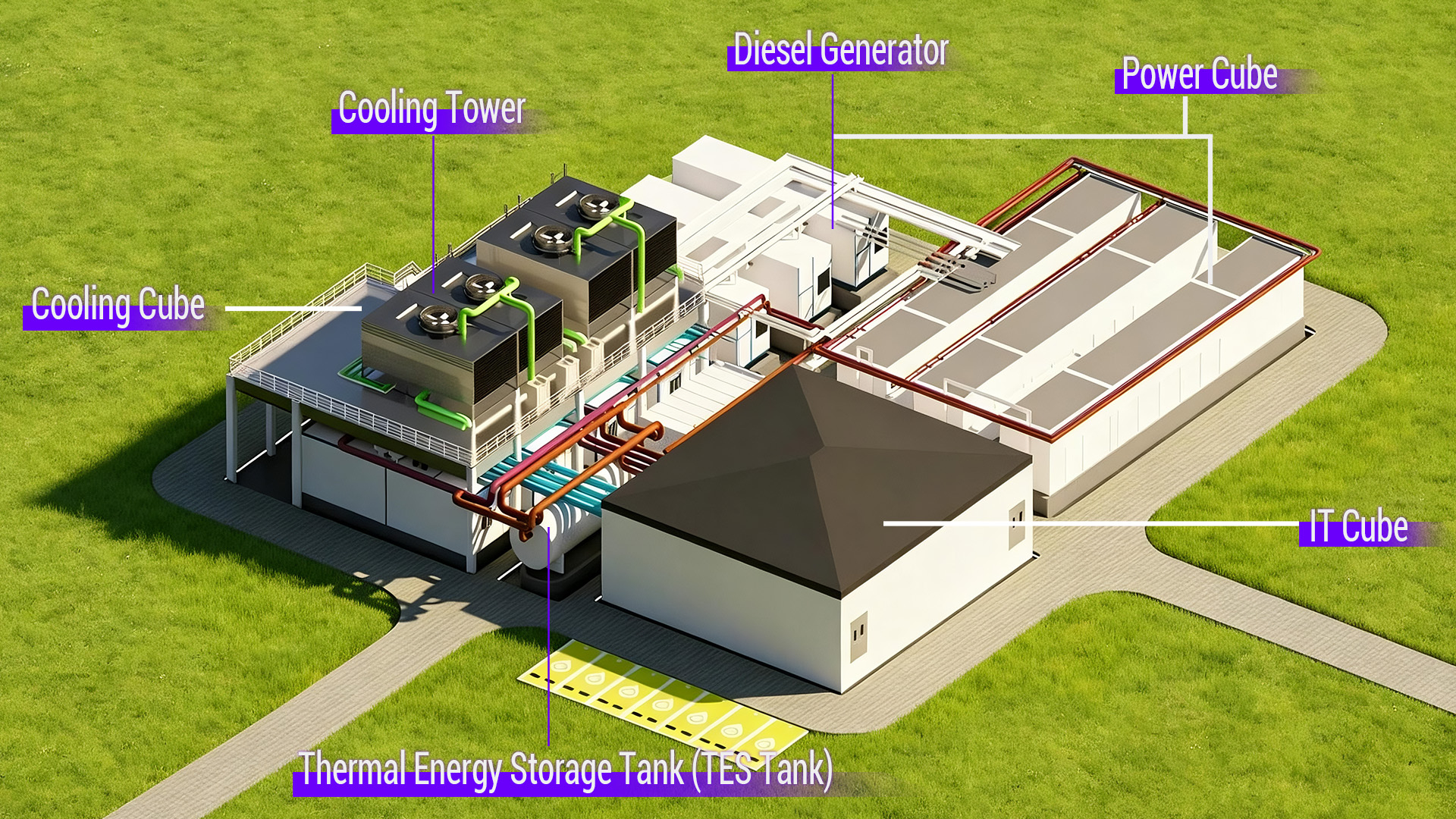
HAMBURG, Germany--(BUSINESS WIRE)--At ISC 2026, KAYTUS, a leading provider in AI infrastructure and liquid cooling solutions, unveiled its gigawatt scale, fully prefabricated containerized liquid cooled data center solution. Based on a full factory prefabrication model, the solution standardizes the data center into three modular container units: IT Cube, Power Cube and Cooling Cube. This design enables integrated prefabrication across IT, power, and cooling systems, supporting faster deployment and simplified project execution. Starting from a 3MW base unit, the architecture can scale to 10MW, 15MW, 100MW, and up to 1GW AI Factory deployments, with KAYTUS providing a single vendor delivery, spanning planning, integration, and operations.
From 3MW to 1GW: Complete end-to-end, single-vendor delivery in as little as six months
Share
Three Key Challenges Impeding AI Factory Deployments in EU
The EU’s AI Factories initiative is accelerating demand for sovereign AI infrastructure across member states, as compute deployments transition to large-scale, high-density AI clusters that must be deployed, integrated, and brought online at speed. However, operators relying on conventional data center construction models continue to face three persistent challenges:
Speed to deployment has become a critical requirement for EU AI infrastructure projects, as operators must absorb high GPU rack colocation costs and substantial capital investment, to bring capacity online quickly and accelerate revenue generation. On the other hand, conventional data center construction typically requires 18 to 24 months, with electrical, mechanical, and cooling systems often delivered by multiple vendors working independently. This fragmented delivery model can create coordination gaps across providers, resulting in schedule delays, cost overruns, and deferred revenue realization.
Construction quality remains difficult to standardize and control, as local construction capabilities vary significantly across regions. Skilled labor is often limited and costly, while conventional build standards may fall short of the requirements for high-density AI systems. In addition, multi-trade site execution makes it challenging to maintain consistent quality across structural, load-bearing, power, and liquid-cooling systems, particularly for deployments supporting high-density GPU rack systems.
Large upfront capital commitments introduce significant deployment risk, while phased expansion can create infrastructure compatibility challenges. Building gigawatt-scale AI infrastructure in a single project phase requires substantial capital expenditure and increases the risk of stranded capacity, if demand patterns shift. However, staged project expansion can lead to interoperability issues between different generations of power, cooling, and facility infrastructure, leaving operators to choose between over-investing upfront or absorbing costly retrofit and rework requirements later.
KAYTUS’ Differentiated Approach: Full Factory Prefabrication of Three Standardized Cubes
Unlike approaches that prefabricate only IT racks and liquid cooling module while leaving mechanical and electrical infrastructure for on-site construction, KAYTUS factory-prefabricates the complete data center encompassing IT, power, and cooling systems. The solution is delivered as three standardized containerized modules, enabling integrated deployment, improved system consistency, and faster time to operation.
IT Cube: Standardized, High-Density Compute Infrastructure
The IT Cube adopts a two-tier stacked container architecture, with compute racks installed on the lower level and consolidated power and data cabling routed through the upper level. Hot and cold aisles are physically separated to optimize thermal management, while full system integration is completed at the factory to improve deployment consistency and reduce on-site complexity.
A 3MW base unit integrates 18 liquid-cooled compute racks, 12 network racks, five storage racks, and five server management racks. Each liquid-cooled rack supports 150kW of power density, with a defined upgrade path to 200–227kW to support next-generation AI accelerators and high-density compute platforms. The CDU is configured with 1+1 redundancy and delivers 1,200kW of cooling capacity per unit, supporting high-temperature chilled-water operation with primary-side supply/return temperatures of 35/45°C and secondary-side supply/return temperatures of 40/45°C. The system also incorporates a standard three-tier Spine-Leaf-Core network architecture, allowing multiple 3MW units to be interconnected and managed as a unified AI cluster. Secondary-side liquid-cooling loops, flow-control valves, and leak-detection systems are fully integrated at the factory. Valve control can be configured for manual operation, remote electric control, or smart energy valve management, enabling flexible on-site and remote operation.
Power Cube: Redundant, High-Reliability Power Infrastructure
The PTU (Power Transfer Unit) enclosure and diesel generator enclosure are independently factory-prefabricated to support modular power deployment. Each PTU is rated at 2,500kVA and integrates a medium-voltage transformer, high- and low-voltage switchgear assemblies, high-frequency UPS systems, and automatic transfer switching between grid and generator power supplies. The companion diesel generator Cube is fully assembled, integrated, and factory-tested prior to shipment. Full-scenario simulation testing is completed before delivery, including loaded transfer switching and short-circuit testing, helping ensure power reliability, system safety, and faster on-site commissioning.
The complete power system is designed to meet Uptime Institute Tier III-level N+1 availability requirements, using a 2+1 redundant architecture to eliminate single points of failure. In the event of grid power loss, the battery system bridges the critical load while the diesel generator starts and assumes supply, preventing interruption to compute workloads. This enables continuous, 24/7 operation for high-density GPU clusters and mission-critical AI workloads.
Cooling Cube: Efficient Thermal Management for Liquid-Cooled Deployments
The Cooling Cube integrates two prefabricated cooling subsystems: a high-temperature liquid-cooling source and a low-temperature air-cooled chiller plant, with closed-circuit cooling towers mounted on the upper platform of the enclosure. The liquid-cooling plant provides 4,200kW of cooling capacity with 35/45°C supply and return temperatures, while the chilled-water plant delivers 3,300kW of cooling capacity with 18/24°C supply and return temperatures. Both subsystems incorporate redundant pumps, water treatment, and pressure management systems to support high availability and operational stability. A thermal buffer tank provides 10 minutes of backup cooling following a power event, covering the generator startup window, while a 72-hour emergency water reserve supports continuous cooling in the event of water supply interruption. All systems are pressure-tested and failover-validated at the factory before shipment to reduce on-site commissioning risk.
Fast Deployment, Flexible Scaling, Consistent Quality, Full Lifecycle Support
Full factory prefabrication across all three Cube types fundamentally redefines how AI data centers are engineered, integrated, and delivered. By shifting IT, power, and cooling integration from the construction site to a controlled factory environment, the model enables measurable improvements in deployment speed, construction quality, capital efficiency, and long-term infrastructure flexibility.
Faster time to revenue is a key advantage of the fully prefabricated model. Compared with the 18–24 months construction cycle typically required for conventional data centers, the prefabricated Cube architecture can reduce deployment timelines to approximately 6–8 months, including about one month for design, three to five months for factory manufacturing and transport, and two months for on-site installation and commissioning.
Because assembly, integration, and system-level validation are completed in the factory, on-site rework is minimized and commissioning risk is reduced. A 3MW unit can be brought online within one month after delivery, helping operators accelerate revenue generation, shorten payback cycles, and improve return on invested capital.
Single-vendor accountability simplifies project execution and reduces delivery risk. KAYTUS provides end-to-end delivery under a single contract, covering site survey, structural assessment, water quality evaluation, solution design, factory manufacturing, freight and customs clearance, installation, commissioning, and ongoing operations support.
This single point of contact integrated delivery model reduces project management overhead, improves schedule predictability, and strengthens accountability across the full deployment lifecycle.
Factory-controlled quality enables consistent build standards across deployments. All Cube modules are assembled, pressure-tested, and load-validated in a controlled factory environment according to uniform engineering and quality assurance requirements. This level of assembly precision exceeds what is typically achievable in field construction and reduces dependency on variable local construction labor capabilities.
The factory-prefabricated approach helps minimize the risk of liquid leaks, electrical faults, and cooling system failures from the outset. The modular architecture also allows individual units to be serviced or replaced without disrupting the broader cluster. Integrated DCIM monitoring provides real-time visibility across racks, power distribution, cooling infrastructure, and leak detection systems, supporting proactive operations and higher system reliability.
Incremental scaling lowers upfront capital commitment while preserving long-term expansion flexibility. The 3MW base unit enables phased deployment, allowing customers to start with an initial capacity block, validate operations, and scale progressively to 100MW or gigawatt-class AI infrastructure as demand grows, without committing the full capital investment upfront. Because the power and cooling architecture remain consistent across deployment generations, expansion can be executed without major modifications to existing infrastructure or disruptive planned maintenance windows. This approach is particularly suited to long-cycle AI infrastructure planning, where compute capacity requirements, GPU platform roadmaps, and customer demand continue to evolve over time.
About KAYTUS
KAYTUS is a leading provider of AI infrastructure and liquid cooling solutions, delivering a diverse range of innovative, open, and eco-friendly products for cloud, AI, edge computing, and other emerging applications. With a customer-centric approach, KAYTUS is agile and responsive to user needs through its adaptable business model. Discover more at KAYTUS.com and follow us on LinkedIn and X
Contacts
Media Contacts
media@kaytus.com