North American Advisors See Growth Outlook Holding Firm as AI and Generational Change Reshape the Business of Advice, says Natixis Investment Managers Survey
North American Advisors See Growth Outlook Holding Firm as AI and Generational Change Reshape the Business of Advice, says Natixis Investment Managers Survey
- Average AUM growth of 12% over the past year and expect continued growth, even as 68% say many clients want to hold more cash amid geopolitical uncertainty
- Advisors expect AI-powered self-directed tools to reshape the competitive landscape, with 40% of North American advisors seeing them as their biggest competitive threat within five years, including 52% of Canadian advisors compared with 35% of U.S. advisors
- 73% of North American advisors are playing offense to capture next-generation assets as wealth transfer and advisor retirements reshape the business
BOSTON--(BUSINESS WIRE)--North American financial advisors report average AUM growth of 12% over the past year and expect continued gains ahead, but new research from Natixis Investment Managers shows the business of advice is entering a period of accelerated change as market volatility, AI-powered competition and generational wealth transfer force advisors to rethink how they grow, scale and defend client relationships.
While advisors expect continued growth, their average 12-month outlook moderates to 10.8% as 68% say many clients want to hold more cash due to geopolitical uncertainty. Longer term, advisors’ average growth outlook remains around 11% over the next three years, suggesting measured confidence that they can navigate the structural changes reshaping the business of advice.
The survey included 400 North American financial advisors as part of a larger global survey of 2,950 financial professionals across 23 countries. North American respondents reported median assets under management of $200 million and average assets under management of $4.8 billion.
Dave Goodsell, Executive Director of the Natixis Center for Investor Insight, said, “Advisors are not looking at disruption as a single event; they are preparing for a fundamental reset in the business of advice. The immediate priority is helping clients protect portfolios and make sound decisions in a volatile environment. The longer-term imperative is to adapt their businesses for a market where AI-powered tools, next-generation investors, and evolving client expectations redefine the competitive landscape. The confidence we see from advisors suggests they recognize the challenge but still see a path to growth.”
Market headwinds put client discipline to the test
Market uncertainty is top of mind for North American advisors, with 64% ranking increasing geopolitical uncertainty among their top economic concerns and 88% expecting it to drive more market volatility. That uncertainty is already influencing client behavior: 68% of North American advisors say many clients want to hold more cash because of ongoing geopolitical uncertainty.
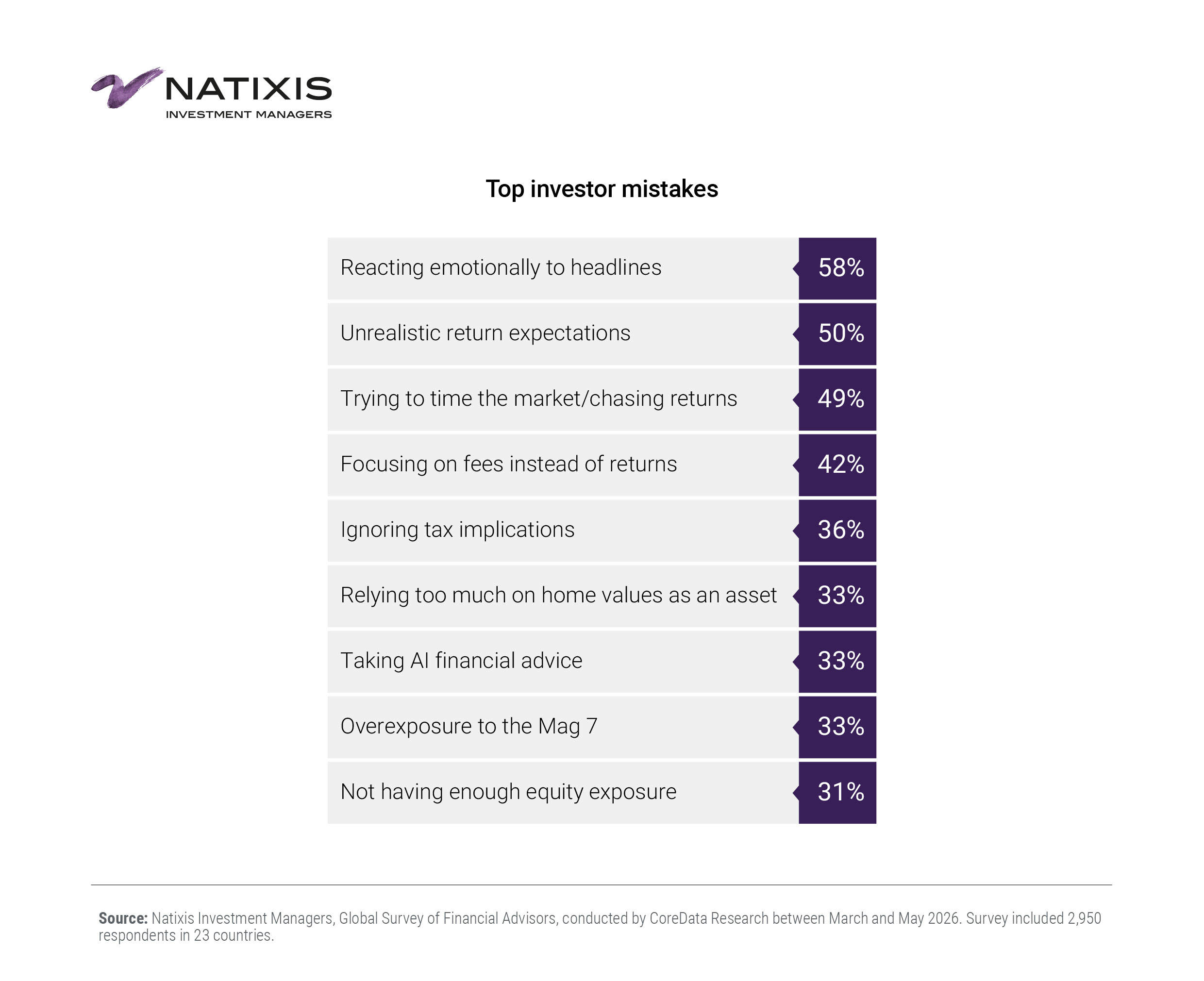
For advisors, the challenge is helping clients stay disciplined without overcorrecting in either direction. They are working to keep clients from retreating too far into cash, while also guarding against emotional or unrealistic investment decisions. Across North America, advisors say the biggest mistakes investors are making today are emotionally reacting to headlines, cited by 65%; trying to time the market, cited by 60%; and holding unrealistic return expectations, cited by 52%.
But the pattern differs notably by market. U.S. advisors are far more likely than Canadian advisors to cite emotional reactions to headlines as a common investor mistake, at 73% versus 42%. Canadian advisors, meanwhile, are more likely to point to tax-related mistakes, with 53% saying investors are ignoring the tax implications of their investments, compared with 33% of U.S. advisors and 38% across North America.
More than half of North American advisors say investors need to be in equities because they offer higher long-term growth potential than other asset classes (56%) and access to growth that can outpace inflation (55%). Still, advisors are emphasizing balance: nearly half (49%) say investors should understand that fixed income can serve as a counterbalance to equity exposure.
AI raises the stakes as advisors defend their value
Advisors expect the competitive landscape to shift dramatically over the next five years as AI-powered tools become more prevalent. Today, traditional financial professionals remain the dominant source of competition, with 72% of North American advisors identifying them as their biggest rival, while only 7% point to improved tools for self-directed investors, including generative AI. Canadian advisors are already more likely than U.S. advisors to see competition from automated advice platforms today, with 26% citing them as their biggest competitor compared with 5% of U.S. advisors.
Looking ahead five years, advisors expect that picture to change significantly. Only 21% expect traditional financial professionals to remain their biggest competitor, including just 7% of Canadian advisors and 26% of U.S. advisors. Meanwhile, concern about self-directed investing tools is expected to surge, with 40% of North American advisors anticipating that AI-enabled and other self-directed platforms will become their greatest competitive threat.
Advisors are also looking for ways to use AI to strengthen their businesses. Two-thirds (66%) say AI has the potential to drive market growth for the next two decades, 70% say it can free up more time to spend with clients, and 76% say advisors who adopt AI will have a competitive advantage. Still, 61% say integrating AI into workflows has been more difficult than expected, and 69% say investors take unnecessary risks when turning to AI for advice.
That risk reinforces the value advisors place on human advice. Nine in ten (89%) North American advisors say they are focusing on personal relationships and accountability when positioning their value to clients against AI. Still, 18% believe AI will put them out of business, a concern that is three times higher among Canadian advisors than U.S. advisors (36% vs. 12%).
Wealth transfer and advisor retirements create a new growth battleground
Advisors are confronting two generational shifts at once: client wealth is moving to spouses and heirs just as the advisory workforce itself is aging. North American advisors report retaining a spouse’s assets an average of 73% of the time after a client transition, but retention drops to 56% for next-generation heirs. Retention is even lower when advisors manage assets for both a parent and an heir, at 45%. More than four in ten North American advisors say they are increasingly worried they will not be able to retain heir assets through wealth transfer, with concern significantly higher in Canada than in the U.S. (63% vs. 39%).
That challenge is also creating opportunities for growth. Nearly eight in ten North American advisors (78%) say the wave of advisor retirements is a significant opportunity to grow their business, even as 66% say it will widen the advice gap. Advisors also acknowledge the talent challenge created by an aging workforce, with 44% saying they are struggling to hire young advisors to help bridge the gap. That challenge appears more acute in Canada, where 67% report difficulty hiring younger advisors, compared with 37% of U.S. advisors.
As the next generation reshapes expectations for advice, advisors are adapting both their service models and client engagement strategies. Nearly three-quarters (73%) say they are playing offense to capture next-generation assets, including by offering specialized planning services for younger clients, expanding digital tools, adding AI capabilities, exploring new prospecting channels such as social media, and hiring younger advisors.
Gad Amar, Head of Western Europe Distribution at Natixis Investment Managers, said, “The advisors best positioned for the next phase of growth will be those that can combine technology, scale and digital access with the personal relationships, accountability and behavioral coaching that investors continue to value from human advisors. As advisors look to demonstrate value beyond asset allocation while operating more efficiently, model portfolio implementation, tax-aware portfolio construction and investment solutions can help them deliver more personalized client experiences at scale.”
Natixis Investment Managers’ global report on the findings of its 2026 survey of Financial Advisors can be found here: https://www.im.natixis.com/en-intl/insights/investor-sentiment/2026/five-factors-set-to-disrupt-the-financial-advice-business
Methodology
Natixis Investment Managers surveyed 2,950 investment professionals across 23 countries. Data was gathered in March-May 2026 by the research firm CoreData with additional analysis conducted by the Natixis Center for Investor Insights.
About the Natixis Center for Investor Insight
The Natixis Center for Investor Insight is a global research initiative focused on the critical issues shaping today’s investment landscape. The Center examines sentiment and behavior, market outlooks and trends, and risk perceptions of institutional investors, financial professionals and individuals around the world. Our goal is to fuel a more substantive discussion of issues with a 360° view of markets and insightful analysis of investment trends.
About Natixis Investment Managers
Natixis Investment Managers’ multi-affiliate approach connects clients to the independent thinking and focused expertise of more than 15 active managers. Ranked among the world’s largest asset managers1 with more than $1.4 trillion assets under management2 (€1.2 trillion), Natixis Investment Managers specializes in high-conviction active investment strategies, insurance and pension solutions, and private assets, and delivers a diverse offering across asset classes, styles, and vehicles. The firm partners with clients in order to understand their unique needs and provide insights and investment solutions tailored to their long-term goals.
Headquartered in Paris and Boston, Natixis Investment Managers is part of Groupe BPCE, the second-largest banking group in France through the Banque Populaire and Caisse d’Epargne retail networks. Natixis Investment Managers’ affiliated investment management firms include AEW; DNCA Investments;3 Flexstone Partners; Gateway Investment Advisers; Harris | Oakmark; Investors Mutual Limited; Loomis, Sayles & Company; Mirova; Naxicap Partners; Ossiam; Ostrum Asset Management; Seventure Partners; Vauban Infrastructure Partners; Vaughan Nelson Investment Management; VEGA Investment Solutions and WCM Investment Management. Additionally, investment solutions are offered through Natixis Investment Managers Solutions and Natixis Advisors, LLC. Not all offerings are available in all jurisdictions. For additional information, please visit Natixis Investment Managers’ website at im.natixis.com | LinkedIn: linkedin.com/company/natixis-investment-managers.
Natixis Investment Managers’ distribution and service groups include Natixis Distribution, LLC, a limited purpose broker-dealer and the distributor of various US registered investment companies for which advisory services are provided by affiliated firms of Natixis Investment Managers, Natixis Investment Managers International (France), and their affiliated distribution and service entities in Europe and Asia.
1 Survey respondents and publicly available data ranked by Investment & Pensions Europe/Top 500 Asset Managers 2025 ranked Natixis Investment Managers as the 20th largest asset manager in the world based on assets under management as of December 31, 2024.
2 Assets under management (AUM) of affiliated entities measured as of March 31, 2026, are $1,452.8 billion (€1,261.0 billion). AUM, as reported, may include notional assets, assets serviced, gross assets, assets of minority-owned affiliated entities and other types of nonregulatory AUM managed or serviced by firms affiliated with Natixis Investment Managers.
3 A brand of DNCA Finance.
NIM-06222026-1ybcy2oo
Contacts
Press contacts:
Kelly Cameron
Natixis Investment Managers
+ 1 617 449 2543
Kelly.cameron@natixis.com