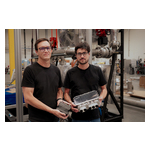
Antares Achieves Initial Criticality of a Privately Developed Advanced Reactor Under DOE Pilot Program
Antares Achieves Initial Criticality of a Privately Developed Advanced Reactor Under DOE Pilot Program
Landmark DOE--INL--Antares collaboration ushers in new era for American Nuclear power
IDAHO FALLS, Idaho--(BUSINESS WIRE)--Antares today announced that its Mark-0 microreactor achieved initial criticality at Idaho National Laboratory (INL) under U.S. Department of Energy (DOE) authorization — making Antares the first private company to bring an advanced reactor to criticality under the DOE Reactor Pilot Program. The demonstration was conducted in partnership with DOE, INL, and BWX Technologies, Inc. (BWXT), with integration and observation support from the U.S. Army.
“Today’s achievement is a historic moment for American nuclear energy,” said U.S. Energy Secretary Chris Wright. “By bringing the first American non-light water privately developed reactor to criticality in more than four decades, Antares has shown what is possible when American innovation is unleashed. The Trump administration is proud to support the rebirth of America’s nuclear industry and ensuring Americans have access to affordable, reliable and secure energy for generations to come.”
The demonstration meets an ambitious objective set by the President and DOE to reform how the federal government tests advanced reactors, and it establishes a replicable licensing pathway that DOE and industry can use to accelerate future reactor demonstrations on commercial timelines.
"Hitting our commitments is everything to us. Nuclear in America has been defined for too long by delays, by companies that said they would and then didn't," said Jordan Bramble, CEO of Antares. "We said criticality in 2026, electricity production in 2027, and power to the warfighter in 2028. Today is the first of those commitments delivered on the schedule we set. The President and DOE set an ambitious timeline for reactor testing, and we met that challenge. I want to thank our partners at the Department of Energy, Idaho National Lab, BWXT, and the U.S. Army. This is what happens when industry and government work together to accomplish big things."
This reactor validates key reactor physics parameters for Antares' reactors and contributes verification and validation data back to the Department of War's Project Pele. The Mark-0 was authorized by DOE under the Reactor Pilot Program, with the U.S. Army integrated throughout as a future end user. This model of interagency coordination directly supports the Army's microreactor deployment timeline.
Mark-0 benefited from using the same nuclear fuel as the Project Pele program, an initiative to design, build, and demonstrate a prototype of a transportable micro nuclear reactor for military use. The TRISO (TRi-structural ISOtropic) fuel was fabricated by Virginia-based BWXT.
“BWXT is proud to work with Antares and deliver the fuel necessary for this important milestone at the Idaho National Lab. Antares is moving quickly to progress from concept to criticality, and we are happy to supply this team with the TRISO needed to do so,” said Joe Miller, BWXT’s president for Government Operations. “The fuel specification and manufacturing expertise we matured through the Strategic Capabilities Office’s Project Pele directly underpin this milestone, and the data from this demonstration will emphasize the strategic importance of the nuclear industry enabled by the strong leadership of the DOE and the Trump Administration.”
The demonstration and the licensing pathway it establishes represent a key step toward deploying electricity-producing microreactors for U.S. military installations by September 30, 2028.
“The DOE Reactor Pilot Program is a critical step necessary to deliver on President Trump’s executive orders,” said Dr. Jeff Waksman, Principal Deputy Assistant Secretary of the Army for Installation, Energy and Environment. “Antares is the first company in that program to achieve criticality. Next, we need to see a reactor generate electricity at full power. Then the Army will take the baton and deliver a full electricity-generating nuclear reactor to a military installation.”
"We went from concept to a critical reactor, safely, in less than 12 months. That doesn't happen by accident. The team treated the schedule as non-negotiable," Bramble added. "It also doesn't happen without decades of DOE investment in the AGR-2 TRISO specification and the Project Pele fuel supply chain at BWXT. Our partners at Idaho National Laboratory and DOE-ID provided the design, regulatory, and facilities support that enabled this schedule. This is a victory for Antares, for our partners, and for an American nuclear industry that is accelerating again."
Beyond meeting the objectives of Executive Order 14301, the demonstration produced the testing data, model validation, and control system performance that will advance Antares' commercial reactor toward full-power electricity production. Engineers gained direct insight into the physics of the Mark-0 core, the behavior of its control drums, and the maturity of its supply chain. These lessons will have compounding benefits across every reactor Antares builds.
"This is a high-safety, high-information test that closes the loop between design prediction and physical realization. It's also a forcing function," Bramble said. "It forced us to build an organization that can design, license, build, and test reactors on a schedule, and it forced DOE's licensing pathway to run at the pace the country needs. For the American nuclear renaissance to succeed, we need efficient, iterative reactor testing, not a decade per design. Criticality is the first step. Electricity from this same facility, using the same TRISO fuel, is expected in roughly a year. Power for military installations follows in two."
Antares' criticality opens the next chapter of American nuclear power and was delivered in time for America's 250th birthday.
About Antares
Antares is a nuclear fission energy company developing compact microreactors for defense and space applications, delivering safe, reliable power where traditional energy sources cannot. Founded in 2023 and backed by over $140 million in funding, Antares achieved initial criticality of its Mark-0 microreactor in 2026 under the DOE Reactor Pilot Program, and is on track to produce electricity from an advanced reactor in 2027, with initial production deployments to U.S. military installations beginning in 2028. Antares operates facilities in Torrance, California; Idaho Falls, Idaho; and Aiken, South Carolina.
Contacts