Galux Shows Broadest Target Coverage in Comparative De Novo Antibody Design Study
Galux Shows Broadest Target Coverage in Comparative De Novo Antibody Design Study
- Across nine publicly comparable targets from recent de novo antibody design studies, GaluxDesign identified experimentally validated binders for eight targets, compared with five and four targets reported for JAM-2 and Chai-2, respectively
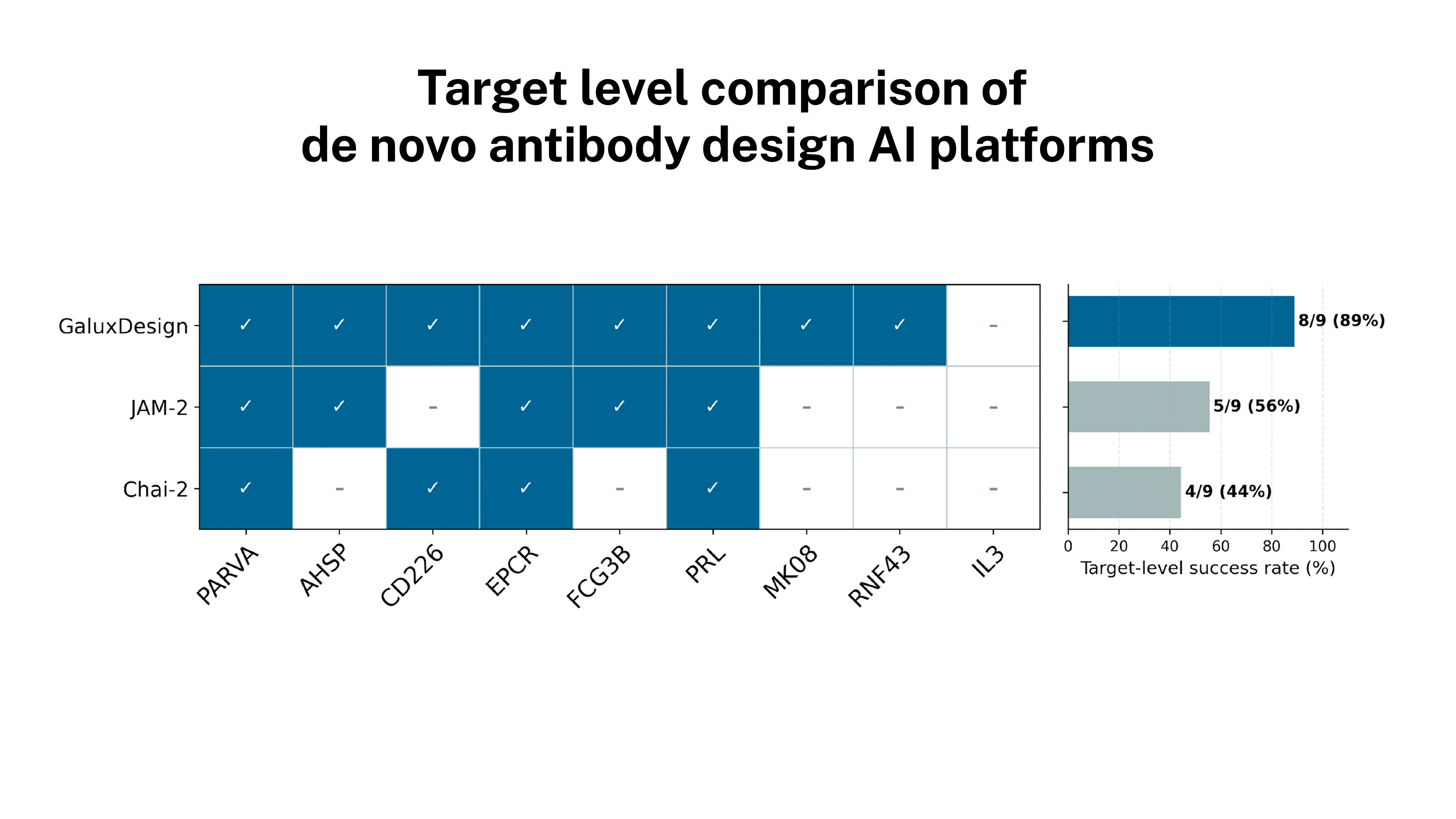
SEOUL, South Korea--(BUSINESS WIRE)--Galux, a South Korean biotechnology company pioneering AI-driven protein therapeutics design, announced comparative research results showing that its AI protein design platform, GaluxDesign, achieved the broadest target coverage across nine publicly comparable targets selected from recent de novo antibody design preprints.
"We aimed to provide a practical view of how different platforms perform across diverse antibody design problems. Within this framework, GaluxDesign showed strong and consistent binder generation across the shared target set."
Share
In the study, GaluxDesign generated 50 antibody designs for each of nine targets previously explored in publicly available AI antibody design studies and experimentally evaluated the resulting candidates in full-length IgG format. The platform identified experimentally validated binders for eight of the nine targets, with BLI-based kinetic analysis confirming low-to-mid nanomolar binding affinities for seven targets.
To compare performance with publicly reported de novo antibody design results, including JAM-2 by Nabla Bio and Chai-2 by Chai Discovery, the study summarized whether at least one experimentally validated binder was reported for each shared target. Based on publicly available preprint results, JAM-2 and Chai-2 reported validated binders for five and four of the nine shared targets, respectively, while GaluxDesign extended this coverage to eight, including targets for which validated binders had not been reported in the corresponding preprint studies.
Taeyong Park, co-founder of Galux, said, “Direct comparison between de novo antibody design platforms remains challenging because the technical details underlying each platform are often not fully disclosed.” He added, “By using the same set of publicly reported targets as a common reference point, we aimed to provide a practical view of how different platforms perform across diverse antibody design problems. Within this framework, GaluxDesign showed strong and consistent binder generation across the shared target set.”
This comparative study builds on Galux’s previously reported streamlined design-and-testing workflow, which was conducted on a separate set of therapeutically relevant target epitopes. In that earlier study, the platform achieved a 31.5% binder hit rate, with picomolar-to-nanomolar affinity binders identified for seven out of eight target epitopes. The latest study extends this performance to an independent shared target set derived from publicly reported de novo antibody design studies.
“De novo antibody design is now moving beyond early proof-of-concept demonstrations toward assessing the ability of AI platforms to generate antibodies with desired binding properties across diverse targets reliably,” added Park. “While experimentally validated binders do not directly translate into therapeutics, the ability to rapidly and consistently generate binders may substantially accelerate downstream therapeutic optimization and drug development. As AI-driven antibody design becomes increasingly reliable, it has the potential to fundamentally reduce one of the major bottlenecks in early-stage biologics discovery.”
About Galux
Galux is a biotechnology company advancing AI-driven protein design technology for drug discovery. Its proprietary platform, GaluxDesign, integrates atomic-level physical insights to enable precise and generalizable protein design across a broad range of targets.
Galux applies this technology across internal programs and external collaborations to address challenging problems in drug discovery. For more information, visit galux.co.kr.
Contacts
Galux
Nicole Noh
press@galux.co.kr