emeis: Revenue and Business Activity as of the End of March 2026
emeis: Revenue and Business Activity as of the End of March 2026
Recovery momentum continues in the first quarter
Occupancy rates rose across all regions to 89.1% (up 2.1 points on average)
Organic revenue growth of +6.3% in the first quarter
PUTEAUX, France--(BUSINESS WIRE)--Regulatory News:
emeis (Paris:EMEIS):
Further increase in occupancy rates: continuation of the trend observed over the past two years
- The Group’s occupancy rate rose by +2.1 points to 89.1% (up +4.1 percentage points over two years), driven in particular by emeis’s efforts to further improve the quality of care and accommodations, enhance marketing processes, and offer a segmented range of services tailored to the needs of residents and patients
- Occupancy rate for nursing homes up by +2.3 points to 88.7% (up +4.5 points over two years)
- A particularly strong recovery in Germany (+3.4 pts yoy), Southern Europe (+2.8 pts), and Central Europe (+2.7 pts)
- Occupancy rates excluding recent openings approaching pre-COVID levels, in Central Europe (93.8%) and Southern Europe (92.3%)
Organic revenue growth of +6.3% as of end-March (+4.8% in France, +7% internationally)
- Organic revenue growth of +6.3% as of the end of March (vs. +6.1% in 2025), driven across all regions by a favorable pricing effect (+3.9% on average) and a notable increase in the occupancy rate
- Strong organic revenue growth in the nursing home segment (+7%) as well as in the clinics segment (+4.9%), which posted encouraging results in the first quarter
- Organic growth continues internationally (+7.3%) and is picking up in France (+4.8%)
Guidance and outlook confirmed
- Confirmation of medium-term guidance: EBITDAR growth on a like-for-like basis1, averaging between +12% and +16% (CAGR 2024–2028)
- For 2026: expected EBITDAR growth on a like-for-like basis1 of over +10%, representing an expected average growth rate (CAGR) between 2024 and 2026 of over +15%1.
About emeis
With nearly 84,600 experts and professionals in the fields of health, care and support for the frail, emeis is present in 19 countries and covers five business lines: Mental health clinics, medical care and rehabilitation clinics, nursing homes, homecare services and residences.
Every year, emeis welcomes nearly 290,000 residents, patients and beneficiaries. emeis is committed to meeting one of the major challenges facing our society: the growing number of people made vulnerable by accidents, old age and mental illness.
In June 2025, emeis became a mission-driven company, incorporating four commitments in its Articles of Association: striving to change the way one looks at the most vulnerables and those close to them, to ensure they are truly included; contributing to the fair recognition and attractiveness of our care professions ; making care for the most vulnerable a major contribution to local social cohesion; and innovating to foster a planet-friendly care that respects living things.
emeis, 50.2% owned by Caisse des Dépôts, CNP Assurances, MAIF and MACSF Epargne Retraite, is listed on Euronext Paris (ISIN: FR001400NLM4) and is a member of the SBF 120 and CAC Mid 60 indices.
Website: www.emeis.com
As a preliminary note, it should be noted that, as part of its financial reporting framework, the Group is changing the geographic breakdown of its activities effective with this press release to better align with emeis’s strategy of focusing on European markets.
Going forward, emeis will report on the following breakdown2 :
- The Northern Europe region includes Germany, the Netherlands, Belgium, Ireland, the United Kingdom, and Luxembourg
- The Central Europe region includes Austria, Switzerland, Poland, Slovenia, and Croatia
- The Southern Europe region includes Spain, Italy, and Portugal, but no longer includes Latin America
- The “Other Regions” category thus includes residual operations in China and Latin America
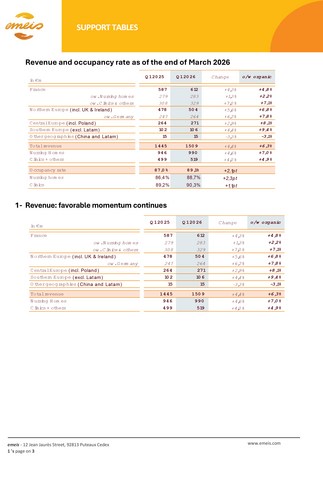
1- Revenue: favorable momentum continues
As of the end of March 2026, the Group’s revenue stood at €1,509 million, up +6.3% on an organic basis, continuing the trend from 2025 (+6.1% for the full 2025 fiscal year), thereby demonstrating that the favorable revenue momentum is continuing.
This momentum is particularly strong for nursing homes (+7% organic growth), with clinics also posting strong performance (+4.9% organic growth).
While France continues on a positive trajectory with organic revenue growth of +4.8%, growth is even more pronounced internationally (+7.3% organic), particularly in the Netherlands, Germany, and Spain.
This increase reflects a combination of three factors, all of which are trending positively:
- A positive price effect supporting organic growth in the first quarter by +3.9%. This contribution exceeds the impact recorded at the end of December 2025, which stood at +3.3%, reflecting a favorable pricing trend;
- An increase in the average occupancy rate at the end of March of +2.1 points, contributing +1.6% to organic growth;
- The facilities opened recently, in 2024 and 2025, whose ramp-up is contributing +0.7% to organic growth, primarily in the Netherlands and Spain.
On a current scope basis, revenue grew by +4.4%, impacted by the effect of the disposals of operations in the Czech Republic (as of the end of March 2025) as well as French senior living operations in early November 2025.
In the nursing home segment (nearly 2/3 of the Group’s business), organic revenue growth reached +7.0% as of the end of March, driven by a significant increase in the average occupancy rate (+2.3 points), a favorable pricing effect, and the ramp-up of new facilities. This trend marks the continuation of a marked recovery in this segment in 2025, even as momentum was already trending favorably in 2024. In the first quarter, this growth also reflects the benefits of enhanced health protocols that helped contain a particularly virulent flu outbreak.
The Clinics segment (54% SMR, 33% psychiatric, and 13% home care) also posted strong momentum, with revenue up +4% yoy (and +4.9% like-for-like). This improvement, particularly in France, benefited from:
- Favorable base effects and one-time items that positively impacted revenue growth in the first quarter of 2026 for clinics in France (a +1.8% effect from one-time items on organic revenue growth for the Clinics segment),
- as well as the effects of operational corrective measures implemented throughout 2025, which helped restore favorable momentum, particularly in the marketing of private rooms.
Internationally, the first quarter followed the same very positive trend as in previous quarters, with an average organic growth rate of +7.3%.
Performance was solid, with organic growth rates approaching or even exceeding +8% in Germany, Central Europe, and Southern Europe, driven by strong pricing effects (particularly in Germany), an increase in occupancy rates (especially in Spain and Belgium, but also in Italy and Poland), as well as the ramp-up of recently opened facilities (notably in the Netherlands and, to a lesser extent, in Portugal and Spain).
- It is worth noting the very strong performance of operations in Southern Europe, where revenue increased by +9.4%. This performance is driven by a significant rise in occupancy rates (now exceeding 92% in Spain and Italy), the ramp-up of recently delivered facilities, and the decision in Italy to divest underperforming facilities.
- In Germany, organic growth is approaching +8%, and even +10% for nursing homes, marking a continuation of the positive momentum observed in 2025, driven by a favorable adjustment in rates following the rise in costs observed in 2024.
- The Netherlands, Poland, and Luxembourg are also posting double-digit organic growth rates.
In France:
- Revenue for clinics in France as of the end of March 2026 rose by +7.1% on an organic basis, benefiting in part from favorable non-recurring effects (a negative base effect in the first quarter of 2025 and a positive one-off effect in the first quarter of 2026). The pace of organic growth is therefore expected to slow naturally in the coming quarters. However, this growth remains encouraging and reflects the sequential improvement observed quarter after quarter, following a first quarter of 2025 that fell short of expectations, particularly regarding the marketing of private rooms.
- Organic revenue growth for nursing homes was +2.2% compared to the first quarter of 2025, driven primarily by an increase in the occupancy rate.
2- Occupancy rates: continued improvement across all regions
The Group’s average occupancy rate rose by +2.1 pts yoy, reaching 89.1% in the first quarter of 2026. This improvement marks the continuation of the steady recovery that has been underway for more than two years now, driven by ongoing efforts to improve the quality of care, marketing processes, and the development of a segmented offering that closely aligns with the needs of residents and patients. For reference, the Group’s average occupancy rate stood at 87% in the first quarter of 2025 and 85% in the first quarter of 2024, representing a steady increase of +2 pts per year.
The recovery is driven in particular by nursing homes, where the occupancy rate reached 88.7% at the end of March, up +2.3 pts yoy. It also rose by +1.1 pt in clinics, now reaching 90.3%.
The trends that gradually emerged in 2024 and 2025 are thus continuing into 2026 across all of emeis’s markets.
-
In France (41% of the Group’s revenue), the average occupancy rate now stands at 89.8%, up +2.1 points from last year.
For nursing homes, the occupancy rate stands at 87.2%, an improvement of +3.6 points yoy. This increase reflects both improved marketing processes, the effects of quality-enhancing measures implemented in recent years, and the disposal of underperforming operations. In addition, nearly one-third of this improvement stems from the removal from the denominator of beds that had previously been counted but were not marketable. Without this adjustment, the increase in the occupancy rate would have been +2.4 points. - In Northern Europe3 (33% of revenue), the momentum that began in 2024 continues. In Germany, the Group’s second-largest market, the notable improvement of +3.4 pts in the occupancy rate partly reflects the measures implemented—particularly regarding quality—with a segmented offering since 2024 tailored to residents’ needs, the effects of which are gradually becoming apparent. The momentum appears to be accelerating, with the average occupancy rate now reaching 88.5% in Germany, compared to just 85.1% a year ago. In the Netherlands, the strong momentum observed reflects the ramp-up of recently opened facilities.
- In Central Europe4 (18% of revenue), there has been a notable improvement, with occupancy rates up by +2.7 points, now close to pre-COVID levels—above 93%—in Austria, Switzerland, Slovenia, and Croatia.
- In Southern Europe5 (7% of revenue), the opening of facilities in the second half of 2024 and throughout 2025 (in Spain and Portugal) is still temporarily weighing on the average occupancy rate, which nevertheless already stands at 90.8%, up nearly +3 points yoy. Within the mature portfolio (excluding recent openings, which are ramping up gradually), the occupancy rate in this region now exceeds 92.3%.
3- €1 billion in disposals finalized in the first quarter or under agreement as of end-March
A total of €1 billion in disposals were finalized during the first quarter or were secured as of March 2026. This volume reflects almost exclusively the progress of transactions already secured as of December 2025, including:
- €761 million received in mid-January 2026 from the creation of Isemia, open to third-party investors, representing 62% of the appraised value of a pan-European portfolio of 68 assets located in France, Spain, and Germany.
- €54 million from other real estate disposals finalized/received since the start of the year, 59% of which were sales and lease-backs with an average yield of 4.9%. These disposals primarily involve assets located in Switzerland (40%) and France (25%), and to a lesser extent in the Netherlands, Latin America, Portugal, and Belgium.
- €191 million in disposal transactions currently secured but not yet cashed in.
Update on the disposal process for operations in the Latam region
As a reminder, emeis has initiated a process aimed at the disposal of all of its operations in Latin America6 . These disposals are expected to be completed gradually, primarily during 2026, and to a lesser extent in 2027.
- As of the end of March 2026, nearly 10% of the total has already been finalized, primarily involving real estate assets. This rate reached 18% when including disposals under agreement.
- Progress in discussions since early April has enabled the disposal process to advance significantly. To date, more than two-thirds of EMEIS’s operations in Latin America have been sold or are subject to sales agreements.
Now that the disposal plan has been significantly exceeded, the Group’s financial structure has been substantially and sustainably strengthened, and emeis’s operational performance confirms a positive trend quarter after quarter, the Group intends to be particularly selective regarding potential further disposals in the coming years.
4- Outlook for 2026 and medium-term outlook
The medium-term outlook for the Group’s key markets is particularly promising for care and support services for the most vulnerable individuals.
The population of seniors aged 85 and older is expected to grow by more than 30% within the next 10 years. The structural supply shortage in the nursing home markets will consequently worsen each year, reaching a shortage of approximately 550,000 beds by 2030 and 800,000 beds by 2035 across the five main EMEIS markets. To illustrate the scale of this future supply shortage, the French market currently has a total of 650,000 beds.
The prevalence of mental health disorders and chronic diseases also continues to rise significantly, creating yet another risk of insufficient supply in the coming years.
This situation of major shortage provides the emeis Group with solid visibility for the coming years, with supply matching rapidly growing demand.
In the medium term, emeis confirms its expectations through 2028, anticipating that the recovery trajectory observed since mid-2024 and largely confirmed in 2025 will continue.
- The compound annual growth rate (CAGR) of revenue on a like-for-like basis7 is expected to be between +4% and +5% between 2024 and 2028
- The Group’s average annual growth rate (CAGR) for EBITDAR on a like-for-like basis7 is expected to be between +12% and +16% between 2024 and 2028
In the shorter term, for 2026: the trend observed in 2025 will continue, driven by the combined effects of a recovery in occupancy rates, the capture of favorable pricing effects, and better control of operating expenses.
It should be noted that emeis’ strategy has helped reduce the Group’s sensitivity to potential inflationary pressures, should these arise in an uncertain global geopolitical context.
The Group has thus been able to hedge nearly 90% of its energy expenses (electricity and gas) for 2026, and nearly 60% for 2027, based on rates lower than those in 2025.
For the record, electricity and gas expenses represent nearly 2.5% of the Group’s revenue in 2025. Less than 40% of these expenses correspond directly to energy consumption and are therefore linked to market trends (the remainder corresponding to fixed transmission charges or taxes). The direct impact of rising energy prices is therefore very limited on the Group’s margin in 2026.
In addition, emeis has entered into debt hedging instruments. To date, nearly 30% of the Group’s debt is fixed-rate or hedged.
Consequently, emeis is currently in a position to confirm that it is maintaining its objectives for the fiscal year, as specified here.
- In 2026, the Group thus anticipates an EBITDAR increase of more than +10% for the year compared to 2025 (on a like-for-like basis, excluding the effects of operational disposals already completed or to be completed in 2026).
- This guidance brings the average annual growth rate of EBITDAR on a like-for-like basis7 between 2024 and 2026 to at least +15%, suggesting a trajectory that would be at the high end of the medium-term target range as described above.
DISCLAIMER
This document contains forward-looking information associated with risks and uncertainties regarding the Group’s future growth and profitability, which may result in actual results differing significantly from those indicated in the forward-looking information. These risks and uncertainties are related to factors that the Company cannot control or accurately estimate, such as future market conditions. The forward-looking information contained in this document constitutes expectations regarding a future situation and should be considered as such. Subsequent events or actual results may differ from those described in this document due to a number of risks or uncertainties described in Chapter 2 of the Company’s 2025 Universal Registration Document, available on the Company’s website and that of the AMF (www.amf-france.org).
APPENDICES
1- Revenue by region based on the previous segmentation
For the record, the previous segmentation grouped countries by region as follows:
- Northern Europe: Germany, the Netherlands, Belgium, and Luxembourg
- Central Europe: Austria, Switzerland, Slovenia, and Croatia
- Southern Europe and Latin America: Spain, Italy, Portugal, and Latin America
- Other countries: Ireland, Great Britain, Poland, and China
2- Occupancy rates by region based on the previous segmentation
| _______________________________________ |
1 On a like-for-like basis (excluding contributions from operating segments divested during the period) |
2 Revenue and occupancy rate figures corresponding to the formats in effect prior to this change are provided in the appendix to this press release |
3 Germany, the Netherlands, Belgium, Ireland, the United Kingdom, and Luxembourg (including Ireland and the United Kingdom since 2026) |
4 Austria, Switzerland, Poland, Slovenia, and Croatia (including Poland since 2026) |
5 Spain, Italy, and Portugal (excluding Latin America since 2026) |
6 Less than 1% of 2025 revenue, non-material EBITDAR |
7 Excluding the impact of divested operations during the period |
Contacts
Press contacts
Isabelle HERRIER NAUFLE
Director of Media Relations &
E-Reputation
07 70 29 53 74
isabelle.herrier@emeis.com
IMAGE 7
Charlotte LE BARBIER
06 78 37 27 60
clebarbier@image7.fr
Investor Relations
Samuel HENRY-DIESBACH
Director of Investor Relations
& Capital Markets
samuel.henry-diesbach@emeis.com
Shareholder Toll-Free Number
0 805 480 480
NEWCAP
Dusan ORESANSKY
01 44 71 94 94
emeis@newcap.eu