Americans Feel Increasingly Alone Despite Craving Connection, New Survey Finds
Americans Feel Increasingly Alone Despite Craving Connection, New Survey Finds
Research reveals a ‘Disconnection Dilemma’ as more people choose isolation over conflict, despite a growing desire for community.
NEW YORK--(BUSINESS WIRE)--Many Americans say they want stronger connections in their lives but are also pulling back from relationships in ways that leave them feeling more disconnected, a new nationwide survey found.
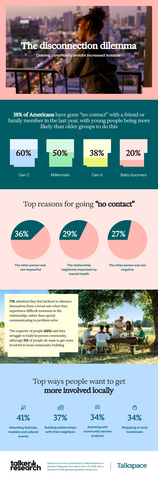
Commissioned by Talkspace and conducted by Talker Research, the survey of 2,000 U.S. adults identifies a ‘Disconnection Dilemma,’ a growing trend where the desire for community is being undermined by increased rates of “going no-contact" as well as isolation to avoid difficult conversations.
- Nearly three-quarters of Americans (73%) say they are more likely to distance themselves from a friend or loved one during difficult moments rather than communicate to resolve issues.
- More than one in three Americans (38%) say they’ve gone “no contact” with a friend or family member in the past year — a figure that rises to 60% among Gen Z.
- 68% say they struggle to build in-person community, and (47%) say they experience loneliness during a typical day.
Mental Health Awareness Month highlights the need for connection
With Mental Health Awareness Month starting in May, the poll brings renewed attention to how relationships can shape our mental well-being. Social isolation and loneliness put a person at risk of developing serious mental and physical health conditions, the CDC warns.
“These results suggest that avoiding relationship challenges is becoming more common, but that approach can come with its own risks, making it harder to sustain meaningful connections over time and leading to more loneliness," said Dr. Nikole Benders-Hadi, the chief medical officer at Talkspace. "Prioritizing communication, setting healthy boundaries, and staying engaged even when it’s uncomfortable can help people preserve the relationships that support their mental wellness.”
Technology is making it easier to opt out of interaction
The survey also found that reduced interaction extends beyond close relationships and into daily life, with many Americans turning to technology to limit in-person contact.
- 68% use online ordering, self-checkout kiosks (64%), and chatbots/automated help systems (42%) to reduce their interactions with others.
- 40% say they would rather cross the street than stop and talk to someone they know.
- 37% will pretend to take a phone call to avoid small talk.
A widespread desire for connection remains
Despite these trends, many Americans say they want stronger connections and more community in their lives.
- Nearly one-third (31%) say they want to become more involved in local community-building and activities.
- Barriers to these social connections include social anxiety (30%), preferring to spend time alone (30%), or feeling like they don’t fit in (26%).
- When asked what defines a healthy relationship, respondents pointed to emotional safety and mutual support — such as feeling comfortable expressing their thoughts and opinions (47%) and feeling seen and understood (41%).
The launch of Connection is Crucial, Talkspace’s 2026 Mental Health Awareness Month campaign, celebrates the power of interpersonal connections and shares expert advice on how to strengthen bonds for improved mental well-being.
See here for a deeper look at the Talker survey results.
About Talkspace
Talkspace (NASDAQ: TALK) is a virtual behavioral healthcare provider committed to helping people lead healthier lives through access to mental healthcare. Talkspace offers therapy for individuals, teens, and couples, as well as psychiatric treatment and medication management for adults.
Members are matched with licensed therapists and can engage in live video, audio, or chat sessions, as well as asynchronous messaging. Services are delivered through a secure web and mobile platform that meets HIPAA and regulatory requirements.
Many Americans have access to Talkspace through health insurance plans, employee assistance programs, or as a benefit through an employer, school, or government program.
For more information, visit www.talkspace.com.
Contacts