Vertical Aerospace Achieves World First Two-Way Piloted Transition Flight
Vertical Aerospace Achieves World First Two-Way Piloted Transition Flight
- First eVTOL to complete two-way piloted transition – switching from helicopter mode to airplane mode and back again - under civil aviation Design Organisation Approval regulatory oversight
- Advances Valo’s path to certification, targeted for 2028, with entry into service expected shortly thereafter on routes such as Canary Wharf to Heathrow and JFK to Manhattan
- Reinforces UK leadership in next-generation aerospace, supporting high-skill jobs and export growth
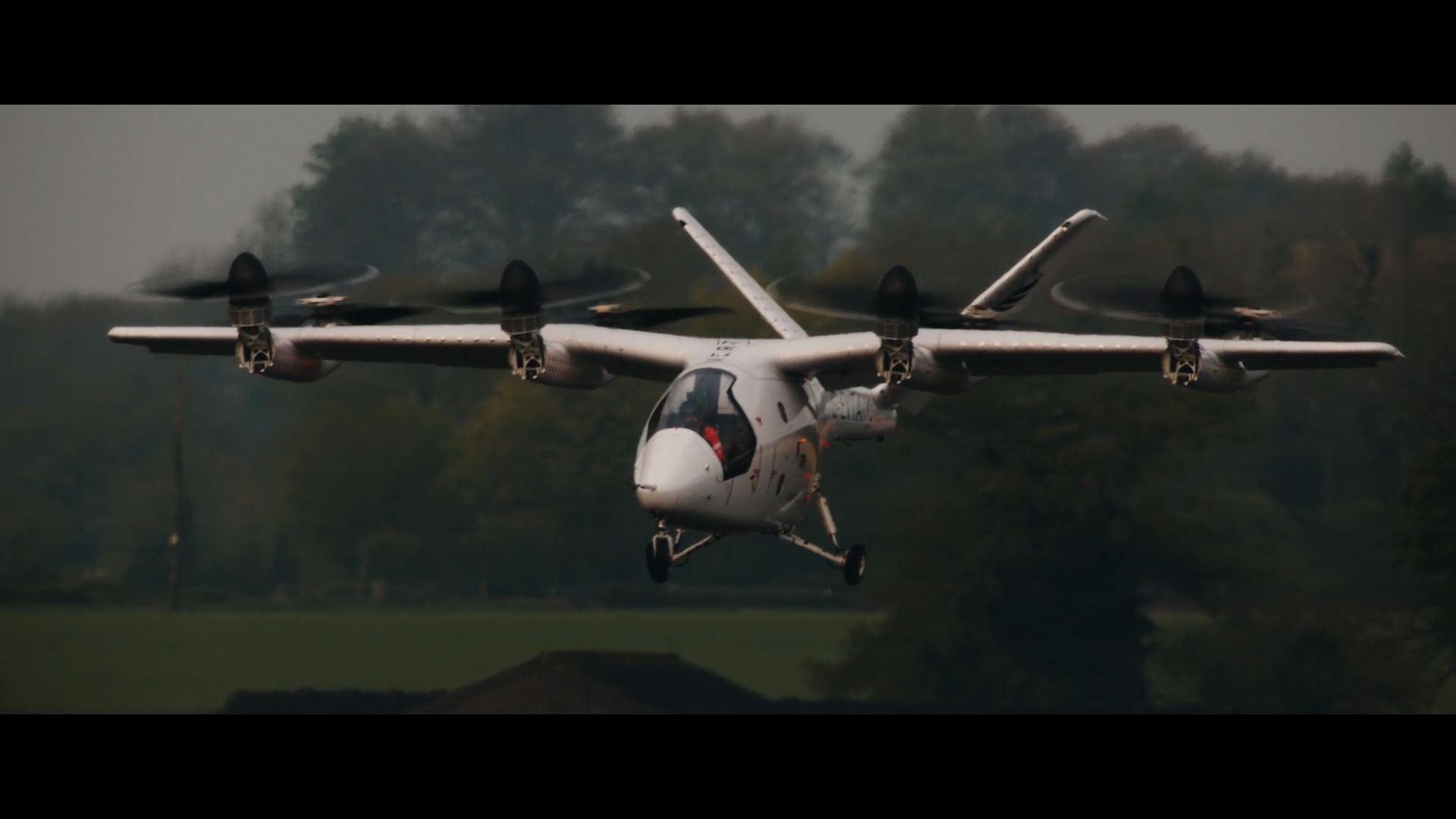
LONDON & NEW YORK--(BUSINESS WIRE)--Vertical Aerospace (“Vertical” or “the Company”) (NYSE: EVTL), a global aerospace and technology company pioneering electric aviation, has successfully completed a historic two-way piloted transition flight.
On 14 April 2026, Vertical became the second company globally to complete a two-way piloted transition flight in a full-scale tiltrotor eVTOL and the first to do so under civil aviation Design Organisation Approval regulatory oversight.
Chief Test Pilot Simon Davies completed the flight – transitioning from vertical take-off to wingborne cruise and back to vertical landing - all in one continuous flight. This builds on Vertical’s thrustborne transition on 2 April 2026 and marks the completion of two-way transition, the defining capability of eVTOL aviation.
Put simply, this is what makes electric air taxis possible. Transition flight validates the technology which will enable Valo, Vertical’s commercial aircraft, to take off vertically from a city-centre vertiport or rooftop with passengers, fly efficiently at speed like an airplane, and land vertically at its destination – comfortably, quietly and without a runway. This unlocks planned real-world routes such as Canary Wharf to Heathrow or JFK to Manhattan, making them operationally and commercially viable.
Stuart Simpson, CEO, Vertical Aerospace, said: “This is now the most significant technical milestone in our history. Full piloted transition is the most critical and complex challenge in eVTOL development, and we’ve achieved it under more rigorous regulatory oversight than anyone in the category. We’re not just participating in this industry - we are helping to define it. Our focus now is on executing our roadmap and bringing certified electric flight into commercial service.”
Path to Certification
As with all Vertical flight tests since 2023, this milestone was achieved under the direct oversight of the UK Civil Aviation Authority (CAA), who are working in close collaboration with the European Union Aviation Safety Agency (EASA) toward Type Certification of Valo. Testing is conducted under Vertical’s Design Organisation Approval, a pre-requisite for entry into service.
With all phases of flight now proven - vertical take-off, wingborne flight and transition between the two - Vertical is moving into the next stage of certification testing. This will include critical design review, when the aircraft design is locked, followed by the build of seven pre-production Valo aircraft in the UK for compliance and verification testing with the CAA and EASA.
Vertical is targeting certification of Valo in 2028 to the highest safety standards in the category, with entry into service expected shortly thereafter. The certification approach is designed to be transferable to other regulators, including the US Federal Aviation Administration (FAA), Brazil’s National Civil Aviation Agency (ANAC) and the Japan Civil Aviation Bureau (JCAB), supporting global deployment with airline and operating partners including American Airlines, Avolon, Bristow, GOL and Japan Airlines.
Steve Johnson, Vice Chair and Chief Strategy Officer, American Airlines, said: “Advanced air mobility represents a natural extension of American’s broader commitment to innovation and shaping the next era of aviation. As both an investor and long-term supporter of Vertical Aerospace, we share a clear ambition to make safe, scalable, and sustainable eVTOL flight a reality, and today's news is a foundational step toward that end. Together, we’re not just imagining the future of travel, we’re actively building it.”
UK Secretary of State for Business and Trade, Peter Kyle, said: “This is a fantastic milestone not only for Vertical, but for the UK’s position in the future of aerospace as we continue to lead the way on zero emission flight.
“Through our Industrial Strategy and the Aerospace Technology Institute we’re backing companies like Vertical who are demonstrating the kind of innovation, engineering excellence and export potential that can keep Britain at the forefront of the global aerospace industry, and create high-skilled jobs for local people.”
Bob Buddecke, president, Electronic Solutions, Honeywell Aerospace, said: “Successful transition flight represents meaningful progress not only for Vertical, but for the entire advanced air mobility industry.
“Our Compact Fly-by-Wire team worked closely with Vertical’s team to help enable the successful flight, and we expect countless more to come. Vertical’s progress underscores the strength of our joint engineering approach and the importance of disciplined system integration in bringing next-generation aircraft to market.”
A Major Opportunity for the UK
As Europe’s only eVTOL developer to achieve full piloted transition, this milestone reinforces the UK’s position at the forefront of next-generation aerospace.
Vertical expects its UK-based manufacturing and supply chain to support thousands of high-skilled jobs and significant export growth, with its ecosystem projected to grow to over 2,000 jobs by 2035.
Progressing Key Strategic Milestones
Vertical will continue its focus on executing key strategic milestones over the next twelve months and beyond. These include public flight demonstrations, including at Farnborough International Airshow in July, progression of the hybrid-electric demonstrator, expansion of the Vertical Energy Center, advancement of the manufacturing facility, and production of the first full-scale Valo certification aircraft.
Vertical’s piloted flight test programme explainer:
- Phase 1: Tethered – stabilised hover while tethered (Completed September 2024)
- Phase 2: Thrustborne – vertical take-off, landing and low-speed manoeuvres (Completed February 2025)
- Phase 3: Wingborne – conventional take-off, flight and landing (Completed September 2025)
-
Phase 4: Transition – transitioning between thrustborne and wingborne flight
- Thrustborne transition (vertical take-off to wingborne flight): Completed April 2026
- Two-way transition (including return to vertical landing): Completed April 2026
About Vertical Aerospace
Vertical Aerospace is a global aerospace and technology company pioneering electric aviation. Vertical is creating a safer, cleaner, and quieter way to travel. Valo is a piloted, Electric Vertical Take-Off and Landing (eVTOL) aircraft, with zero operating emissions, designed to fly up to 100 miles at speeds of up to 150 mph. Vertical is also developing a hybrid-electric variant, offering increased range and mission flexibility to meet the evolving needs of the advanced air mobility market.
Vertical combines partnerships with leading aerospace companies, including Honeywell, Syensqo, Evolito, Isoclima and Aciturri, with its own proprietary battery and propeller technology to develop the world's most advanced and safest eVTOL. Vertical has c.1,500 pre-orders of Valo, with customers across four continents, including American Airlines, Avolon, Bristow, GOL and Japan Airlines. Certain customer obligations are expected to be fulfilled via third-party agreements. Headquartered in Bristol, UK, Vertical's experienced leadership team comes from top-tier aerospace and automotive companies such as Rolls-Royce, Airbus, GM, and Leonardo. Together, they have previously certified and supported over 30 different civil and military aircraft and propulsion systems.
Forward Looking Statements
This press release contains forward-looking statements within the meaning of the U.S. Private Securities Litigation Reform Act of 1995 that relate to our current expectations and views of future events. We intend such forward-looking statements to be covered by the safe harbor provisions for forward-looking statements as contained in Section 27A of the Securities Act and Section 21E of the Exchange Act. Any express or implied statements contained in this press release that are not statements of historical fact may be deemed to be forward-looking statements, including, without limitation, statements regarding the design and manufacture of our aircraft and the hybrid-electric variant; certification and the commercialization of our aircraft and our ability to achieve regulatory certification of our aircraft product on any particular timeline or at all; the features and capabilities of the aircraft; business strategy and plans and objectives of management for future operations, including the building and testing of our prototype aircrafts on timelines projected; selection of suppliers; the differential strategy compared to our peer group; expectations surrounding pre-orders and commitments; as well as statements that include the words “expect,” “intend,” “plan,” “believe,” “project,” “forecast,” “estimate,” “may,” “should,” “anticipate,” “will,” “aim,” “potential,” “continue,” “are likely to” and similar statements of a future or forward-looking nature. Forward-looking statements are neither promises nor guarantees, but involve known and unknown risks and uncertainties that could cause actual results to differ materially from those projected, including, without limitation, the other important factors discussed under the caption “Risk Factors” in our Annual Report on Form 20-F filed with the U.S. Securities and Exchange Commission (“SEC”) on March 24, 2026, as such factors may be updated from time to time in our other filings with the SEC. Any forward-looking statements contained in this press release speak only as of the date hereof and accordingly undue reliance should not be placed on such statements. We disclaim any obligation or undertaking to update or revise any forward-looking statements contained in this press release, whether as a result of new information, future events or otherwise, other than to the extent required by applicable law.
Contacts
For more information:
Justin Bates, Head of Communications justin.bates@vertical-aerospace.com +44 7878 357463
Samuel Emden, Head of Investor Affairs samuel.emden@vertical-aerospace.com +447816 459 904