New Report Reveals 92% of Breached Organizations Admit Stronger Cyber Hygiene Could Have Prevented Incident
New Report Reveals 92% of Breached Organizations Admit Stronger Cyber Hygiene Could Have Prevented Incident
Swimlane study finds most security teams are struggling with the basics, but 84% say AI and automation are key to restoring cyber hygiene
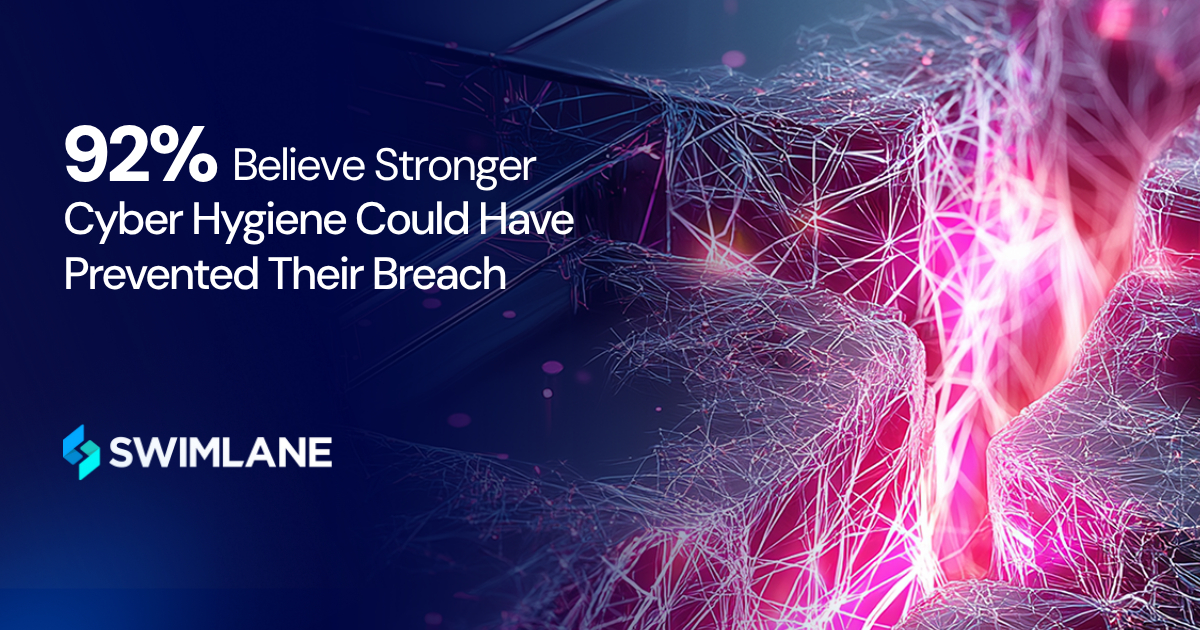
DENVER--(BUSINESS WIRE)--According to a newly released report from Swimlane, the leader in agentic AI automation for every security function, most enterprises still struggle with the fundamentals of cyber defense. The report, “Cracks in the Foundation: Why Basic Security Still Fails,” reveals that 92% of organizations that experienced a security incident in the past year believe stronger cyber hygiene could have prevented it, underscoring how persistent execution gaps continue to leave organizations exposed to preventable risk.
Despite unprecedented spending on cybersecurity tools and services, foundational security practices remain inconsistent and often overlooked. To better understand why these basics continue to falter, Swimlane surveyed 500 IT and security decision-makers across the U.S. and U.K. The findings show how operational blind spots, leadership misalignment, and slow patching processes are leaving even well-resourced organizations exposed, while forward-thinking teams are increasingly turning to AI and automation to close execution gaps and drive continuous cyber resilience.
“The fundamentals of security shouldn’t be the hardest part, but they remain the weakest link,” said Michael Lyborg, CISO at Swimlane. “Too many teams treat hygiene as a checklist instead of a living process. Intelligent automation makes it continuous, measurable, and built-in, turning resilience from a goal into a deliverable outcome.”
Key Takeaways
- The Basics Still Break Security: Over half (52%) of organizations say their greatest weakness is the human element, including employee training and awareness. Two-thirds (67%) audit user access privileges quarterly or less often, and 64% fail to continuously assess vendor and supplier security after onboarding.
- Cyber Hygiene Still Isn’t a Leadership Priority: Only 32% of respondents say hygiene and resilience rank among their C-suite’s top priorities, suggesting leadership continues to underestimate how much fundamentals drive overall risk reduction.
- Process Delays Widen Vulnerability Windows: Nearly three-quarters (73%) of organizations take longer than 24 hours to apply critical patches; one in four take between 8 and 30 days.
- Most Incidents Are Still Preventable: Sixty-six percent of organizations faced a security incident in the past year, and 92% say better hygiene could have prevented it. Just 15% of organizations self-identify as “leading” in cyber hygiene maturity.
- AI and Automation Are Closing the Fundamentals Gap: Eighty-four percent say AI and automation enhance cyber hygiene, and 64% report these tools have increased organizational focus on the basics. Expanding AI usage and expertise ranks as the top improvement area (41%).
“Cyber resilience depends on operational discipline as much as technological sophistication,” said Cody Cornell, Co-Founder and CEO at Swimlane. “We’re at a turning point where agentic AI can finally make the fundamentals automatic. The organizations that embed AI agents into daily automated workflows will transform hygiene from a persistent challenge into a lasting competitive advantage.”
Key Resources
- Download the report: Cracks in the Foundation: Why Basic Security Still Fails
- Register for Swimlane’s upcoming webinar Fundamentals First: Building a Stronger Cybersecurity Foundation on December 9th, 2025 at 12 PM ET.
Methodology
The survey was conducted among 500 IT and cybersecurity decision-makers at enterprise companies with at least 1,000 employees in the United States and the United Kingdom. The interviews were conducted online by Sapio Research, under the guidance of Swimlane, in October 2025, using an email invitation and an online survey.
About Swimlane
At Swimlane, we believe the convergence of agentic AI and automation can solve the most challenging security, compliance and IT/OT operations problems. With Swimlane, enterprises and MSSPs benefit from the world's first and only hyperautomation platform for every security function. Only Swimlane gives you the scale and flexibility to build your own hyperautomation applications to unify security teams, tools and telemetry ensuring today’s SecOps are always a step ahead of tomorrow's threats.
Learn more: swimlane.com
Contacts
Media Contacts
Allison Knight
swimlane@10fold.com
806-570-9819