Microdramas to generate $11 billion in global revenues by 2025 says Omdia
Microdramas to generate $11 billion in global revenues by 2025 says Omdia
LONDON--(BUSINESS WIRE)--Microdramas, a fast-growing short-form scripted video format, are projected to generate $11 billion in global revenues by 2025, according to new research presented at MIPCOM by Maria Rua Aguete, Head of Media and Entertainment at Omdia.
“Microdramas are redefining what premium storytelling means in the digital era,” said Maria Rua Aguete, Head of Media and Entertainment at Omdia.
Share
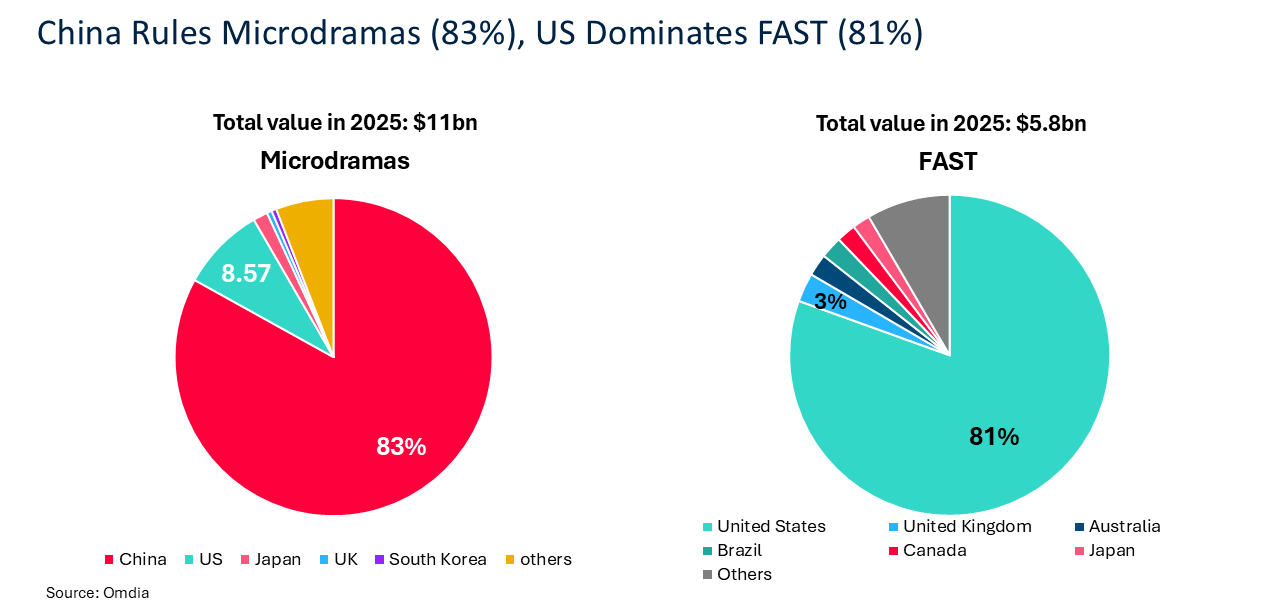
The analysis shows that microdramas - short, serialized stories typically running around 2-3 minutes per episode - have emerged as a major category within mobile-first video entertainment. Revenues from this format are forecast to be nearly twice the size of free ad-supported streaming television (FAST) channels, which Omdia expects to reach $5.8 billion at the end of this year.
“Microdramas are redefining what premium storytelling means in the digital era,” said Rua Aguete. “They combine the immediacy of social media with the emotional depth of television drama. They are short, accessible, and increasingly popular among mobile audiences.”
Omdia’s data indicates that more than 60% of global microdrama revenues come from subscription or transactional payments, often following a free introductory model. The average revenue per user (ARPU) can reach $20 per week or up to $80 per month, underscoring the strong monetization potential of the format.
China accounts for 83% of total revenues, driven by its large-scale audiences and mobile viewing trends. Outside China, the United States leads international markets, followed by Japan, South Korea, the U.K., and Thailand, where adoption continues to grow.
“Viewers are increasingly willing to pay for content that engages them immediately,” Rua Aguete added. “While attention spans are shorter, engagement levels are deeper - and that’s what makes this format so commercially effective.”
Omdia’s analysis suggests that microdramas are poised to become a core part of the digital entertainment ecosystem, sitting between social video and traditional scripted television.
“The rise of microdramas illustrates how new storytelling models and distribution platforms continue to reshape global viewing behavior,” Rua Aguete concluded. “This marks the next phase of evolution in digital content.”
ABOUT OMDIA
Omdia, part of Informa TechTarget, Inc. (Nasdaq: TTGT), is a technology research and advisory group. Our deep knowledge of tech markets combined with our actionable insights empower organizations to make smart growth decisions.
Contacts
Fasiha Khan: fasiha.khan@omdia.com