Argonne Scientists Develop Innovative Protective Coating to Boost Solid-State Battery Stability
Argonne Scientists Develop Innovative Protective Coating to Boost Solid-State Battery Stability
LEMONT, Ill.--(BUSINESS WIRE)--In everyday life, we use many protective barriers: Sunscreen shields us from the sun, umbrellas keep us dry in the rain and oven mitts protect our hands from hot pans. Similarly, batteries need protection to stop their internal components from breaking down due to environmental exposure.
Inside a battery, the electrolyte is the chemical medium that allows electrical charge to flow between components. Solid-state batteries (SSBs) use solid electrolytes instead of the liquid ones found in regular lithium-ion batteries. By using solid electrolytes, SSBs could revolutionize energy storage by offering better energy density, safety and lifespan.
However, a big challenge for SSBs is that solid electrolytes can break down when exposed to humidity and oxygen. This is particularly severe for high-performance, sulfide-based solid electrolytes such as lithium phosphorus sulfur chloride (LPSCl). Making SSBs with these materials requires maintaining a dry room below -40°C, which makes production costly.
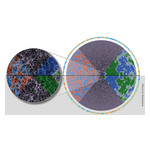
To improve chemical stability and make manufacturing more affordable, researchers at the U.S. Department of Energy’s Argonne National Laboratory have developed a method to coat sulfide-based solid electrolytes. They use atomic layer deposition (ALD) to apply a protective layer. This coating improves stability by acting as a shield and modifying the surface’s electronic structure, resulting in materials that are more resistant to moisture and oxygen.
“Our research shows that even a very thin coating — just a few nanometers thick — can act as a strong barrier, keeping the electrolyte intact and boosting its performance,” said Argonne materials scientist Justin Connell. “This breakthrough can extend battery life and lower manufacturing costs by allowing production in less controlled environments.”
The ALD process deposits a layer of aluminum oxide onto the electrolyte particles. In tests with high humidity and oxygen, the coated electrolytes performed much better than uncoated ones, remaining stable with little degradation.
The ability to work with these materials in less controlled environments is a key advantage. Materials scientist Zachary Hood noted that handling these materials under harsher conditions would simplify manufacturing. “It would allow manufacturers to use existing infrastructure, similar to what is used for lithium-ion batteries,” he said. "This would result in significant savings in the upfront cost of factories, while also improving reliability.”
The team is working to scale up this method and is collaborating with a commercial partner to produce larger quantities of the coated electrolyte for demonstration in larger format batteries. Future research will focus on exploring other coating chemistries.
Contacts
Christopher J. Kramer
Head of external communications
Argonne National Laboratory
Office: 630.252.5580
Email: media@anl.gov