Teledyne FLIR Commends NHTSA Ruling for Automatic Emergency Braking Requirement on Passenger Vehicles
Teledyne FLIR Commends NHTSA Ruling for Automatic Emergency Braking Requirement on Passenger Vehicles
Thermal Infrared Cameras Can Help Manufacturers Meet New Life-Saving PAEB Requirement by 2029
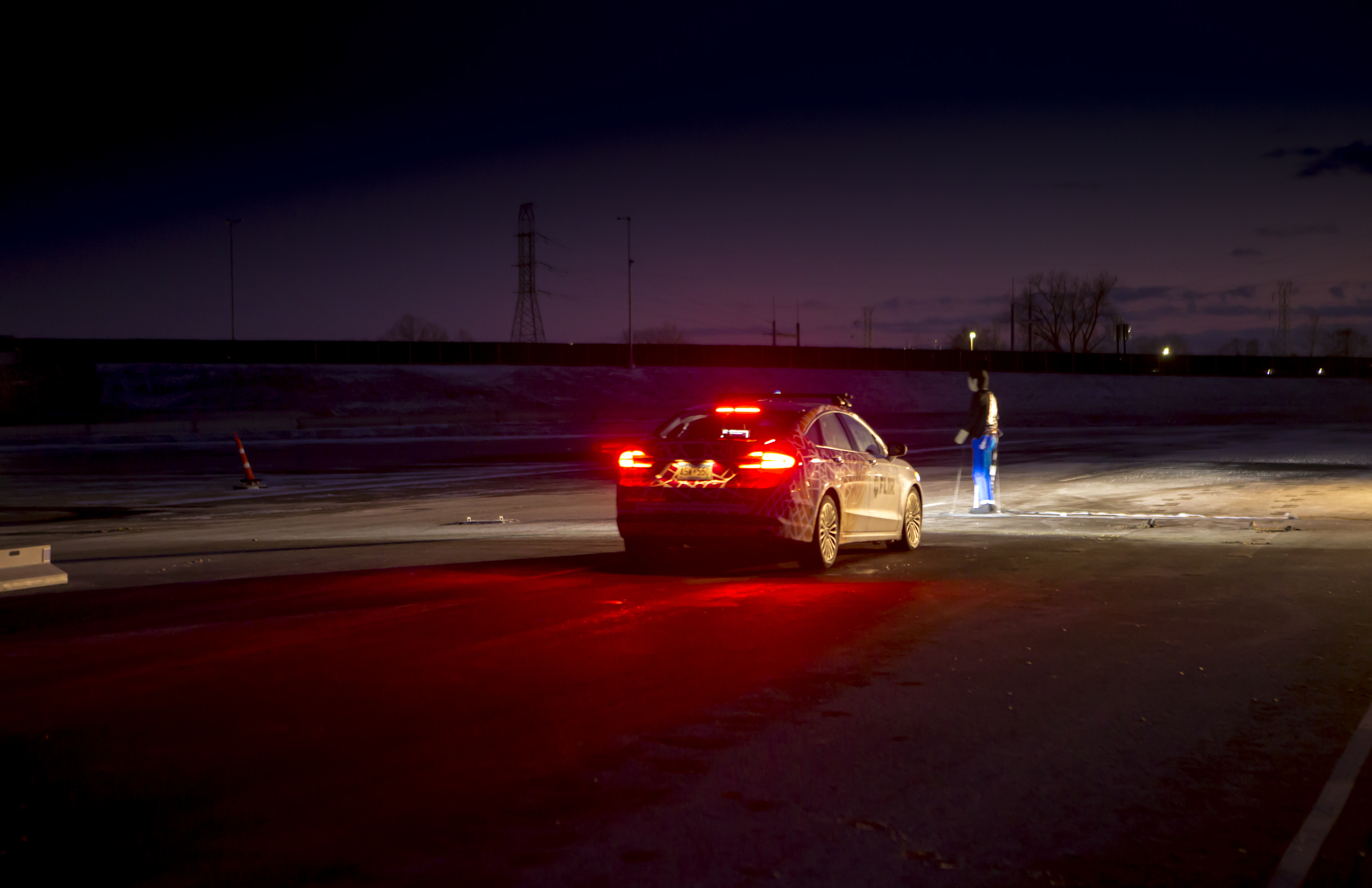
GOLETA, Calif.--(BUSINESS WIRE)--Teledyne FLIR, part of Teledyne Technologies Incorporated, today commends the National Highway Transportation Safety Commission (NHTSA) for finalizing a Federal Motor Vehicle Safety Standard that will require pedestrian automatic emergency braking (PAEB) on all passenger cars and light trucks by September 2029.
More than three-quarters of pedestrian fatalities, and about half of pedestrian injuries, occur in darkness. The final rule places an upper bound on the requirement that a PAEB system operate at 73 km/h (45.4 mph) in daylight or darkness, requiring automakers to greatly improve the performance of existing PAEB systems by the end of the decade.
“Existing AEB hardware on light vehicles primarily consists of radar or a combination of radar and visible cameras,” said Paul Clayton, vice president and general manager, Teledyne FLIR. “To achieve enhanced safety at the new PAEB required speeds, lighting conditions, and false-positive requirements, automakers should adopt sensing technologies that are more effective at night and in low-visibility conditions. Teledyne FLIR has demonstrated that thermal imaging technology integrated into existing AEB systems can help automotive manufacturers meet the new requirements and save lives.”
More than 1.2 million cars rely on Teledyne FLIR thermal sensors as part of driver warning systems. Through a strategic collaboration with leading tier-one automotive supplier Valeo, Teledyne FLIR is enabling automotive OEMs to rapidly integrate thermal imaging into the AEB systems of the future. This includes the world’s first Automotive Safety Integrity Level (ASIL) B thermal camera from Teledyne FLIR, announced in January.
Automotive thermal cameras, which detect heat energy, can reliably detect and classify pedestrians at distances several times farther than standard light-vehicle headlights can illuminate, as confirmed by research conducted by VSI Labs. In essence, PAEB systems equipped with a thermal camera can detect pedestrians at night and in low visibility conditions at a greater distance, with improved accuracy and at higher vehicle speeds. Better detection accuracy not only enhances safety, but translates into fewer false-positive scenarios, thereby improving reliability.
When utilized with existing radar- and visible light camera-based AEB systems, thermal cameras provide improved performance in other types of adverse conditions, such as fog, rain, smoke, sun glare, and high-contrast, sunlight-shadow scenarios such as when a vehicle is emerging from a tunnel or traveling through an underpass during bright days. Thermal integration into AEB systems can also help achieve enhanced safety in corner cases, such as detection of large animals on the roadway at night.
For more about how Teledyne FLIR is helping improve automotive safety, visit https://www.flir.com/oem/adas/.
About Teledyne FLIR
Teledyne FLIR, a Teledyne Technologies company, is a world leader in intelligent sensing solutions for defense and industrial applications with approximately 4,000 employees worldwide. Founded in 1978, the company creates advanced technologies to help professionals make better, faster decisions that save lives and livelihoods. For more information, please visit www.teledyneflir.com or follow @flir.
Contacts
Media Contact
Keith Metz-Porozni
971-506-7769
keith@kgmp-strategies.com