Jabil Unveils Findings of Global Survey on 3D Printing Technology Trends
Jabil Unveils Findings of Global Survey on 3D Printing Technology Trends
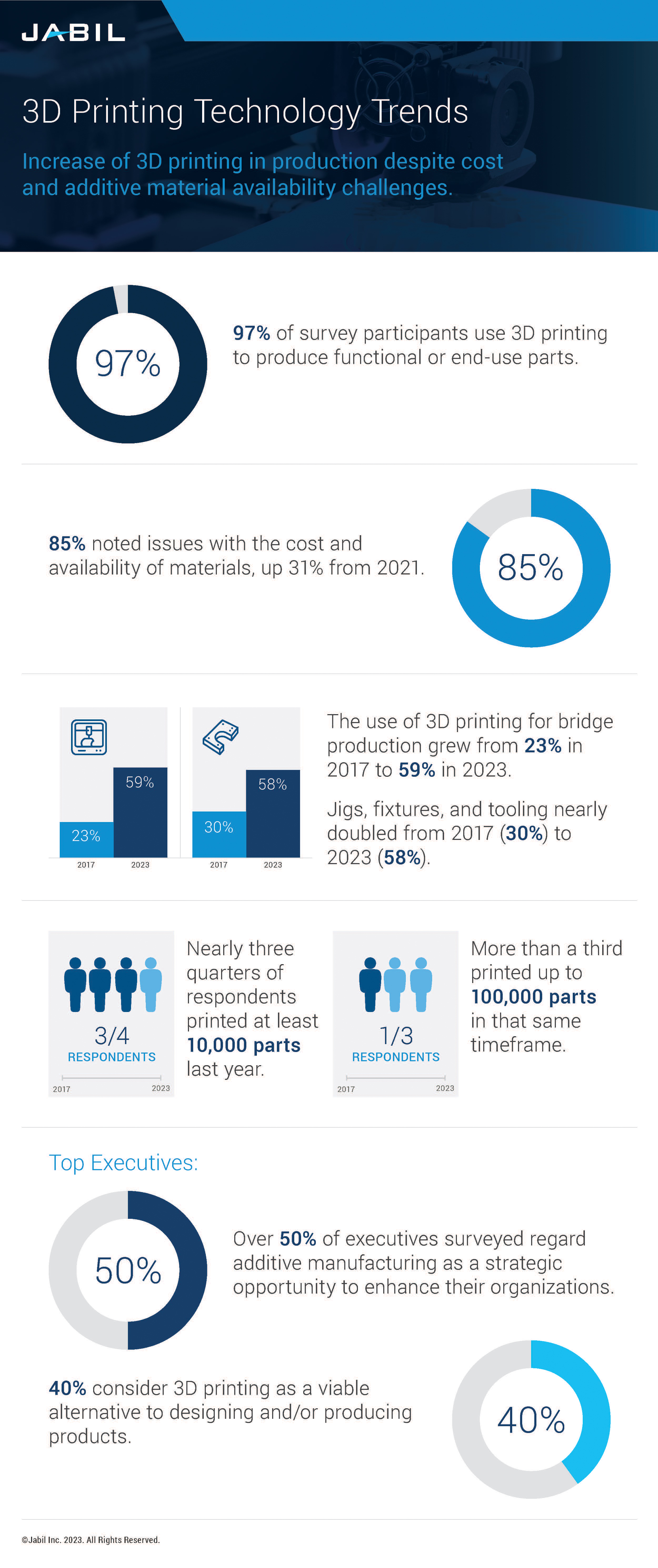
- 97% of survey participants use 3D printing to produce functional or end-use parts
- Nearly three quarters of respondents printed at least 10,000 parts while more than a third printed up to 100,000 parts last year
- 85% of those polled grapple with the cost and availability of additive manufacturing materials that fit application requirements
ST. PETERSBURG, Fla.--(BUSINESS WIRE)--Jabil Inc. (NYSE: JBL) today announced the findings of its latest global survey of additive manufacturing decision makers, which reinforces the steady ascent of 3D printing technologies and additive materials into production environments. Since 2017, Jabil has conducted this biennial survey to trace the trajectory of additive manufacturing while identifying the most promising opportunities and lingering challenges facing decision makers. The latest survey results reveal continued adoption of 3D printing in production environments despite ongoing roadblocks with the cost and availability of additive materials.
“The results of our latest manufacturing survey confirm our experiences in helping customers leverage the speed and agility of 3D printing to transform different manufacturing steps — from prototyping to production,” said Luke Rodgers, Jabil’s senior director of R&D for additive manufacturing. “In particular, this survey underscores how increased adoption of additive manufacturing is driving demand for differentiated additive materials with improved physical properties to deliver greater functionality, increased sustainability, and economies of scale.”
Jabil commissioned SIS International Research to conduct the 3D Printing Technology Trends Survey with participation from 200 additive manufacturing stakeholders worldwide. Questions were designed to offer a better understanding of decisions concerning 3D printing and additive manufacturing materials based on current opportunities, challenges, and industry developments. More than half of the top executives surveyed regard additive manufacturing as a strategic opportunity to enhance their organizations, while 40% consider 3D printing as a viable alternative to designing and/or producing products.
A vast majority of the participants (97%) currently are using 3D printing to produce functional or end-use parts. Nearly three-quarters of participants produced at least 10,000 3D-printed parts over the past year, and more than a third printed up to 100,000 parts. Overall, participants anticipate an uptick in the use of 3D printing for production parts or goods in the next three-to-five years, despite being less bullish about overall 3D printing industry growth than previous participants of additive manufacturing surveys.
Other key findings include:
- The top three use cases for 3D printing are prototyping (97%), research and development (75%), and production parts (59%).
- 3D printing use for bridge production (moving from prototyping to initial production) grew from 23% in 2017 to 59% in 2023, while 3D-printing jigs, fixtures, and tooling nearly doubled from 2017 (30%) to 2023 (58%).
- Prototyping is widely recognized for delivering the most significant impact to product lifecycles by 95% of the participants, followed by product designs (52%) and small-scale production (27%).
- Additive manufacturing benefits have remained consistent since 2019, with the ability to deliver parts faster, decrease production costs, respond to issues on production lines, as well as enable production of personalized and customized goods.
Addressing Lingering Challenges in Additive Materials
Over the years, Jabil’s survey participants increasingly embraced the myriad advantages of additive manufacturing, yet issues concerning the cost and availability of materials have remained consistent. In fact, materials were identified as the primary financial or cost burden to adopting 3D printing by 79% of participants, up from 18% just two years prior. Moreover, nine in 10 of those surveyed assert that the biggest challenge is the unavailability of desired materials.
Two-thirds of this year’s participants say they utilize custom-engineered materials as part of their overall additive manufacturing strategies. This finding may be in response to ongoing materials shortages, along with increased demands to produce parts with superior performance characteristics. Increased use of engineered materials with value-added attributes also reflects continued innovations in additive materials to improve the physical properties of end-use parts for greater utilization at lower costs, as well as faster delivery and less waste.
Overall, the use of plastics/polymers has been consistently pervasive among survey respondents since 2019. The use of metals, however, has greatly increased, from 39% in 2019 to 92% in this year’s survey. More than 96% expressed a preference for using metal materials under the right conditions, up from 63% in the 2019 survey.
Jabil Extends Additive Manufacturing from Ideation to Industrialization
Jabil continues to expand its global additive manufacturing solutions, encompassing continuous advancements in additive materials and leading-edge platforms to complement its global manufacturing capabilities. Among its additive materials innovations are Jabil PLA 3110P, a sustainable PLA powder based on NatureWorks’ Ingeo biopolymer; and Jabil PK 5000, an engineered material that delivers improved chemical resistance and resilience in comparison to general-purpose nylon materials.
About Jabil:
Jabil (NYSE: JBL) is a manufacturing solutions provider with over 250,000 employees across 100 locations in 30 countries. The world's leading brands rely on Jabil's unmatched breadth and depth of end-market experience, technical and design capabilities, manufacturing know-how, supply chain insights, and global product management expertise. Driven by a common purpose, Jabil and its people are committed to making a positive impact on their local community and the environment. Visit www.jabil.com to learn more.
Contacts
Michael Kovacs
Senior Director, Marketing, Jabil
1.408.427.1191
michael_kovacs@jabil.com