bit.bio Launches New Custom Disease Model Cells Offering, Advancing Disease Research and Drug Discovery
bit.bio Launches New Custom Disease Model Cells Offering, Advancing Disease Research and Drug Discovery
- Researchers can now order their mutation of choice in bit.bio’s opti-oxTM powered human-iPSC derived cells, receiving consistent, defined, cryopreserved products that can be immediately incorporated into drug discovery workflows.
- The disease model cells will support scientists in the generation of data in a human context with improved translatability in early stage drug discovery.
- Aligns with the FDA Modernisation Act 2.0 that allows cell based assays as an alternative to animal testing for the purposes of drug and biological product applications.
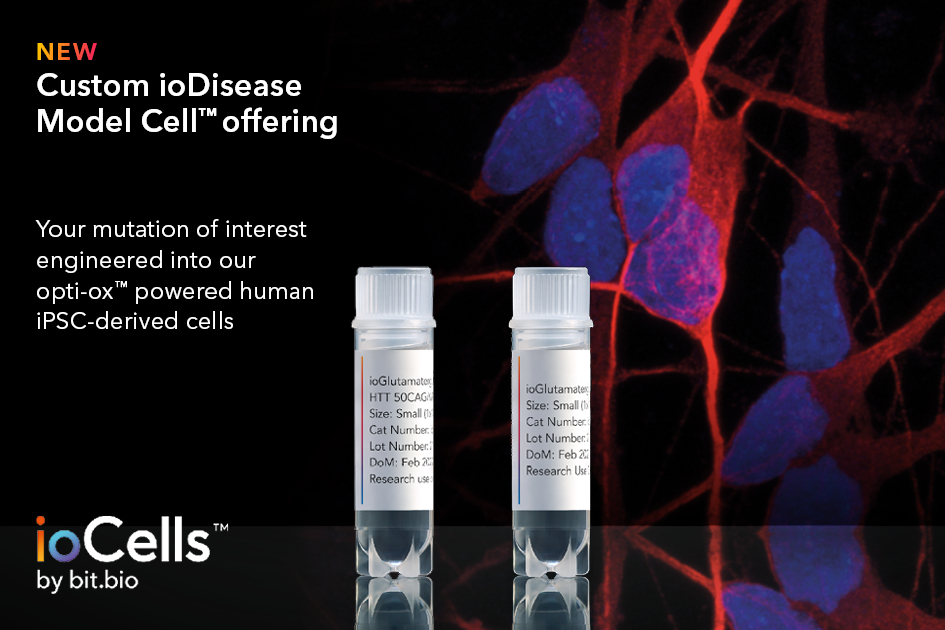
SAN FRANCISCO & CAMBRIDGE, England--(BUSINESS WIRE)--bit.bio, the cell coding company today launches its new Custom ioDisease Model Cells offering. This offering allows scientists to commission their disease-relevant mutation of interest in bit.bio's human induced pluripotent stem cell (iPSC)-derived cells powered by opti-ox technology.
The disease-relevant mutation is engineered into bit.bio’s human ioWild Type cells using CRISPR/Cas9 gene editing. As disease model cells come from an identical human genetic background to ioWild Type cells, any experimental differences observed between the wild type and the disease model can be confidently attributed to the effects caused by the disease-specific mutations.
bit.bio’s cells are precision reprogrammed by opti-ox, which enables the manufacturing of any human cell type at scale with precision and consistency. These key features make the models ideally suited to screening applications for early drug discovery as well as for fundamental research. Scientists receive defined, consistent, ready-to-use cells, empowering them to investigate the impact of their mutation in a human context.
Due to a lack of standardised, easy to use and readily accessible human cell models, scientists have relied on animal models and cell lines that differ considerably from human biology. iPSC-derived cells from patients offer a human model for disease research, but sourcing them with the disease-specific mutation of interest can be a complex and time-consuming process. These cells also often lack standardisation and optimised, fast protocols, making it difficult to generate consistent data and scalable disease models.
This offering provides scientists with a powerful tool to overcome these limitations.
Dr Mark Kotter, CEO of bit.bio, expressed his excitement about the new offering:
"With this new offering, we can cater to the vast diversity of scientific research into human diseases, providing scientists with the models they need to study their specific interests. Our custom disease cell model offering aligns with bit.bio's mission to democratise access to human cells for research and drug discovery.”
bit.bio has partnered with leading contract research organisation Charles River Laboratories to provide disease models in their early drug discovery programmes. Models were developed for Duchenne muscular dystrophy, Huntington’s, amyotrophic lateral sclerosis and frontotemporal dementia, which have now been successfully integrated into their phenotypic screening workflows. The cells are now available off the shelf as part of bit.bio’s ioDisease Model Cells portfolio.
Dr Paul Morrill, Chief Business Officer, bit.bio said:
“Human cells are key to disease research, drug discovery, and clinical translation. However, traditional methods of producing human cells have long, laborious, protocols that often result in heterogenous cell populations that can lead to significant data variability. With this customised offering, we can provide robust, standardised tools for research and drug discovery. This gives researchers a unique method to gain valuable insights into disease mechanisms and assess the efficacy of potential drugs for treatment. We are already seeing demand for our Custom ioDisease Model Cells from industry and it will be particularly exciting to understand how they will use their models to gain new insights and treatments for conditions where patients are waiting for life changing breakthroughs.”
Scientists can now request their mutations in bit.bio’s ioGlutamatergic Neurons, ioGABAergic Neurons, ioMicroglia and ioSkeletal Myocytes by contacting info@bit.bio.
Notes to editors
About Custom Disease Models
Researchers can order their mutation of choice in bit.bio’s opti-oxTM powered human-iPSC derived cells, receiving consistent, defined, cryopreserved products that can be immediately incorporated into drug discovery workflows.
This removes the need for gene editing expertise in the customer’s lab and enables scientists to design experiments in a model that is tailored to their needs. Custom ioDisease Models Cells are provided ready to use along with a straightforward protocol that uses open source media.
About bit.bio
bit.bio is a synthetic biology company providing human cells for research, drug discovery and cell therapy, enabling a new generation of medicines. This is possible with our precision cellular reprogramming technology, opti-ox - a breakthrough gene engineering approach that enables unlimited batches of any human cell to be manufactured consistently at scale through direct reprogramming of stem cells. The company was founded in 2016 by Dr Mark Kotter from his labs at the University of Cambridge after his discovery of the opti-ox technology. It has raised over $150m in funding so far, has over 180 employees and is headquartered in Cambridge, UK and San Francisco, US.
www.bit.bio
Contacts
April Six on behalf of bit.bio
bitbio@aprilsix.com
+44 7875 468942