NTHU Researchers Develop Technology for Photographing Electrons
NTHU Researchers Develop Technology for Photographing Electrons
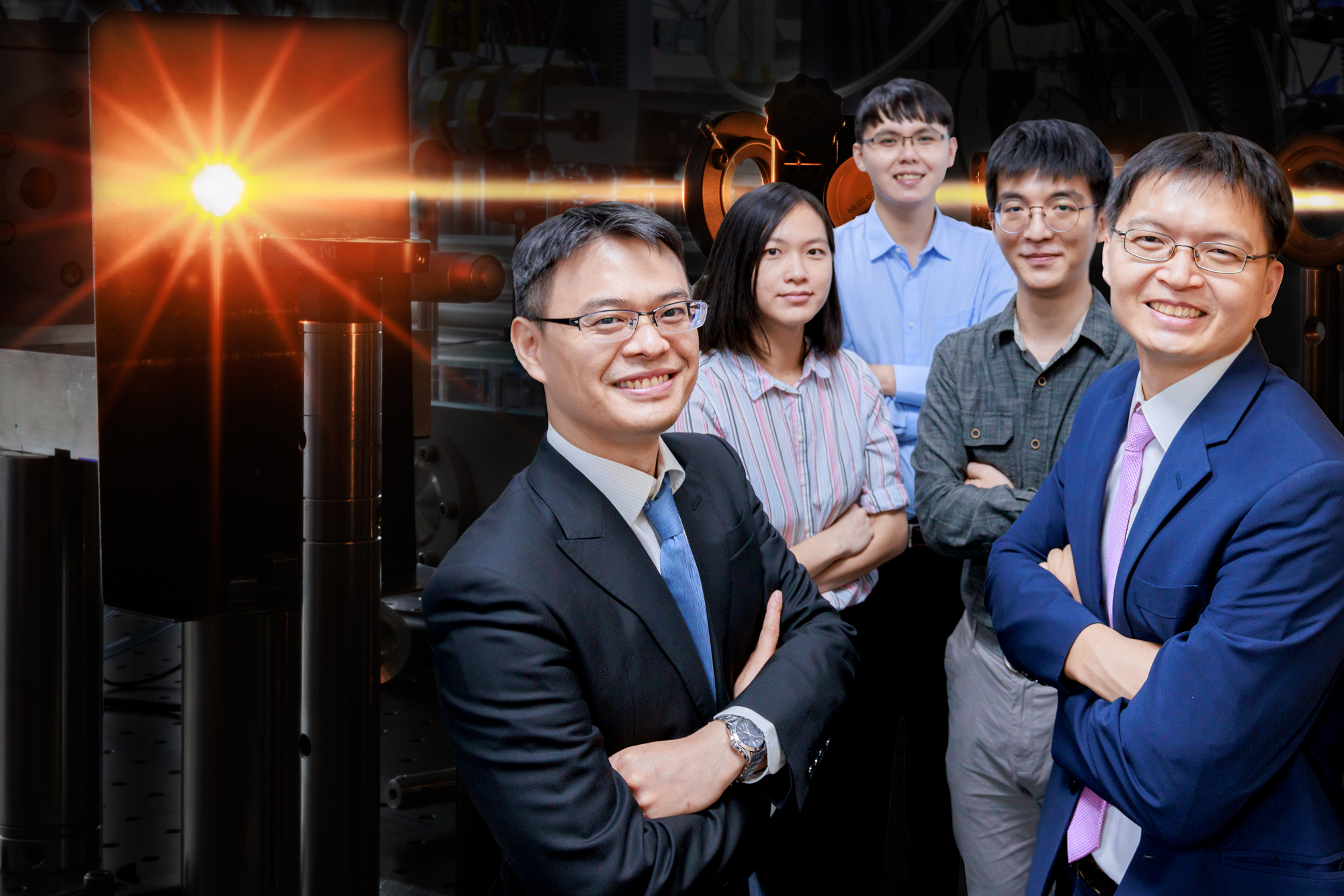
HSINCHU, Taiwan--(BUSINESS WIRE)--A research team at National Tsing Hua University (NTHU) in Taiwan has captured an instant moment in the nanoworld by producing attosecond extreme ultraviolet pulses. This light source can work as a nano camera to capture images of 5-nanometer-scale objects that move at an extremely high speed, such as an electron. This technology is expected to advance the design of next-generation transistors and memory chips with significantly increased speed for computers and communications.
Led by Associate Professor Ming-Chang Chen of the Department of Electrical Engineering and Associate Professor Ming-Wei Lin of the Institute of Nuclear Engineering and Science, the team, for the first time in the world, developed a high-efficiency pulse compression technology for compressing a ytterbium-doped laser to 3,000 attoseconds. When this light source was further focused into an inert gas, it produced extreme ultraviolet pulses with a duration of only 290 attoseconds. Patents for this innovative technology have been applied for in the United States, Europe, and Taiwan, and the team's research has been published by the top journal Science Advances.
Electrons are very small and move fast, so photographing them is a grand challenge. Chen explained that it is similar to using a fast shutter speed for photographing a hummingbird in flight and clearly resolving the vibrating wings. Therefore, because electrons move so rapidly, photographing them requires a camera with a high time resolution for capturing extremely fast motion and a high spatial resolution for capturing these small objects.
Chen also pointed out the importance of developing light sources of short wavelengths to improve the spatial resolution in a measurement. For visible light, the 400-nanometer wave simply provides a spatial resolution of ≈ 400 nanometers. In contrast, a much better spatial resolution down to 10 nanometers can be obtained by using the 10-nanometer extreme ultraviolet light generated in this work. Meanwhile, with a duration of 290 attoseconds, our pulses enable an ultrafast shutter speed for conducting measurements.
With the goal of greatly reducing the pulse duration, the team focuses on developing a “spectrum broadening and pulse compression” technology by first stimulating more light waves of different frequencies in the space and then aligning the peaks of these new waves to superimpose them. Repeating this process of spectral broadening and compression can subsequently shorten the duration of the pulse and increase the pulse peak. Through this technology, the pulse duration can be compressed from 160,000 attoseconds to 290 attoseconds with a remarkable compression ratio of 550.
Chen said that the fastest speed of a conventional camera is about one-thousandth of a second, but the shutter time for an attosecond-level camera is ten trillion times faster, making it possible to photograph fast-moving electrons. The future applications of this technology include the nano-scale components of precision semiconductors and sensors, which require attosecond light sources to analyze the dynamics of nanodevices.
Contacts
Holly Hsueh NTHU
(886)3-5162006
hoyu@mx.nthu.edu.tw