The Quest for an Ideal Quantum Bit
The Quest for an Ideal Quantum Bit
LEMONT, Ill.--(BUSINESS WIRE)--Qubits — quantum bits — are the fundamental components of quantum computing and other quantum information systems. Scientists around the world are racing to design a qubit that maintains information in the quantum state for a second or seconds, performs operations in nanoseconds, and can link with many other qubits.
Scientists at the U.S. Department of Energy's Argonne National Laboratory and several collaborating institutions have created a new qubit platform that potentially ticks all three boxes.
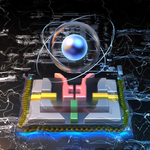
The system design sounds almost too good to be true in its simplicity. As announced in a recent Nature paper, the scientists froze neon gas on a microchip and sprayed electrons from a tiny light bulb filament onto it. They then trapped an electron on the frozen neon, an inert element that serves as the cleanest possible solid in a vacuum to host and protect qubits from disturbance.
Although at present the well-known qubits are not ideal, companies like IBM, Intel, Google, Honeywell and many startups have picked their favorite and are vigorously pursuing development. “Our ambitious goal is not to compete with those companies, but to discover and construct a fundamentally new qubit system that could lead to an ideal platform,” said Dafei Jin, Argonne scientist and principal investigator of the project.
A key component in the team's qubit platform is a chip-scale microwave resonator made out of a superconductor. (The much larger home microwave oven is also a microwave resonator.) Superconductors — metals with no electrical resistance — allow electrons and photons to interact together at near to absolute zero temperature with minimal loss of energy or information.
With this platform, the team achieved, for the first time ever, strong coupling between a single electron in a near vacuum and a single microwave photon in the resonator. This opens up the possibility to use microwave photons to control each electron qubit and link many of them in a quantum processor.
"Our qubits are actually as good as ones that people have been developing for 20 years," said David Schuster, physics professor at the University of Chicago and a senior co-author of the paper. "This is only our first series of experiments. Our qubit platform is nowhere near optimized.” It would appear an ideal qubit is on the horizon.
Contacts
Christopher J. Kramer
Head of Media Relations
Argonne National Laboratory
media@anl.gov
Office: 630.252.5580