Corporate Action on Toxic Chemicals in Clothing: Target Leads, Amazon Lags According to New Company Scorecard
Corporate Action on Toxic Chemicals in Clothing: Target Leads, Amazon Lags According to New Company Scorecard
“Toxic Textiles” Report Also Finds Apparel Brands Outpacing Retailers on Chemical Management Policies, Protecting Worker Health, and Sustainability
WASHINGTON--(BUSINESS WIRE)--A new report found that top U.S. clothing retailers and brands need to do better on toxic chemical management policies. The “Toxic Textiles” report by Green America provides a company-by-company breakdown of 15 major corporations and shows significant room for improvement across the sector on hazardous chemicals use, workplace conditions, and transparency.
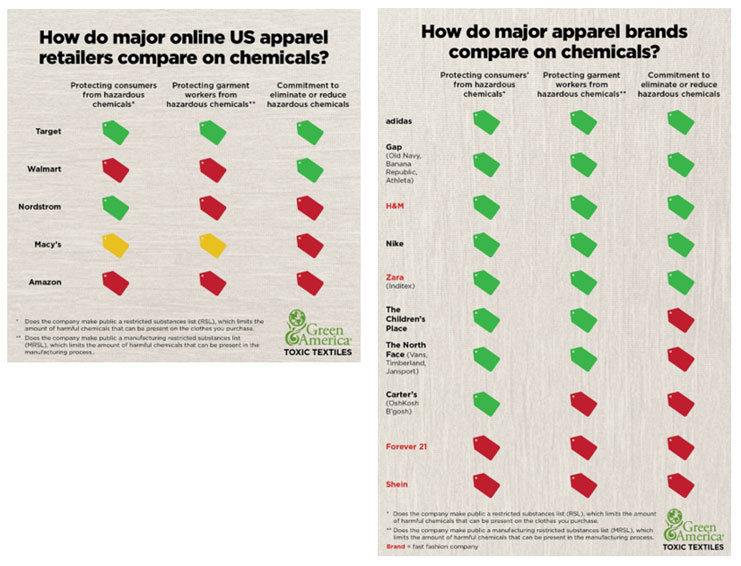
While individual clothing brands outperformed larger retailers overall, the report details how both areas of the industry can do better to protect consumers and workers from toxic chemicals used in textile manufacturing and found in clothing itself. Retailer and brand scorecards illustrated the top-level findings of the report.
Charlotte Tate, Labor Justice Campaigns director at Green America, said: “Looking at the success of some companies on the scorecard, there is simply no reason for a company to not, at a minimum, have a restricted substances list and a manufacturing restricted substances list. In just a few years, we’ve seen some companies take major steps in the right direction, and now, we must see retailers -- some of which, notably Amazon, have had hugely profitable years -- step it up on chemical management in apparel.”
Other key findings of the report include:
- Target is the clear retail leader. Target has both an online platform and stores, and sells many apparel items under its own brands, which demonstrates it is feasible for every retailer included in the scorecard to improve its chemical management policies. Target has a publicly available restricted substances list (RSL) and a publicly available manufacturing restricted substances list (MRSL). It also has clearly stated goals of eliminating hazardous classes of chemicals.
- Amazon must do better. Amazon is a retailer and also an apparel brand with numerous private labels. Amazon has no public information about its chemical management for apparel, despite being the largest US retailer of apparel, and it has disclosed no RSL or MRSL. The report calls on Amazon to address the impacts of own-branded products and to encourage sellers on its platform to step up on chemical management.
- Nike, Gap, Adidas and H&M beat out other clothing brands. Each of these brands have a public RSL and MRSL and have committed to eliminate or reduce the use of hazardous chemicals.
- Beware token plans and greenwashing. Companies often incorporate one policy on a single issue in the supply chain, and then use it to claim overall sustainability. And many companies claim to have policies addressing environmental or labor issues but have not followed through with specific goals, metrics, or timelines.
- The industry is far from sustainable. This scorecard examined chemical management policies that were publicly available. But there are many factors that contribute to whether a company is sustainable or not. For example, some leading fast fashion brands (H&M and Zara) performed well on the scorecard. However, due to the business model of fast fashion brands (creating short-lived clothing, for example), it is NOT possible for these companies to be sustainable.
Following the previous edition of the Toxic Textiles report and a campaign by Green America that generated over 30,000 comments, Carter’s, the largest U.S. retailer of baby clothes, took important first steps towards limiting toxic chemicals in its supply by instituting an RSL to help protect consumer health. Carter’s is now working to expand its offering of clothing with the OEKO-TEX Certification, which addresses some of the hazardous chemicals used in apparel.
Todd Larsen, executive co-director of Consumer and Corporate Engagement at Green America, said: “Consumers demand that companies improve their toxic chemical and sustainability policies, and we’re starting to see retailers and brands respond. While it is important for consumers to make informed decisions in their shopping habits, it is even more crucial for companies to take responsibility for the huge role they play.”
ABOUT GREEN AMERICA
Green America is the nation’s leading green economy organization. Founded in 1982, Green America provides the economic strategies, organizing power and practical tools for businesses, investors, and consumers to solve today’s social and environmental problems. http://www.GreenAmerica.org
Contacts
MEDIA:
Max Karlin for Green America, (703) 276-3255, or mkarlin@hastingsgroup.com.