Global Cellular IoT Module Shipments Decline 28% Sequentially During Q1 2020
Global Cellular IoT Module Shipments Decline 28% Sequentially During Q1 2020
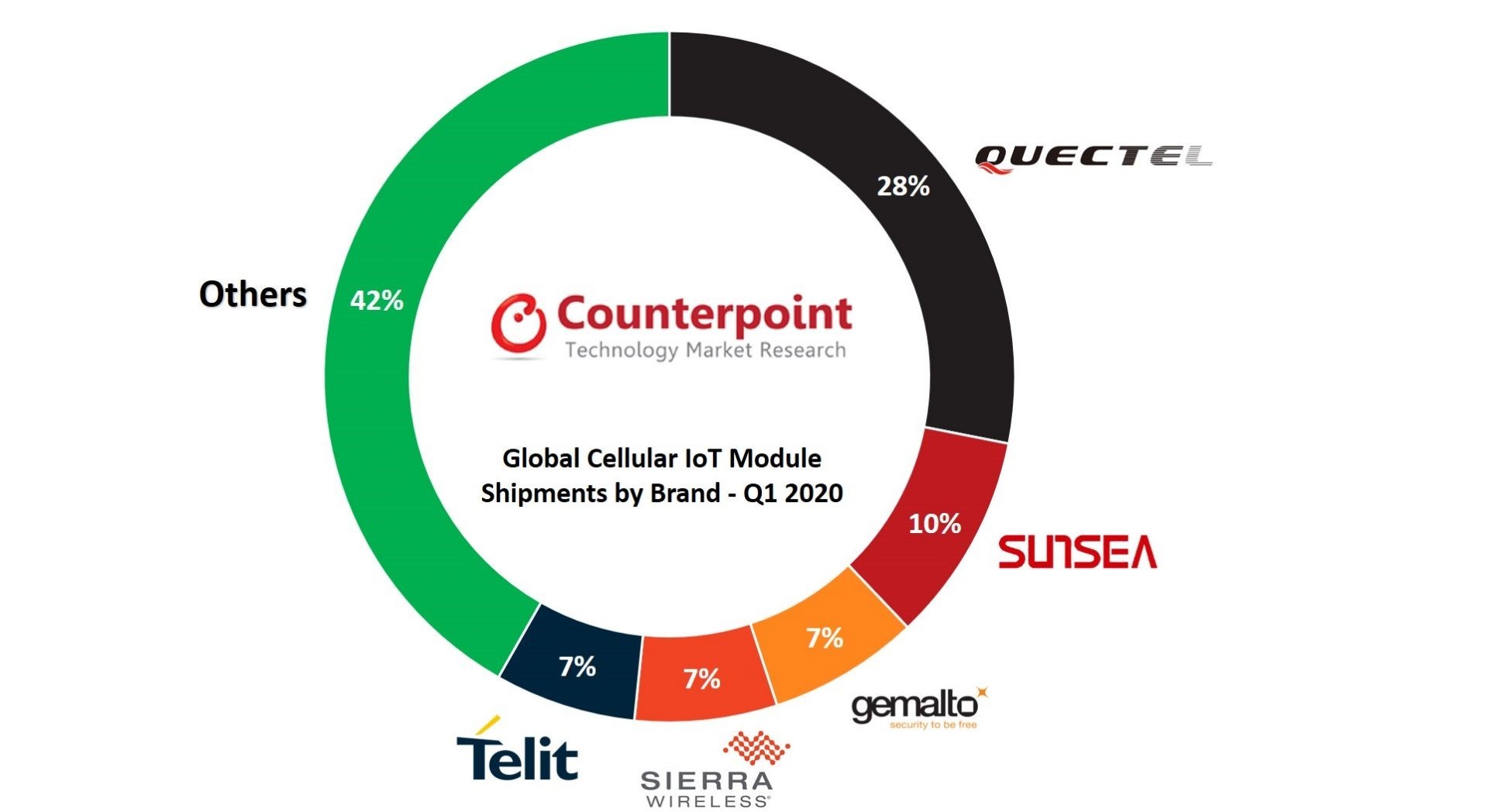
Quectel led the global cellular IoT module shipments with 28% market share during Q1 2020
SAN DIEGO & BUENOS AIRES & LONDON & NEW DELHI & HONG KONG & BEIJING & TAIPEI & SEOUL--(BUSINESS WIRE)--Global cellular IoT module shipments reduced by 4% YoY and 28% QoQ during Q1 2020 due to the negative impact of COVID-19 outbreak, according to the latest research from Counterpoint Global Cellular IoT Module and Chipset Tracker. However, IoT module shipments based on the Low Power Wireless Access (LPWA) technology increased by 51% during this quarter, offsetting the decline in automotive and other mobility applications. The falling prices, lower power consumption and extended coverage are the major reasons for growing popularity of LPWA modules among other cellular technologies.
Research Associate Soumen Mandal said: “Driven by a wider geographic reach, faster time-to-market, excellent IoT application support, aggressive marketing and a broader portfolio, with the MC, M and BC series modules performing well, Quectel managed to retain top spot in the global cellular IoT module market. However, SLM152, ME909 and SIM868 modules from Meig, Huawei and SIMCom, respectively, did well to help these brands compete with Quectel. Further, cost-effectiveness is helping other Chinese players like Fibocom, MobileTek, Lierda and Neoway to increase share in the global cellular IoT module market. International vendors such as Gemalto, Sierra, Telit and u-blox continued to maintain top rankings behind Sunsea IoT and Quectel with strongholds in North America, Europe and other developed markets.”
Research Associate Anish Khajuria said: “The average price of IoT modules decreased by 12% YoY in Q1 2020. The rising demand for low-cost LPWA modules such as NB-IoT, LTE-M and LTE Cat-1 has been driving the overall IoT module ASP down.”
Vice-President Research Neil Shah noted: “Qualcomm is leading the share of chipset shipments powering the IoT cellular modules. Diversifying product offerings, robust supply chain network, innovation and price competitiveness have helped Qualcomm maintain collaboration with major cellular IoT module players.”
The comprehensive and in-depth ‘Global Cellular IoT Module and Chipset Tracker 2018Q1-2020Q1′ report is a part of Counterpoint’s IoT (Internet of Things) Service. The report is available for download here for subscribing clients.
Contacts
Analyst:
Soumen Mandal
soumen@counterpointresearch.com
Neil Shah
neil@counterpointresearch.com
Aman Madhok
aman@counterpointresearch.com
Anish Khajuria
anish@counterpointresearch.com
Fahad Siddiqui
fahad@counterpointresearch.com
Counterpoint Research
press@counterpointresearch.com