Huawei Surpasses Samsung to Become Number One in Global Smartphone Shipments
Huawei Surpasses Samsung to Become Number One in Global Smartphone Shipments
Huawei’s 11% YoY growth in China helped it surpass Samsung in Q2 2020
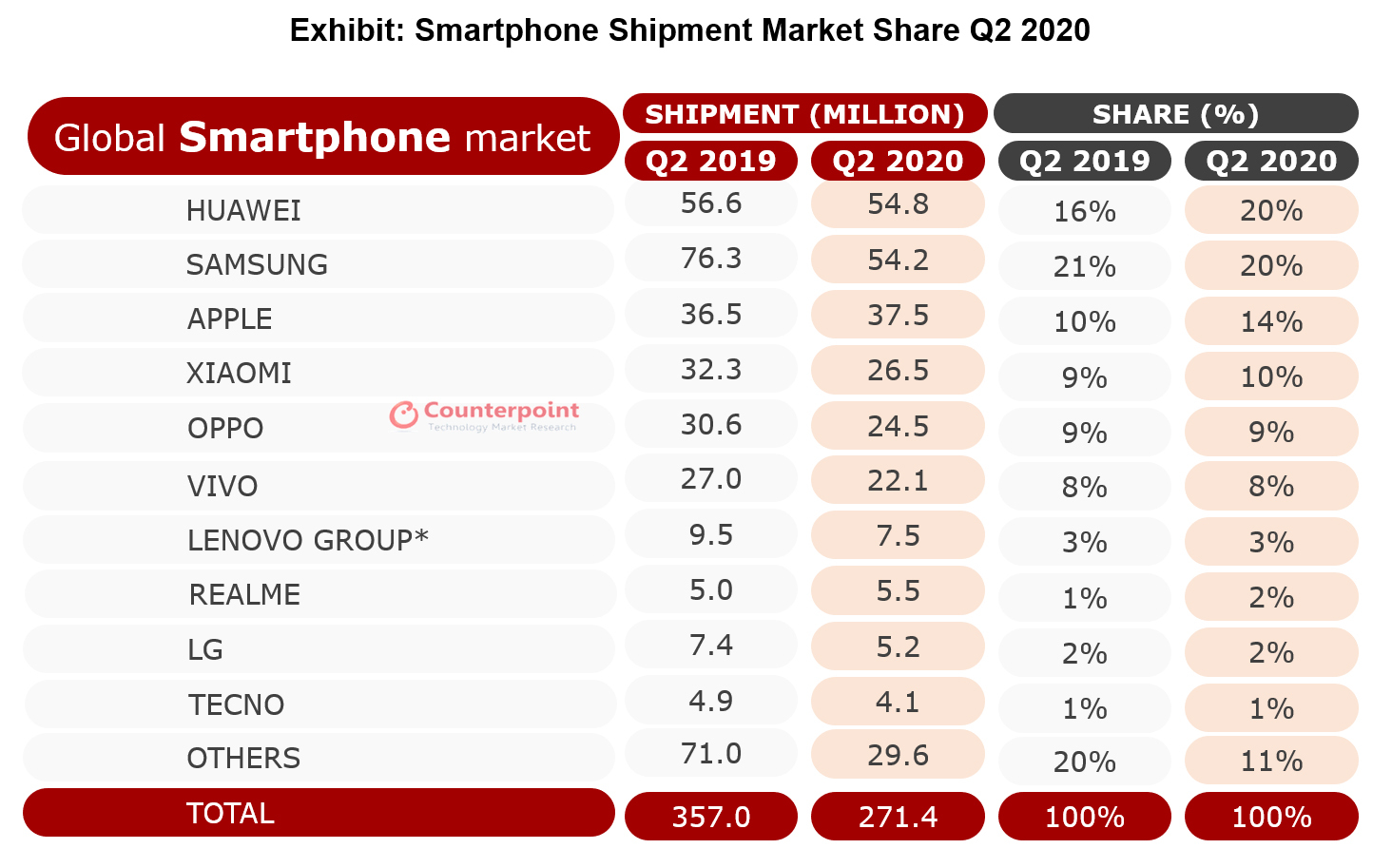
NEW DELHI & MUMBAI & HONG KONG & SEOUL & SAN DIEGO & LONDON & BUENOS AIRES--(BUSINESS WIRE)--Huawei has surpassed Samsung to become the top player in the global smartphone market in Q2 2020, according to the latest research from Counterpoint’s Market Monitor service. The global smartphone market declined at its fastest ever rate (-24% YoY) in Q2 2020 to 271.4 million units.
Counterpoint Research Associate Director Tarun Pathak said: “Huawei was able to attain this feat due to a unique market scenario created because of COVID-19. China, Huawei’s largest market, is now recovering from the pandemic compared to other markets like Europe, Latin America and North America. Smartphone shipments in China declined 17% YoY, a more modest decline than the rest of the world that fell 28% YoY. Huawei continued its push in China, benefiting from the recovery. It now holds almost half (47%) the market in China, and this alone contributes to 71% of Huawei’s shipments. However, in markets outside China, its shipments declined 29% YoY. Huawei did well in some Eastern Europe markets like Russia and Ukraine. But as markets outside China recover, it will be difficult for Huawei to maintain this lead.”
Commenting on the market dynamics, Counterpoint Research Analyst Varun Mishra said: “The impact of COVID-19 on the smartphone market was more evident in the second quarter compared to the first quarter. The world’s largest smartphone market, China, fared better. As a result, China accounted for almost a third (31%) of global smartphone shipments, the highest since Q2 2017. However, despite the daily COVID-19 cases in China falling to very low levels, the smartphone market is only running at around 85% of the pre-COVID-19 levels, indicating continuing consumer caution.”
Mishra added: “Shipments improved in each month through the quarter, with global smartphone shipments in June rebounding by 34% over May. Markets like India reached pre-COVID-19 levels in June due to pent-up demand. This is a positive sign as we head towards recovery.”
Detailed version of the press release can be found here.
Visit our Data Section (updated quarterly) to view the smartphone market share Globally and for the US, China and India.
Contacts
Tarun Pathak
tarun@counterpointresearch.com
Shobhit Srivastava
shobhit@counterpointresearch.com