Cushman & Wakefield Study Shows How Demographic Shifts Will Impact
the Global Workplace by 2030
Cushman & Wakefield Study Shows How Demographic Shifts Will Impact the Global Workplace by 2030
New Opportunities and Challenges Arise for Global Cities as 693 Million Boomers Reach Retirement Age and 1.3 Billion Gen Z Set to Enter Workforce
CHICAGO--(BUSINESS WIRE)--The retirement of Baby Boomers and the debut of Generation Z workers, along with other demographic shifts, has major implications for real estate occupiers, investors and policy-makers around the world according to a new global research report from Cushman & Wakefield (NYSE: CWK). All stakeholders need to understand the impacts of these trends and how to position themselves to maximize opportunities.
Entitled “Demographic Shifts: The World in 2030,” the report analyzes the seismic shifts in workforces worldwide as 693 million Baby Boomers reach retirement age and 1.3 billion members of Gen Z enter the labor force over the next 10 years.
The report looks at the different approaches to work and lifestyle taken by Baby Boomers, Millennials and Gen Z around the world, and the impact on workplace strategy, sectoral growth and the changing order of the world’s cities over the next decade as one generation exits the workforce and another enters.
“These demographic trends will drive the pace of growth in cities around the world,” said Dr. Dominic Brown, Head of Insight & Analysis, Asia Pacific at Cushman & Wakefield. “Cities will need to establish themselves as ‘places’ to attract the highest quality workers and in turn create the greatest real estate opportunities for occupiers and investors alike.”
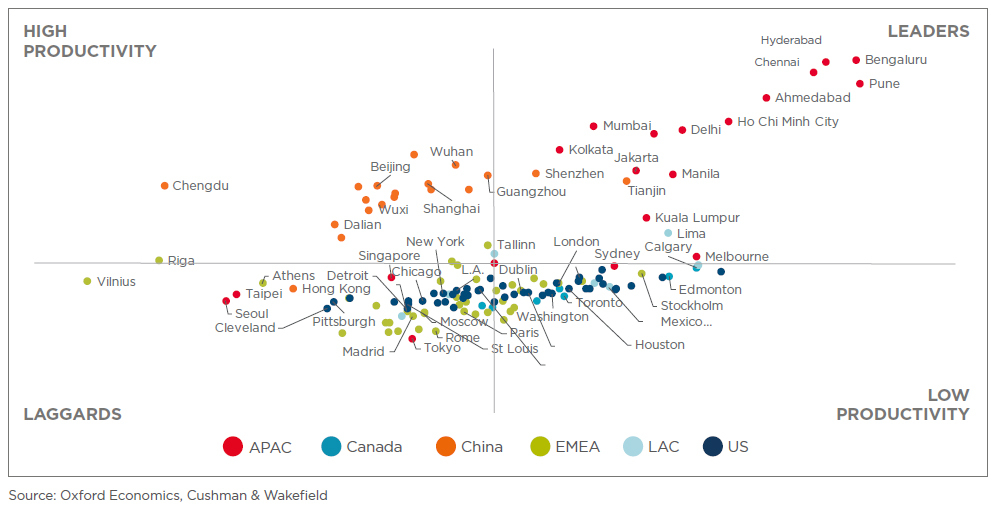
Cushman & Wakefield compared labor force growth and GDP growth of more than 137 cities worldwide. Cities with high growth in both categories have the best prospects for strong real estate demand, while slow growth in both categories indicates a lagging market. Cities with faster growth in GDP than in the working-age population are “high productivity” markets that may appeal to investors as they rise up the value proposition. Those with greater growth in labor than GDP are considered “low productivity” markets that need to harness that attraction of talent to boost output. (See table.)
The study concluded that the world’s top-performing cities are located in South East Asia and India, which bodes well for the economic growth and strength of real estate markets in these areas. High productivity cities are located mainly in China. Most cities in Europe and North America ranked as low productivity or lagging markets for economic and real estate growth and their trajectories need to be assessed accordingly. While individual countries and cities have their own demographic trajectories, the differences are more intergenerational than international.
“We were surprised that generational behaviors superseded cultural ones. Gen Y and Gen Z workers, to some extent, have similar workplace preferences no matter where in the world they live, but the two generations also differ in many ways,” said Kevin Thorpe, Chief Economist and Head of Global Research. “For example, workplace strategy will need to account for an ever-increasing array of requirements to meet the needs of tomorrow’s professionals. Understanding these generations’ values, how and where they want to work, and their interpersonal strengths and weaknesses will lay the foundations of securing the best talent available.”
About Cushman & Wakefield
Cushman & Wakefield (NYSE: CWK) is a leading global real estate services firm that delivers exceptional value for real estate occupiers and owners. Cushman & Wakefield is among the largest real estate services firms with approximately 51,000 employees in 400 offices and 70 countries. In 2018, the firm had revenue of $8.2 billion across core services of property, facilities and project management, leasing, capital markets, valuation and other services. To learn more, visit www.cushmanwakefield.com or follow @CushWake on Twitter.
Contacts
Grace Wilk
Global Corporate Communications
+1 312 470
1848
grace.wilk@cushwake.com