GA-ASI Concludes Successful Series of MQ-9 Demonstrations in Greece
GA-ASI Concludes Successful Series of MQ-9 Demonstrations in Greece
European Countries See Maritime Surveillance and Detect and Avoid Capabilities
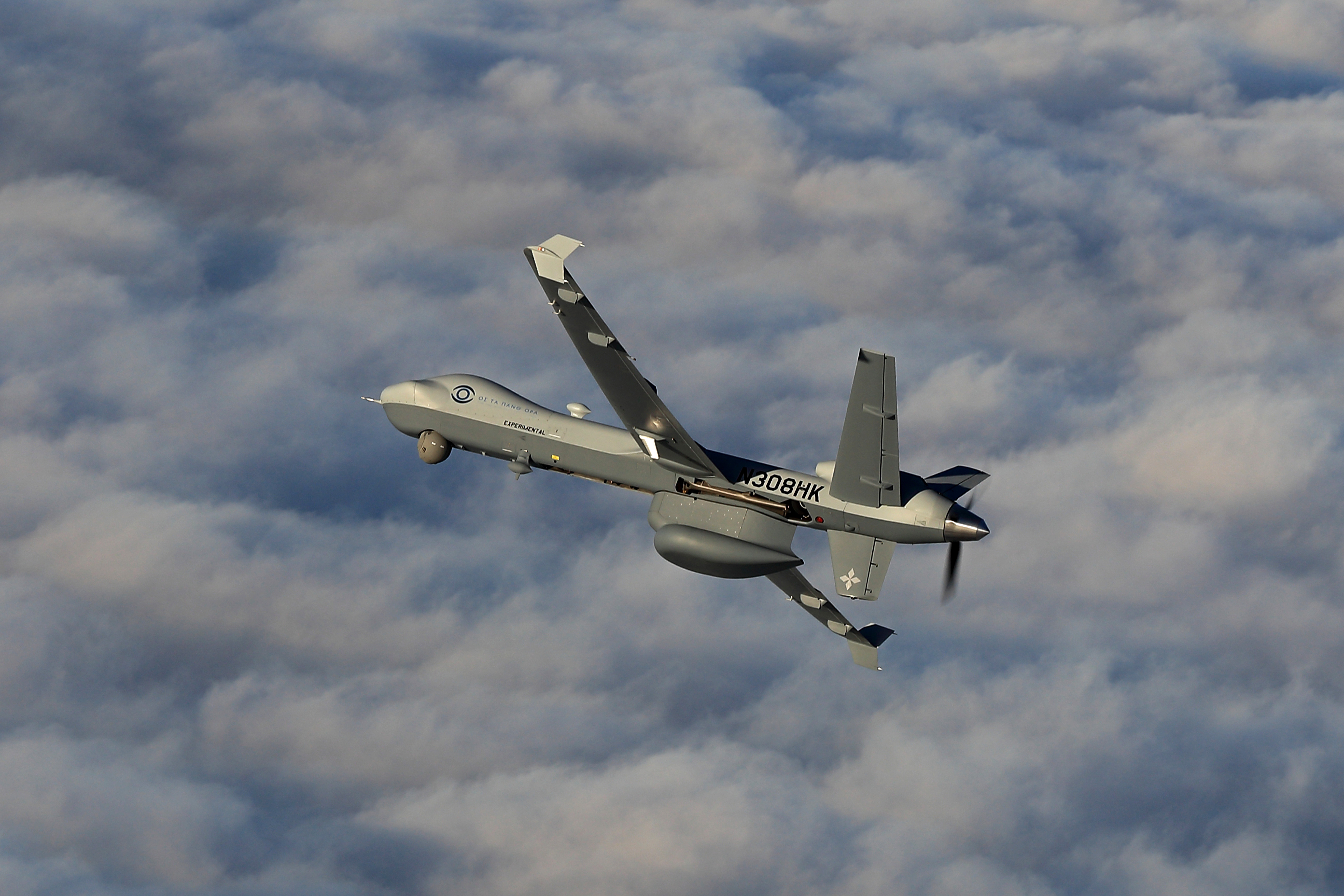
SAN DIEGO--(BUSINESS WIRE)--General Atomics Aeronautical Systems, Inc. (GA-ASI) concluded a series of flight demonstrations using its MQ-9 Guardian Remotely Piloted Aircraft System (RPAS) on December 19, 2019. The demonstrations showcased the maritime surveillance capabilities of the MQ-9, and the GA-ASI-developed Detect and Avoid (DAA) system for traffic-deconfliction in civil airspace. The flights were sponsored by the Hellenic Air Force (HAF) and the Hellenic Coast Guard (HCG) and staged out of Larissa Air Base in Greece. The flights were performed for an audience of European military and civilian representatives.
“We were honored to have the HAF’s and the HCG’s support for these flight demonstrations with our MQ-9,” said Linden Blue, CEO, GA-ASI. “The MQ-9 RPAS is already a strategic asset for NATO countries, providing mission persistence and interoperability between allies. We showcased MQ-9’s maritime surveillance and the civil airspace integration capabilities for our European customers.” The MQ-9 configuration demonstrated is operational in the U.S.
Currently GA-ASI aircraft systems support the Italian Air Force, the UK Royal Air Force, the French Air Force, and the Spanish Air Force. The Ministry of Defence for the Netherlands has selected MQ-9 for the Royal Netherlands Air Force, and the Government of Belgium has approved Belgian Defense to negotiate the acquisition of GA-ASI’s MQ-9B. In early December, the Australian Government announced selection of MQ-9B for the Australian Defence Force under Project Air 7003. GA-ASI RPAS are operated by the U.S. Air Force, U.S. Army, U.S. Marine Corps, U.S. Department of Homeland Security and NASA.
“The advanced capabilities of these aircraft are striking. Through the 10 days of demonstrations, the country of Greece has seen the value of MQ-9s for maritime patrol and EEZ monitoring, border surveillance, support for search and rescue efforts, and over-watch of forest fire response efforts,” said an HAF official.
The DAA system consists of an air-to-air radar integrated with Traffic Alert and Collision Avoidance System (TCAS II), and Automatic Dependent Surveillance-Broadcast (ADS-B). The DAA system enables safe flight of an MQ-9 in civil airspace, and can even detect air traffic that is not actively transmitting its position.
The MQ-9 also demonstrated a multi-mode, maritime surface-search radar, and High-Definition/Full-Motion Video Optical and Infrared sensor. This sensor suite enables real-time detection and identification of large and small surface vessels in all-weather at long ranges, 360 degrees around the aircraft. The featured Raytheon SeaVue surface-search radar provided continuous tracking of maritime targets and correlation of AIS transmitters with radar detections. The Inverse Synthetic Aperture Radar (ISAR) mode facilitates classification of vessels which are beyond optical sensor range.
For the demonstration, GA-ASI partnered with SES, a leading satellite communications (SATCOM) operator and managed services provider, with over 70 satellites in Geostationary Orbit (GEO) and Medium Earth Orbit (MEO). SES provided the GEO satellite connectivity that enabled the MQ-9 to operate securely with a high capacity datalink, enabling real-time transmission of sensor data from the aircraft, and extending its effective operational range far beyond that of “line-of-sight” datalinks.
“With our global satellite fleet, SES has been supporting the critical needs of GA-ASI and their government customers who have operated these aircraft for close to two decades,” said Nicole Robinson, Senior Vice President, Global Government at SES Networks. “We were proud to support this demonstration effort for the Hellenic Air Force as part of our long-standing relationship with General Atomics.”
Hi-resolution images from the demonstration are available to qualified media outlets from the GA-ASI and HAF media contact list. More information about the event is available at www.ga-asi.com/european-maritime-demo.
About GA-ASI
General Atomics Aeronautical Systems, Inc. (GA-ASI), an affiliate of General Atomics, is a leading designer and manufacturer of proven, reliable Remotely Piloted Aircraft (RPA) systems, radars, and electro-optic and related mission systems, including the Predator® RPA series and the Lynx® Multi-mode Radar. With more than six million flight hours, GA-ASI provides long-endurance, mission-capable aircraft with integrated sensor and data link systems required to deliver persistent flight that enables situational awareness and rapid strike. The company also produces a variety of ground control stations and sensor control/image analysis software, offers pilot training and support services, and develops meta-material antennas. For more information, visit www.ga-asi.com.
Predator and Lynx are registered trademarks of General Atomics Aeronautical Systems, Inc.
Contacts
Steven Henden
General Atomics Aeronautical Systems, Inc.
+1
(858) 524-8101
ASI-MediaRelations@ga-asi.com