5 Ways to Increase the Visibility of Your Earnings Release in Search and AI
Earnings releases are designed to communicate important financial information, but investors are not always finding that information by going directly to a company’s website.
Today, financial news can surface through search engines, financial news sites, social platforms, media coverage, and AI-powered search tools. Investors and other audiences may ask questions about a company’s latest results and encounter an earnings release as part of the answer.
That makes the content itself an important part of earnings visibility.
Distribution still matters. A well-written earnings release needs to reach the audiences who care about the company and its results. But visibility also starts with what happens on the page: how clearly the release identifies the company and reporting period, how financial results are presented, and how easily readers and digital systems can identify the information they need.
The good news is that the practices that help search engines and AI systems understand an earnings release also make it easier for investors and journalists to read.
Here are five ways to make your earnings release easier to find, understand, and reference.
1. Write Your Earnings Release with Search and Discovery in Mind
The first step is straightforward: make it clear what the release is about. An earnings release should identify the company, reporting period, financial results, and most important news as clearly as possible. Avoid making readers or search systems piece together the basic information from several paragraphs.
Start with a descriptive headline that tells readers what happened.
For example:
| Instead Of | Consider This |
| Company Announces Strong Results | ABC Corporation Reports Third-Quarter 2026 Revenue of $2.4 Billion, Raises Full-Year Guidance |
The second headline gives readers considerably more information. It identifies the company, reporting period, revenue result, and an important piece of guidance.
That same clarity can help when someone searches for the company's quarterly results or asks an AI-powered tool about its latest earnings.
Throughout the release, use relevant financial and industry terminology naturally. If the announcement is about quarterly revenue, adjusted EPS, operating margin, free cash flow, or full-year guidance, use those terms where they accurately describe the results.
Think about the questions your audience may have:
- What were the company's latest earnings?
- How did revenue compare with the prior year?
- What was earnings per share?
- Which business segments grew?
- Did the company change its guidance?
- What factors affected the results?
- What does management expect for the next quarter or full year?
The release should provide enough context to answer those questions without requiring readers to hunt through unrelated company information.
A clear opening can help establish that context quickly. Identify the company, reporting period, key financial results, and significant developments near the beginning of the release. Supporting details can follow.
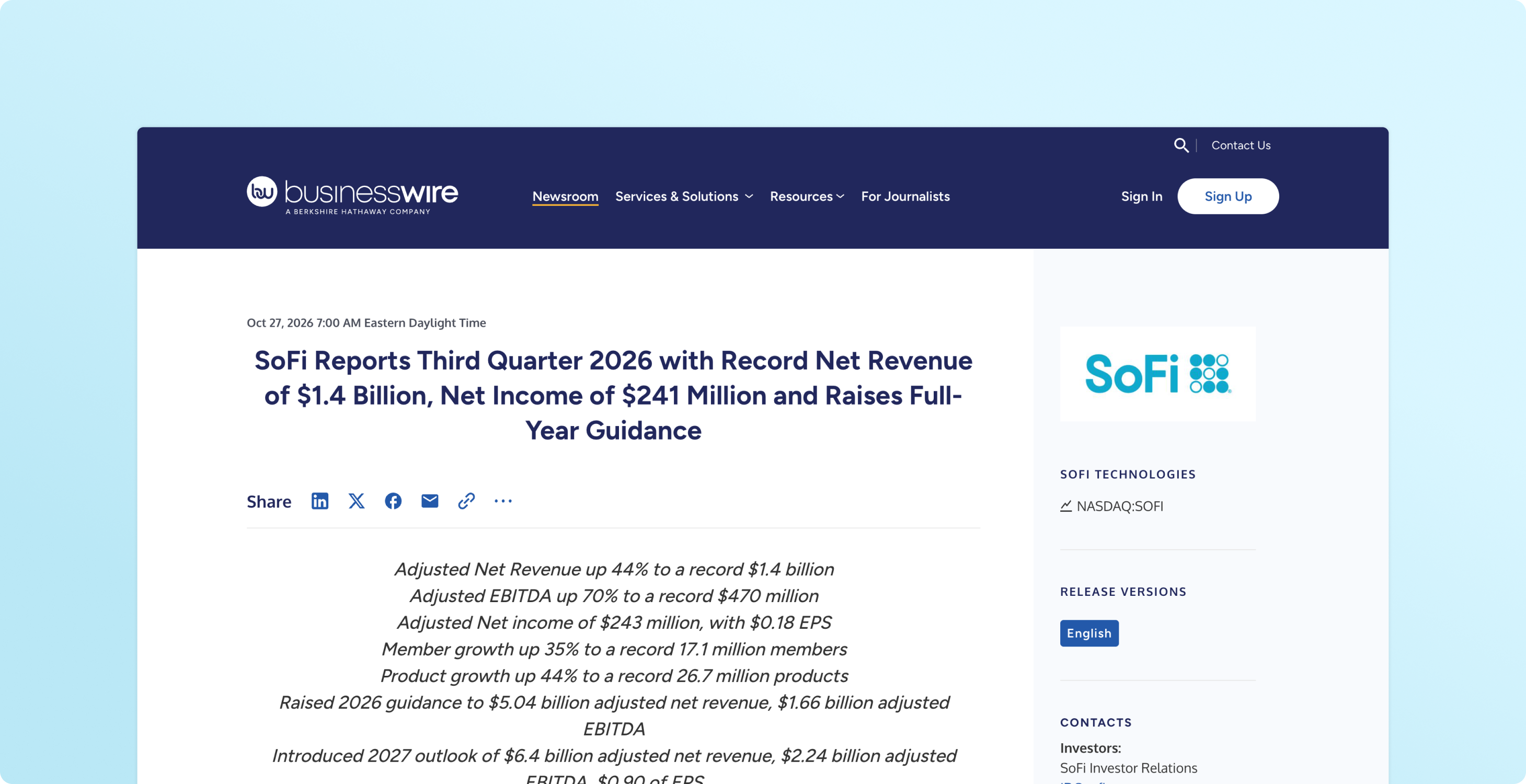
Look for a release with a particularly clear headline and opening. Consider highlighting how quickly a reader can identify the company, reporting period, primary financial results, and key business developments.
Think Like a Searcher
Search visibility does not require stuffing a release with keywords. In fact, awkward repetition can make financial communications harder to read. Instead, ask whether the terminology in the release matches the way your audiences would naturally describe the information.
If investors search for “Company X Q3 2026 earnings,” for example, the release should clearly identify the company, quarter, year, and earnings results. That is useful information for people and digital systems alike.
2. Make Financial Data Easy to Find with Structured Tables
Financial results contain a lot of numbers. Tables can make those numbers considerably easier to scan, compare, and understand.
Use tables to present information such as:
- Revenue
- Net income
- Earnings per share
- Operating income
- Margins
- Cash flow
- Year-over-year growth
- Segment results
- Quarterly comparisons
- Full-year guidance
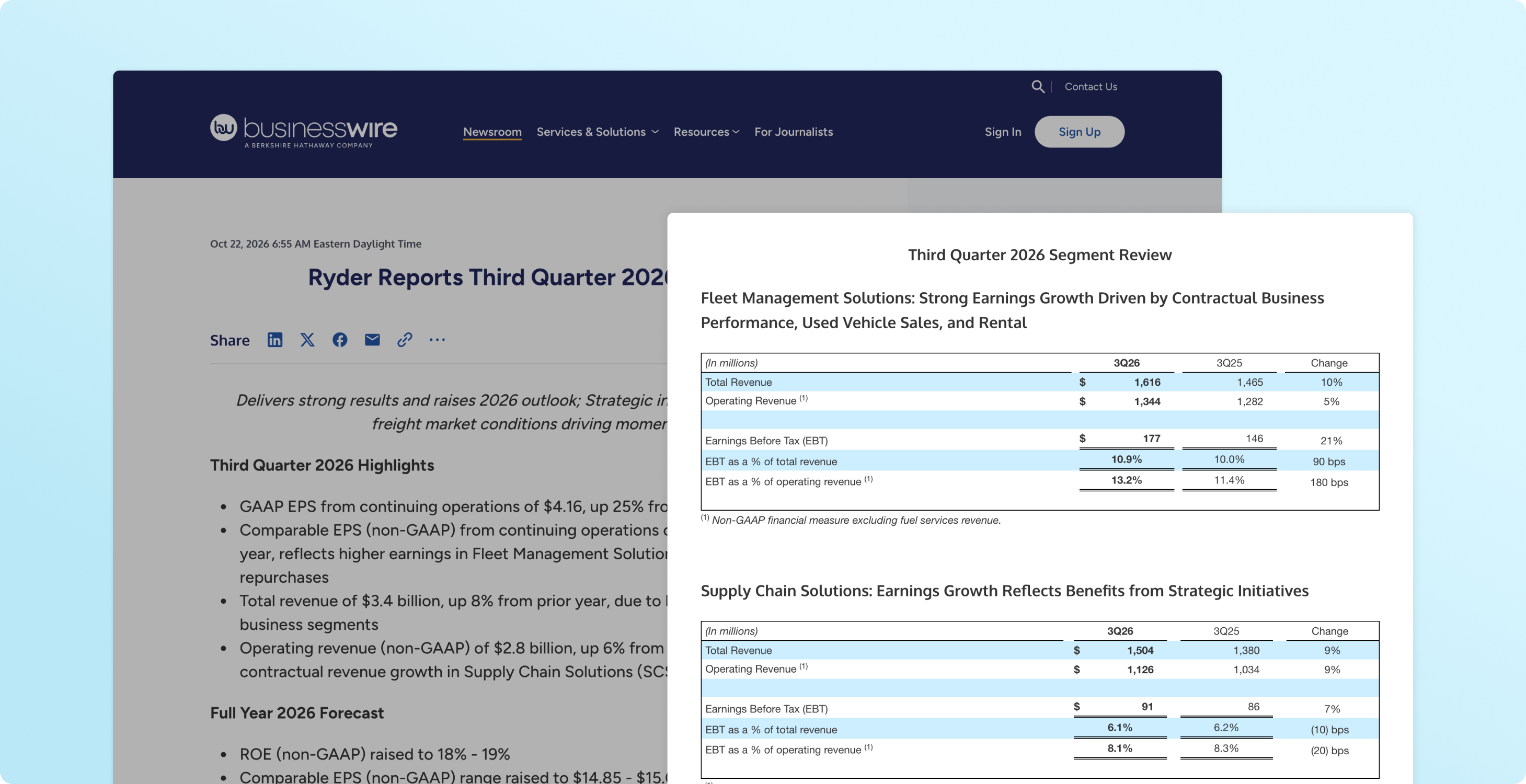
A well-formatted financial table creates a visual structure around the information. Readers can quickly identify the metric they are looking for and compare results across reporting periods.
For example, a table comparing current-quarter and prior-year revenue can communicate the change much more efficiently than several sentences describing the same numbers.
Make Financial Tables Clear and Consistent
A few formatting practices can make a significant difference:
- Use descriptive labels and clear headers. Readers should immediately understand what each column and row represents.
- Identify the reporting periods. Don't make readers guess whether a column represents the current quarter, prior-year quarter, or full year.
- Include units. Clearly identify whether amounts are presented in thousands, millions, billions, or percentages.
- Use consistent number formatting. Align decimal places, percentage formats, currency symbols, and other conventions throughout the release.
- Use shading strategically. Light shading can help separate sections or highlight important information without overwhelming the table.
- Avoid overly complex tables. If a table requires extensive explanation before someone can understand it, consider breaking it into smaller tables.
- Don't rely on color alone. Important distinctions should also be communicated through labels, headers, symbols, or text.
These practices benefit more than human readers. Clear labels, consistent terminology, and well-organized financial information can also give search engines and AI systems clearer signals about what the numbers represent.
For example, a number such as “12.4%” has little meaning by itself. A table that identifies it as Revenue Growth, Q3 2026 vs. Q3 2025 provides considerably more context.
That context helps readers understand the result and gives digital systems more information to work with.
3. Turn Complex Results into Infographics
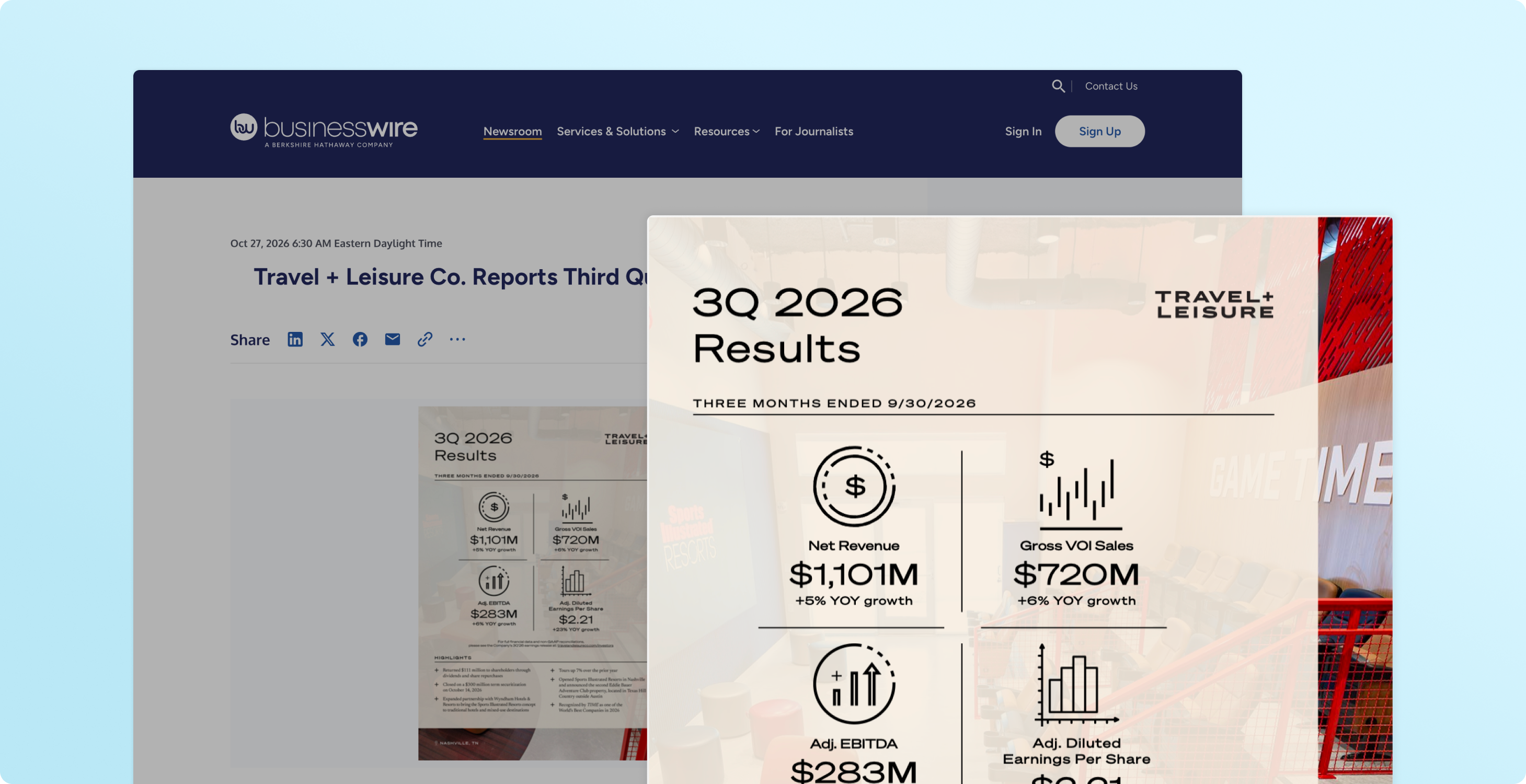
Not every financial result is easy to understand from a table alone. Infographics can provide another way to communicate important earnings information, particularly when the results involve trends, comparisons, multiple business segments, or other information that benefits from visual explanation.
Consider using an infographic to highlight:
- Revenue or earnings growth
- Year-over-year comparisons
- Key financial metrics
- Segment performance
- Business milestones
- Geographic growth
- Product or service performance
- Major changes during the reporting period
The key is to give the visual a clear purpose. An infographic might show that revenue increased 18% year over year, for example, but the surrounding text should explain what drove that growth. Was it increased demand? A new product? An acquisition? Growth in a particular geographic market?
Let the Infographic Complement the Financial Information
Infographics should add context, not replace the underlying financial information.
A strong earnings release can use both. Tables provide detailed financial data that readers can reference and compare, while infographics can draw attention to important trends and make complex information easier to absorb.
A few practices can help:
- Focus on one story. Give the infographic a clear takeaway rather than trying to visualize every result.
- Lead with the most important insight. Make the primary takeaway obvious at a glance.
- Use accurate, clearly labeled data. Every number should have enough context to be understood.
- Keep the design simple. Too many graphics, colors, labels, or data points can make the information harder to follow.
- Provide context. A percentage or growth figure is more useful when readers know what it measures and what period it covers.
- Put important information in the text, too. Don't make an important financial fact available only inside an image.
That last point is particularly important for search and AI visibility. An infographic can help a reader understand the story, but text provides additional context that can be indexed, interpreted, and referenced.
4. Structure Your Release So People and AI Can Understand It
Earnings releases should have a clear information hierarchy.
Think about how someone might read it. An investor may scan the headline, summary, financial highlights, and tables before deciding whether to read further. A journalist may look for the most important result and management commentary. Someone using an AI-powered search tool may be looking for a specific answer about revenue, earnings, guidance, or business performance.
Your release should make those answers easy to find.
Use:
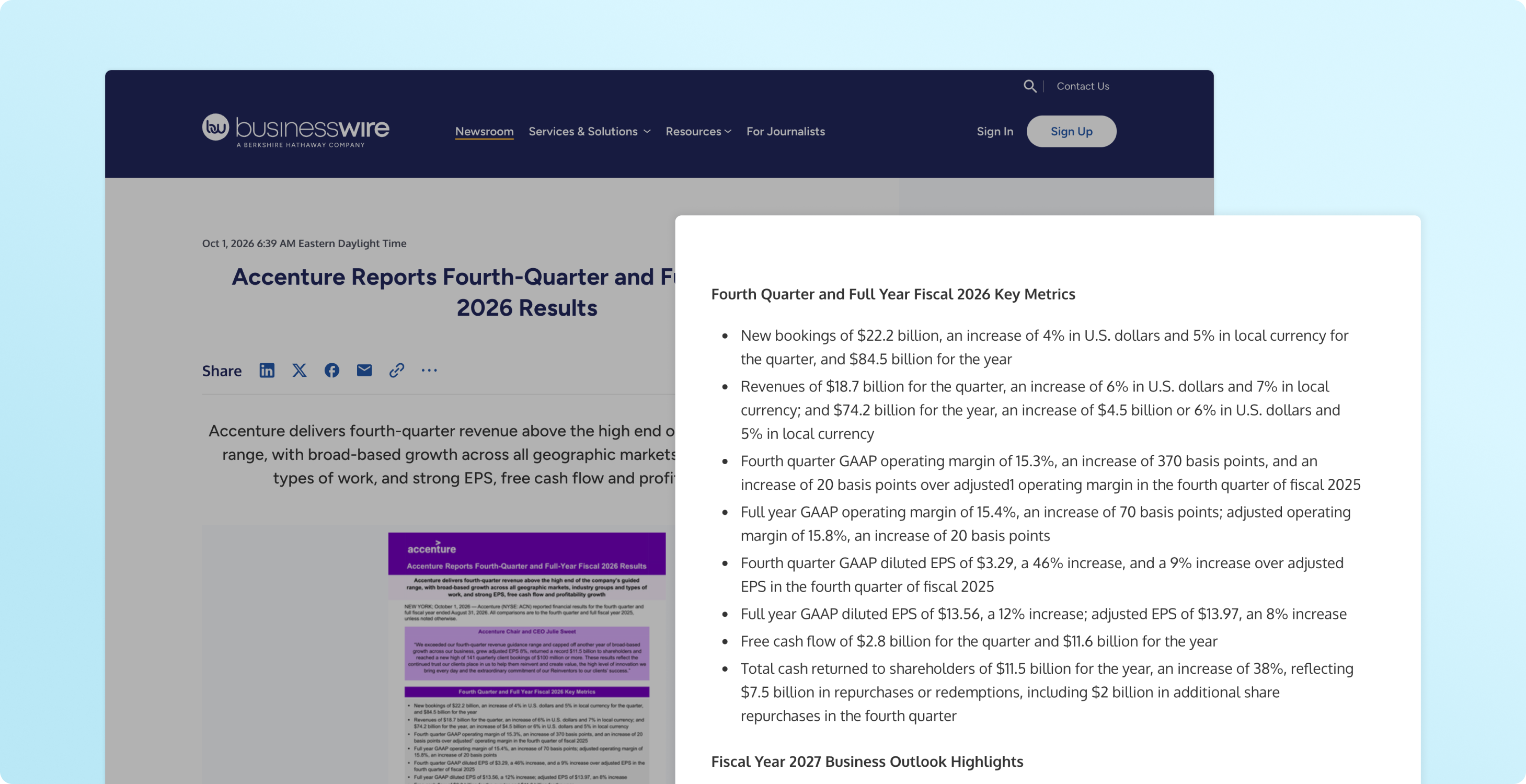
- Descriptive subheads
- Concise paragraphs
- Bulleted financial highlights where appropriate
- Clearly labeled tables
- Direct explanations of significant results
- Relevant links and supporting information
Put important information toward the beginning of the release. If the company reported record revenue, raised its guidance, entered a significant new market, or experienced a major change in performance, don't bury that information several paragraphs down.
This is where the idea of answer-ready content can be useful.
You don't need to write an earnings release specifically for an AI system. Instead, write it so that a person can quickly find a clear answer to a reasonable question.
For example:
Question: How did Company X's revenue change in the third quarter?
| Less helpful: | More helpful: |
| Company X continued to make progress across its strategic priorities during the quarter. | Company X reported third-quarter revenue of $2.4 billion, an 18% increase from $2.0 billion in the third quarter of 2025. |
The second version gives readers the answer immediately and provides the context needed to understand it.
The same principle applies throughout the release. Clearly identify the subject, action, timing, results, and relevant relationships between facts.
This can help search engines and AI systems interpret the content while making the release more useful to the people reading it.
5. Think Beyond Earnings Day
An earnings release may be published on a specific day, but its useful life does not necessarily end that day.
Investors may encounter the release weeks or months later when researching a company. Journalists may reference its financial results in a later story. Analysts may compare results across several quarters. Search engines can continue surfacing the release for relevant queries, and AI-powered tools may encounter it when answering questions about the company or its financial performance.
That makes the earnings release more than a one-day announcement. It can become part of the company's broader body of publicly available information.
Think about what someone who encounters the release later will need to understand it.
Does the release clearly identify:
- The company?
- The reporting period?
- The relevant financial results?
- Comparisons with previous periods?
- Factors affecting performance?
- Management's perspective?
- Current or future guidance?
- Business segments or markets discussed?
- Relevant supporting information?
Complete context matters because a release may be separated from the moment in which it was originally published.
This is also why terminology matters. If a company uses an abbreviation or industry-specific term, explain it when appropriate. If a financial metric is adjusted, define the measure and provide the appropriate context. If a result is compared with the prior year, clearly identify the comparison period.
The goal is to create a release that remains understandable even when someone encounters it outside the original earnings cycle.
Pair Strong Content with Distribution
Of course, strong content is only one part of earnings visibility.
A well-written earnings release still needs to reach the audiences who are interested in the company's results. Distribution can extend the announcement beyond the company's owned channels and make it available to media, investors, and other relevant audiences.
For public companies, this is particularly important because earnings communications can serve multiple purposes at once: sharing financial results, providing information to investors, supporting media coverage, and creating a public record of the company's announcement.
The strongest approach combines clear content, useful formatting, and effective distribution.
Visibility Starts with Clarity
Search and AI visibility can sound like a technical challenge, but many of the practices that support discoverability are straightforward.
Write a descriptive headline. Identify the company and reporting period. Put important information up front. Make financial data easy to scan and compare. Use tables to organize detailed results and infographics to communicate important trends. Provide enough context that someone encountering the release later can understand what the numbers mean.
These choices make an earnings release better for investors and journalists while also giving search engines and AI-powered tools clearer information to interpret.
As the ways people discover financial information continue to evolve, the fundamentals remain important: make the news clear, make the information useful, and make the content easy to understand.
A strong earnings release does more than report the numbers. It gives audiences the context they need to understand what those numbers mean.
Download Our Earnings Release Checklist Ready to Send Your Earnings Release?