From Launch to Year-Round Impact: PR Strategy for CES and Other Events
CES, the massive annual tech showcase where companies debut their biggest innovations, creates both excitement and real opportunities for brands looking to stand out. Learn how to plan smart CES PR strategy initiatives before and after the show, using CES as a launchpad for visibility that lasts well beyond January. See how Business Wire clients approach CES, what works, and how Business Wire supports stronger news distribution, multimedia storytelling, and ongoing momentum throughout the year.
- Crafting Your Core Story Before You Launch
- Getting Ready: Pre-CES Prep and Planning
- Extending Your CES Buzz: A 12-Month Post-Event PR Plan
- The First 60 Days After CES: Turning Attention into Impact
- Keeping Momentum Going: Months 3–12
- How to Measure Your CES PR
- Common Questions About Event PR
CES is the Starting Line, Not the Finish Line
Events are famous for launch spikes: big announcements, big crowds, big coverage… and then, two weeks later, a big drop-off. The solution? Treat CES as the start of a year-round PR plan, not a one-off event. Long-term winners aren’t just flashy booths or bold demos; they turn that energy into quarterly story arcs, ongoing proof, and repurposing CES announcements for lasting visibility.
Building Your Foundation: The Core Narrative
Before you start creating press releases and multimedia, you need a strong narrative foundation. Every successful CES program starts with a clear story that can be repeated, reinforced, and expanded throughout the year. Think of it as the thread that ties all your press releases, recaps, and post-trade show follow-ups together so your audience and the media always understand what your brand stands for.
At its simplest, your core narrative has three parts:
- Category POV: What’s happening in your market? What trends or challenges are shaping the space, and how does your brand fit into that story?
- Product Promise: What are you delivering that’s new, unique, or better than what’s out there? Why should people care?
- Proof: How can you back up your claims? Use customer success stories, data points, awards, benchmarks, or other validation.
Content That Compounds
Momentum in PR comes from connected stories that reinforce your message and credibility. Each piece builds on the last, amplifying impact across media, search, social, and AI platforms. For example:
- A CES press release introduces your product and key benefits.
- A follow-up customer success story proves it works in the real world.
- A benchmark report or data point adds credibility and authority.
- A partner announcement or integration shows your ecosystem growing.
- Thought leadership commentary keeps your brand positioned as an expert.
Together, this content planning creates a compounding effect: coverage grows more consistent, your story gains traction, and your CES buzz lasts long after the show ends.
Your Distribution Backbone
After planning your content, decide where it should appear and who should see it. Not every piece of content needs to go everywhere. Using the right channel ensures you reach the right audience, maximizes CES media coverage, and supports both immediate engagement and long-term search visibility. Here’s how to think about it:
- Newswire: major milestones, availability, customer stories, partnerships, data reports.
- Owned newsroom/blog: recaps, thought leadership, “what we learned” narratives.
- Social: demos, visuals, micro-moments.
- Direct outreach: analyst notes, partner updates, customer newsletters.
Multimedia = Your Accelerant
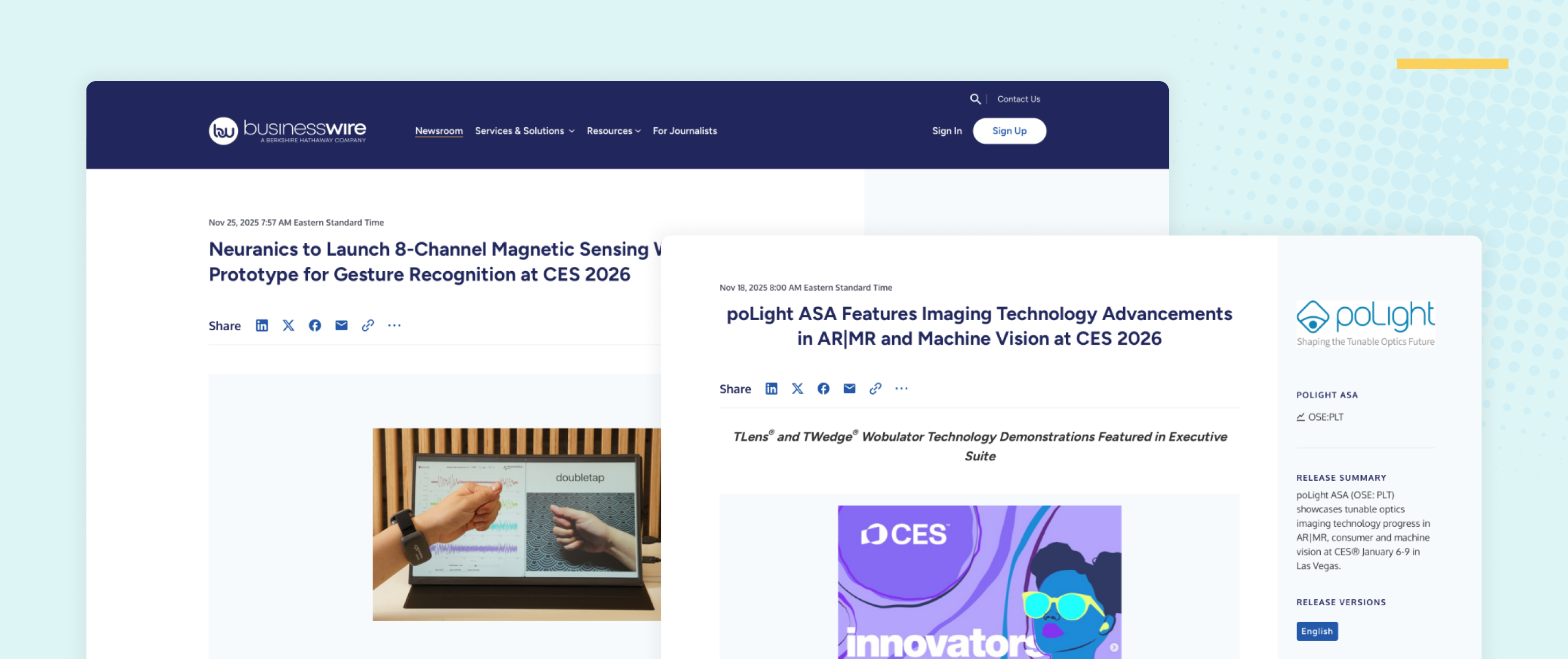
CES is all about experiences you can see and feel, so your PR should match that energy. Adding multimedia to your CES press releases makes them more engaging for reporters, partners, online audiences, and AI systems to “see” and cite your content. Some examples of multimedia that work well include:
- 15–30 second demo clips that show your product in action.
- Annotated screenshots that highlight key features or benefits.
- GIFs of hero features to quickly capture attention.
- Product shots that make your launch tangible.
- “Booth energy” assets that convey the excitement of CES in real time.
Using these visuals can dramatically increase media pickups, click-through rates, social shares, and your visibility in AI/LLM-driven search and discovery platforms.
Measuring Your Impact
To understand your performance, track post-event PR success in three layers:
- Outputs: These are the direct, measurable actions: how many media pickups your news release earned, impressions, engagement, or views on your content. Think of this as the immediate footprint of your effort.
- Outcomes: These show the effect of that activity on your brand’s presence: share of voice compared to competitors, improved search rankings for CES-related queries, or referral traffic driven by media coverage.
- Impact: This is the ultimate business value: new demo requests, additions to your sales pipeline, investor interest, or even recruiting inquiries sparked by your visibility.
Pre-CES: Setting the Runway
Before CES begins, focus on laying the groundwork so your announcements land effectively. Build a clear message map: define the problem, what’s new, why it matters, and supporting proof. This will help every press release, social post, or blog update reinforce the same story. Gather core assets: product images, logos, teaser videos, demo screenshots, executive quotes, and customer soundbites to prepare CES press kits.
Plan your news distribution strategy early, align teaser and launch timelines, and map roles so everyone knows responsibilities. Lock in press release dates for teaser, launch, recap, and post-trade show follow-up. Prepping approvals, crisis cards, and media lists ensures a smooth, high-impact launch.
Speak to a Business Wire representative to discuss your launch narrative and distribution plan.
CES PR Afterlife: A 12-Month Plan to Extend Your CES Impact
Next, focus on capturing attention in the middle of CES chaos while setting up your year-round PR plan. This is when all your pre-show preparation comes to life, turning your narrative into visible, high-impact storytelling that cuts through the noise.
Launch-day CES press releases should clearly communicate what’s new and why it matters, with benefit-led headlines, sharp subheads, rich multimedia, and clear calls to action, whether it’s watching a demo or booking a meeting. In a sea of competing announcements, clarity is your strongest differentiator.
CES is also full of micro-moments that fuel content long after the show ends. Quick demo clips, influencer or analyst booth visits, customer reactions, live product shots, and any awards earned become high-value assets that boost engagement during CES and feed your content pipeline for weeks.
Visibility doesn’t stop with the initial launch. Feature updates, new visuals, and timely quotes help your story stay fresh, maintain momentum, and increase pickup potential across media and AI platforms.
During this phase, track KPIs like coverage velocity, outlet quality, demo bookings, and referral traffic to see how your story is landing and where to adjust.
Use Business Wire to issue multimedia CES press releases that amplify your coverage opportunities.
After CES: First 60 Days
CES gives you attention, but the following 60 days are when you turn that attention into credibility, search visibility, and lasting impact.
Weeks 1–2
Start with a CES recap. A press release or blog post should cover what you saw at the show, the questions customers asked, the direction you’re headed, and your unique point of view. This positions your brand as a thought leader and helps you capture search interest around CES topics. Take a look at Business Wire’s ICON 2025 recap blog post!
Weeks 2–4
Share availability or integration updates. Ship dates, retail rollouts, software launches, and app integrations continue to attract attention and keep your story moving.
Weeks 4–6
Highlight customer proof. Pilot results, testimonials, or early usage metrics demonstrate real-world adoption and build credibility.
Weeks 6–8
Seek analyst or award validation. Even small wins can anchor a full news release and reinforce your messaging.
Throughout these eight weeks, don’t forget to leverage your owned channels and social media:
- CES highlights reel
- “Top questions we got” posts
- Emails recapping your Business Wire announcement and press kit
Track KPIs that show the impact of your post-show strategy, including search volume lift on key themes, analyst briefings booked, pipeline and demo request increases, and referral traffic from media pickups. By treating the first 60 days after CES as an intentional storytelling window, you extend the life of your announcements and set your brand up for sustained visibility throughout the year.
Months 3–12: The Momentum Map
After the first 60 days post-CES, the focus shifts to sustaining momentum across the rest of the year. By planning quarterly story arcs, you keep your narrative alive, build credibility, and create ongoing opportunities for media coverage, search visibility, and audience engagement.
Months 3–4: Validation
Focus on proving your claims and building trust. Examples include independent testing results, certifications, security reviews, or early case studies. Issue a validation press release with supporting visual assets to reinforce credibility, and track KPIs like credibility signals and SEO gains on trust-related search terms.
Months 5–6: Expansion
Once validation is established, focus on growth and reach. Examples include partner integrations, market expansion, channel programs, or pricing tier updates. By sequencing your news releases around these themes, each announcement compounds the impact of the last.
Months 7–9: Proof & Thought Leadership
Next, demonstrate measurable results and establish expertise. This can be benchmark reports, white papers, mid-year momentum press releases, or ROI data.
Months 10–12: Close the Loop
Wrap up the year by showing progress and setting up anticipation for the next CES. Consider version updates, awards wrap-ups, or “one year since CES” recap content. A roadmap or anniversary press release highlights narrative retention and drives interest for upcoming launches, helping to maintain waitlist sign-ups or pre-launch buzz for next year’s show.
Measuring PR Success
Measuring CES PR success isn’t just about counting headlines. It’s about understanding what actually moves the needle. Start by tagging everything with tracking links and anchor URLs so you can track activity across each phase. If issuing press releases with Business Wire, watch your NewsTrak Reports for activity. Monitor your company’s analytics tools or build dashboards to monitor CES media coverage, share of voice versus competitors, and search rankings for CES-related phrases.
Finally, do a quarterly retro: keep what works, ditch what doesn’t, and plan your next announcements based on real data.
Monitor NewsTrak and uncover key insights to inform your next press release.
Common Event PR Questions
Should we issue multiple CES-week press releases or consolidate?
If you have truly different updates (a product launch, award, or partnership), spread them out so each gets attention. If it’s all part of one story, keep it together.
How soon after CES should the recap go live?
Publish within a week or two while your news is still top-of-mind. People are searching for “what mattered at CES,” and interest drops fast after two weeks.
What counts as a newsworthy “availability” update?
Anything that’s new or expanded: shipping, new regions, integrations, or pricing tiers. If customers can do something today that they couldn’t before, it’s news.
Do we need video for every press release?
Video is nice, but not required. At a minimum, have a high-quality image, your logo, and one product or feature shot. Video is ideal for demos or launches.
When should we use a newswire vs. a blog post or social update?
Use a newswire for big news, anything reporters should see. Blogs and social media are better for behind-the-scenes stories or commentary. Core news = wire; color or context = owned channels.
From Launch Day to Year-Round Impact
An event announcement doesn’t have to be a two-week spike. With a smart PR strategy, one big moment can drive coverage, boost search visibility, attract investors and partners, and fuel your customer pipeline for the entire year.
Business Wire supports you at every step, so your story keeps building. If you want help pressure-testing your CES plan or mapping a full-year release calendar, we’re ready to help.