New SolarWinds Research Reveals the Gap Between AI Potential and Payoff in IT Service Management
New SolarWinds Research Reveals the Gap Between AI Potential and Payoff in IT Service Management
Survey of 800+ IT professionals finds AI is meeting expectations on paper, but only 7 percent say the true cost matched what they planned for
AUSTIN, Texas--(BUSINESS WIRE)--SolarWinds, a leading provider of simple, powerful, secure observability and IT management software, today released its 2026 State of ITSM Report, which studies how IT teams are using AI in their Information Technology Service Management (ITSM) workflows. The report, based on a survey of IT professionals around the world, surfaces a growing paradox: AI is broadly meeting ROI expectations in IT service management, but for most teams, it is not yet easing the burden on the people doing the work.
The report, based on a survey of IT professionals around the world, surfaces a growing paradox: AI is broadly meeting ROI expectations in IT service management, but for most teams, it is not yet easing the burden on the people doing the work.
Share
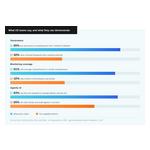
Eighty-four percent of respondents say AI has met or exceeded ROI expectations, and they report meaningful time savings across core ITSM tasks. Yet 52% say their overall workload has increased since adopting AI, and only 7% say the cost of AI adoption matched what they planned for. After an average of about 16 months using AI in their ITSM environment, most teams are still managing AI’s overhead rather than realizing its full potential.
The AI Productivity and Cost Enigma
The data makes clear that AI creates real productivity gains. Respondents report AI saves an average of 3.2 hours per week on detecting and flagging issues, 3.0 hours on end-user requests, and 2.9 hours on ticket triage. But those savings are largely being reinvested into a new category of work that did not exist at the same scale before AI:
- Managing and maintaining AI tools and integrations: 48%
- Reviewing and validating AI-generated outputs: 47%
- Training and fine-tuning AI models: 37%
The costs that catch organizations off-guard compound this further. The top surprise expenses — staff training (48%), data quality and cleanup (47%), and ongoing tuning and maintenance (45%) — are not one-time setup costs. They are recurring parts of the operating model, and more than four in five respondents (83%) now spend three or more hours per week just keeping their AI systems running reliably.
Despite clear productivity gains, IT teams are discovering that AI isn’t reducing their workload; it’s reshaping it.
Reactive Instead of Proactive
Despite significant maturity in AI adoption, most ITSM teams are still using AI to respond to problems rather than prevent them. When asked where AI has had the greatest impact across the incident lifecycle, respondents cited identifying issues before they impact users (31%) and prioritizing and routing issues (23%) as the top two areas, which are both fundamentally reactive responses to problems that have already emerged. Only 19% cited preventing issues before they occur as the area of greatest impact.
This reactive posture points to a gap between AI adoption and AI maturity. The tools are in place. The missing piece is the infrastructure, data foundation, and organizational discipline to move AI upstream into prevention. Budget momentum suggests organizations know this: 85% say their AI in ITSM budget has increased year-over-year, with 36% saying it has increased significantly, and agentic workflows, the most proactive AI capability category, show the highest expected investment growth of any area in the survey.
An Intentional Approach is Best
Organizations can avoid inflating AI workloads and unexpected costs by taking a more intentional approach to AI implementation. IT leaders should build the right infrastructure and governance to enable proactive AI adoption, including:
- Start where the path to value is clear. Focus AI on high-frequency, well-defined tasks first — ticket triage, issue detection, incident documentation — where gains are measurable and feedback loops are tight.
- Reduce friction around the work. Consolidate AI closer to existing service workflows rather than spreading it across disconnected tools. Every integration point is another source of maintenance overhead.
- Strengthen the data foundation. Data quality is the top reason AI fails to deliver expected value — treating it as part of the AI strategy, not a separate cleanup project, directly determines output quality.
- Measure outcomes, not just activity. Only 21% of respondents measure AI in outcome or experience terms. Teams that measure AI by activity, rather than outcomes, are 2.4 times more likely to say their workload has increased since adopting AI.
- Bring people along intentionally. Eighty-two percent of organizations offer formal AI training and structured change management, with 66% of respondents seeing their bonuses and performance reviews tied to AI efficiency gains.
“We’re at an inflection point in IT service management. AI adoption is no longer the hard part — the hard part is building the organizational discipline to make AI actually deliver,” said Brad McGinity, GM of ITSM, SolarWinds. “The teams that get this right aren’t just running a faster service desk; they’re running a fundamentally different operation. At SolarWinds, our job is to make that transition as straightforward as possible — giving customers the platform, the data foundation, and the governance they need to move from AI activity to real AI payoff.”
For the full 2026 State of ITSM Report, visit here. For more information on SolarWinds ITSM offerings, visit here.
Connect with SolarWinds
About SolarWinds
SolarWinds is a leading provider of simple, powerful, secure observability and IT management software built to enable customers to accelerate their digital transformation. Our solutions provide organizations worldwide—regardless of type, size, or complexity—with a comprehensive and unified view of today’s modern, distributed, and hybrid network environments. We continuously engage with IT service and operations professionals, DevOps and SecOps professionals, and database administrators (DBAs) to understand the challenges they face in maintaining high-performing and highly available hybrid IT infrastructures, applications, and environments. The insights we gain from them, in places like our THWACK community, allow us to address customers’ needs now and in the future. Our focus on the user and our commitment to excellence in end-to-end hybrid IT management have established SolarWinds as a worldwide leader in solutions for observability, IT service management, application performance, and database management. Learn more today at www.solarwinds.com.
The SolarWinds, SolarWinds & Design, Orion, and THWACK trademarks are the exclusive property of SolarWinds Worldwide, LLC or its affiliates, are registered with the U.S. Patent and Trademark Office, and may be registered or pending registration in other countries. All other SolarWinds trademarks, service marks, and logos may be common law marks or are registered or pending registration. All other trademarks mentioned herein are used for identification purposes only and are trademarks of (and may be registered trademarks of) their respective companies.
© 2026 SolarWinds Worldwide, LLC. All rights reserved.
Contacts
Cait Lower
SolarWinds
Phone: +1-512-571-3455
pr@solarwinds.com