Georgia Tech Wins the Final Year of EcoCAR Challenge
Georgia Tech Wins the Final Year of EcoCAR Challenge
Top teams recognized as four-year collegiate competition concludes with real-world vehicle testing and final evaluations
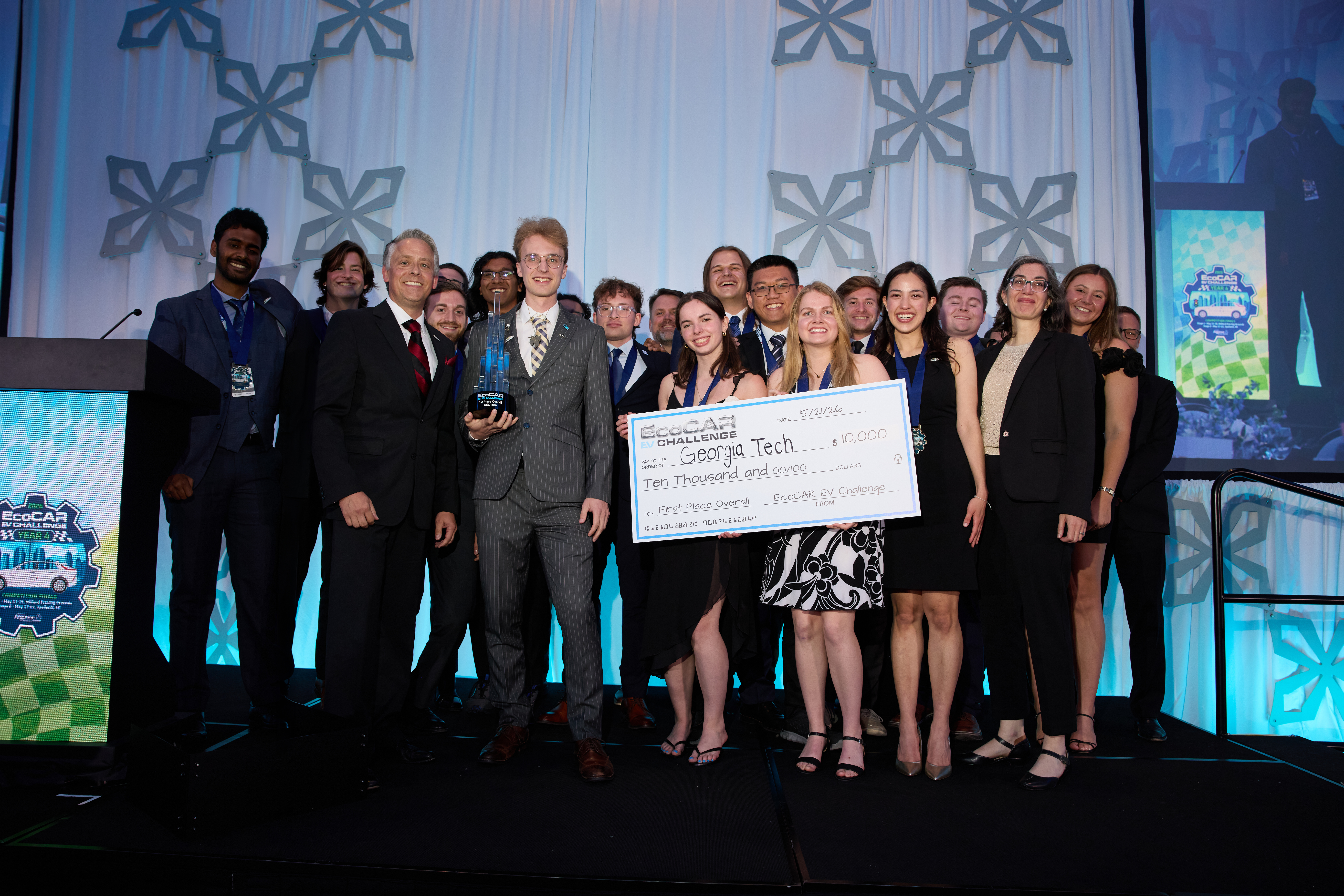
DETROIT--(BUSINESS WIRE)--Georgia Tech has won Year Four of the EcoCAR EV Challenge, claiming the top spot in the final year of the collegiate engineering competition. McMaster University took second place, and Virginia Tech received third place.
Managed by Argonne National Laboratory and headline sponsored by the U.S. Department of Energy (DOE), General Motors, and MathWorks, the competition challenged students from 15 North American universities to engineer a next-generation vehicle using automation and vehicle-to-everything (V2X) connectivity.
“Inspiring the next generation of engineering talent is an important component of DOE's strategy to maintain America's leadership in applied energy research and innovation,” said Matthew Grosso, Deputy Assistant Secretary for Energy Technology, DOE. “We thank our industry partners for helping to make the Advanced Vehicle Technology Competitions such a success over the last three decades.”
In fall 2022, the competition tasked each university team with reengineering a 2023 Cadillac LYRIQ to demonstrate the potential of advanced vehicle technologies while maintaining consumer expectations for performance and driving experience.
Teams put their reengineered LYRIQs through rigorous testing at the GM Milford Proving Ground in Milford, Michigan, from May 11-16. Judges assessed each team’s vehicle in a series of dynamic tests, including a Connected Intersection Navigation Challenge, an Adaptive Cruise Control Feature Evaluation, and a Consumer Ride and Drive Event.
“Four years ago, these students took on one of the most ambitious challenges in collegiate automotive engineering: transforming a Cadillac LYRIQ into a showcase of next-generation automotive technology,” said Ken Morris, Senior Vice President — Product Programs, Product Safety, Integration & Motorsports for General Motors. “This year, they reached a defining milestone, taking their vehicles beyond the proving grounds and onto the streets of Detroit, demonstrating their innovations in a real-world environment and culminating their journey at General Motors’ global headquarters, the Hudson Building. That moment represents more than technical achievement; it reflects the confidence, capability, and readiness of these future engineers to shape the future of mobility.”
Following the testing event, teams gathered in Ypsilanti, Michigan, for final presentations, a sponsor networking event, and the awards ceremony on May 21 where winners received $100,000 in total prize money, provided with industry funds. Teams presented the technical foundations behind their vehicles, as well as their communications and project-management strategies.
“Throughout the EcoCAR EV Challenge series, students have pushed the boundaries of what’s possible with Model-Based Design, leveraging MATLAB and Simulink to develop and validate complex embedded systems. EcoCAR has given them the industry-standard tools and the real-world experience they need to hit the ground running in their careers. We’re proud to have been part of this program from start to finish and congratulate all the teams on an outstanding final year,” said Lauren Tabolinsky, Senior Manager, Student and Academic Global Programs at MathWorks.
Winning a total of 867 out of 1,000 total points, Georgia Tech dominated both the communications and vehicle events during the competition. Their fully integrated Cadillac LYRIQ successfully met all design targets, winning an award for its smooth, intuitive operation and innovative one-pedal driving capability. Most notably, the team delivered the top performance in the Connected Driving Evaluation (CoDE), an event developed by Argonne National Laboratory that evaluates how effectively teams integrate vehicle connectivity into longitudinal automated driving features using a suite of target vehicle and traffic signal test systems.
In addition, the team earned the highest scores in both lateral automation categories, lane centering and automatic parking, and stood out as they successfully demonstrated automatic parking during the competition. By combining excellence in both propulsion and autonomy, the team also earned the Consumer Acceptability Award, where a panel of industry judges evaluated the vehicle’s driving performance alongside its Connected and Automated Vehicle features.
For more information about the EcoCAR EV Challenge, visit avtcseries.org, and follow EcoCAR on social media for updates on what’s next.
About EcoCAR Challenge:
Managed by Argonne National Laboratory and sponsored by DOE, General Motors, and MathWorks, the EcoCAR Challenge is a four-year collegiate engineering program that builds on the successful 38-year history of Department of Energy Advanced Vehicle Technology Competitions (AVTC). EcoCAR challenges 15 North American universities to engineer a next generation vehicle that utilizes automation and vehicle-to-everything (V2X) connectivity to implement advanced vehicle technologies and customer-pleasing features, while meeting the evolving needs of the automotive industry.
Contacts
Media Contact
Ashley Kronsell-Oller, Argonne National Laboratory, akronsell@anl.gov, 219-794-4315
Jack Crawley, General Motors, jack.crawley@gm.com, 248-219-4969
Tim Morin, MathWorks, timmorin@mathworks.com, 508-647-3048