OpenObserve Introduces AI-Native Observability Platform with Autonomous AI SRE Agent to Unify Infrastructure, Application and LLM Monitoring
OpenObserve Introduces AI-Native Observability Platform with Autonomous AI SRE Agent to Unify Infrastructure, Application and LLM Monitoring
New Observability 3.0 capabilities include autonomous AI SRE, anomaly detection, and LLM observability, enabling engineering teams to move from reactive incident response to proactive autonomous operations
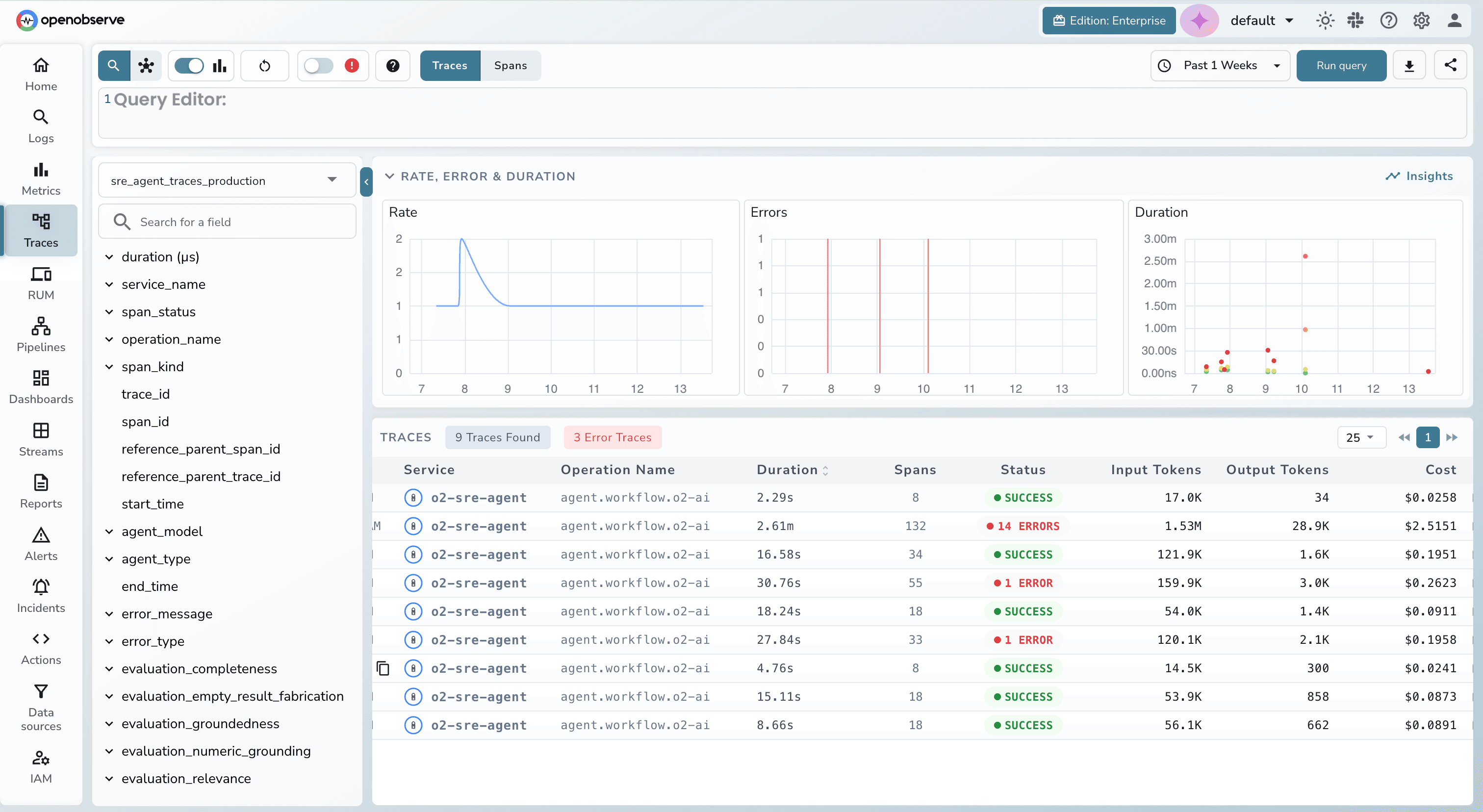
OpenObserve's LLM Observability gives engineering teams full visibility into LLM agent behavior, tracking token consumption, cost per operation, error rates, and duration across every span. Unlike legacy tools, OpenObserve surfaces AI-specific telemetry alongside infrastructure and application data in a single interface.
MENLO PARK, Calif.--(BUSINESS WIRE)--OpenObserve today introduced Observability 3.0, a new generation of its AI-native platform that brings autonomous anomaly detection, AI SRE, and LLM observability within one solution. While legacy tools like Prometheus-Grafana and ELK were built for a world of static infrastructure, Observability 3.0 is designed for the scale and complexity of modern AI workloads. At the center of this suite is AI SRE, an autonomous layer that uses unified telemetry to identify root causes and recommend or take corrective steps without requiring engineers to manually sort through data.
OpenObserve unifies infrastructure, application, and AI observability without stitching together separate solutions, delivering 140 times lower storage costs with zero database management for enterprises and empowering engineering teams to move from reactive firefighting to autonomous operations.
Legacy open source observability stacks such as Prometheus-Grafana and ELK cannot manage the scale of telemetry generated by today’s LLM workloads. Additionally, legacy commercial vendors are forcing their customers onto data diets, which are deliberate limits on what telemetry gets ingested and stored, then reduce the context available for predictive diagnosis and analysis. Separate platforms have filled individual gaps, with tools for LLM observability, AI-driven incident triage and front-end monitoring. Each requires its own instrumentation, interface and operational overhead. OpenObserve replaces that with a single platform that engineering teams can operate in one interface.
OpenObserve’s S3-native architecture handles high-volume telemetry without the cost or complexity of legacy platforms. The new AI suite builds on that, with intelligence across logs, metrics, traces and now LLM telemetry in a single interface.
The new suite has three interconnected capabilities:
AI SRE is an autonomous layer that analyzes telemetry context and extracts signals. Modern systems generate more data during an incident than teams can review manually. AI SRE can identify the root cause and recommend or take actions.
Anomaly detection gives early warning signals that a system has problems. Teams receive proactive alerts before an incident occurs in their existing OpenObserve workflow so they can quickly respond.
LLM Observability extends OpenObserve’s telemetry pipeline to cover prompt monitoring, eval tracking and generative AI application performance. Organizations get a single view from the server to the application layer.
“Observability 3.0 is a new operating model for engineering teams, and the companies that adopt it will ship faster, sleep better, and outpace those still wiring together legacy tools,” said Prabhat Sharma, founder and CEO, OpenObserve. “With Observability 3.0, companies can move from firefighting to proactive autonomous operations and get back to building the products that drive their businesses forward.”
OpenObserve is used by more than 6,000 organizations, including many Fortune 100 companies. The open-source project has 18,000 GitHub stars, showing strong developer adoption.
The new AI capabilities come as OpenObserve accelerates its commercial expansion following a recent $10 million Series A financing led by Nexus Venture Partners and Dell Technologies Capital.
“Legacy observability stacks weren’t built for AI-scale telemetry, and that’s creating real friction. Telemetry volumes are growing roughly 30% year over year, yet 75% of organizations still rely on 6 to 15 tools, leading to fragmentation and blind spots," said Paul Nashawaty, Principal Analyst and Practice Lead at theCUBE Research. "Vendors responding with ‘data diets’ are solving the wrong problem; engineering teams need more contextual, correlated telemetry, not less, to diagnose issues in AI-driven environments. This is driving a shift to unified observability, where a shared telemetry layer replaces stitched-together tools. Ultimately, it’s leading to autonomous operation, AI-driven SRE models such as OpenObserve's where systems surface root cause and act, instead of teams manually triaging incidents.”
About OpenObserve
OpenObserve is the modern observability platform that unifies logs, metrics, traces and real user monitoring with 140x lower storage costs and zero database management. Built on S3-native Parquet architecture, OpenObserve delivers enterprise-grade observability without the operational complexity and escalating costs of legacy platforms. Founded in 2022 and based in Menlo Park, California, OpenObserve serves customers globally.
To learn more about Observability 3.0 or request a demo, visit openobserve.ai/observability-3. or follow @OpenObserve.
Contacts
Media Contact
Diana Puckett
PRforOpenObserve@bospar.com