Digital Trust Index 2026: AI Skepticism and Identity Access Friction Are Costing Revenue
Digital Trust Index 2026: AI Skepticism and Identity Access Friction Are Costing Revenue
- 93% of IT leaders are deploying GenAI, but only 23% of consumers trust companies that use AI to handle their data.
- Friction at sign-up, login, and onboarding is causing customer abandonment and revenue loss, with 68% of consumers switching due to website issues.
- 69% of consumers trust companies more when MFA (multi factor authentication) is used, 68% say the same about passkeys.
MEUDON, France--(BUSINESS WIRE)--Thales today released the 2026 Digital Trust Index, one of the most comprehensive global studies of digital trust. Surveying more than 15,000 consumers, business partners, and IT decision makers across 13 industries, the research reveals that digital trust is won or lost during sign-up, login, and throughout the lifecycle of personal data handling.
"When AI simply helps people work faster, confidence is high. But when AI starts acting autonomously and making decisions or interacting with systems on a user’s behalf, people begin asking harder questions about security, control, and accountability.”
Share
Consumer Trust is Won or Lost at Login
For consumers, digital trust often begins at login. Yet, 57% reported problems accessing a website in the past year, and 68% abandoned or switched providers due to slow performance or complicated sign-up processes. When access feels too slow or intrusive, 33% switch to a competitor or abandon the attempt, while 36% delay engagement or look for alternative channels.
Consumers are not demanding speed at the expense of security. Forty-five percent say they prefer stronger security checks, even if sign-ups take longer, compared to 22% who favor faster access with lighter protections. Familiar safeguards help build confidence, with 69% saying multifactor authentication increases trust and 68% saying the same about passkeys. Still, only 16% say they clearly understand how companies collect and use their personal data.
AI Adoption Outpaces Trust
As organizations accelerate their use of generative AI, 93% of IT leaders say they are already using, deploying or planning AI initiatives. Yet consumer confidence has not kept pace: only 23% say they trust companies to use AI responsibly with their data, while 77% remain concerned about AI agents acting on their behalf online.
Trust Gaps Widen as Banking Pulls Ahead
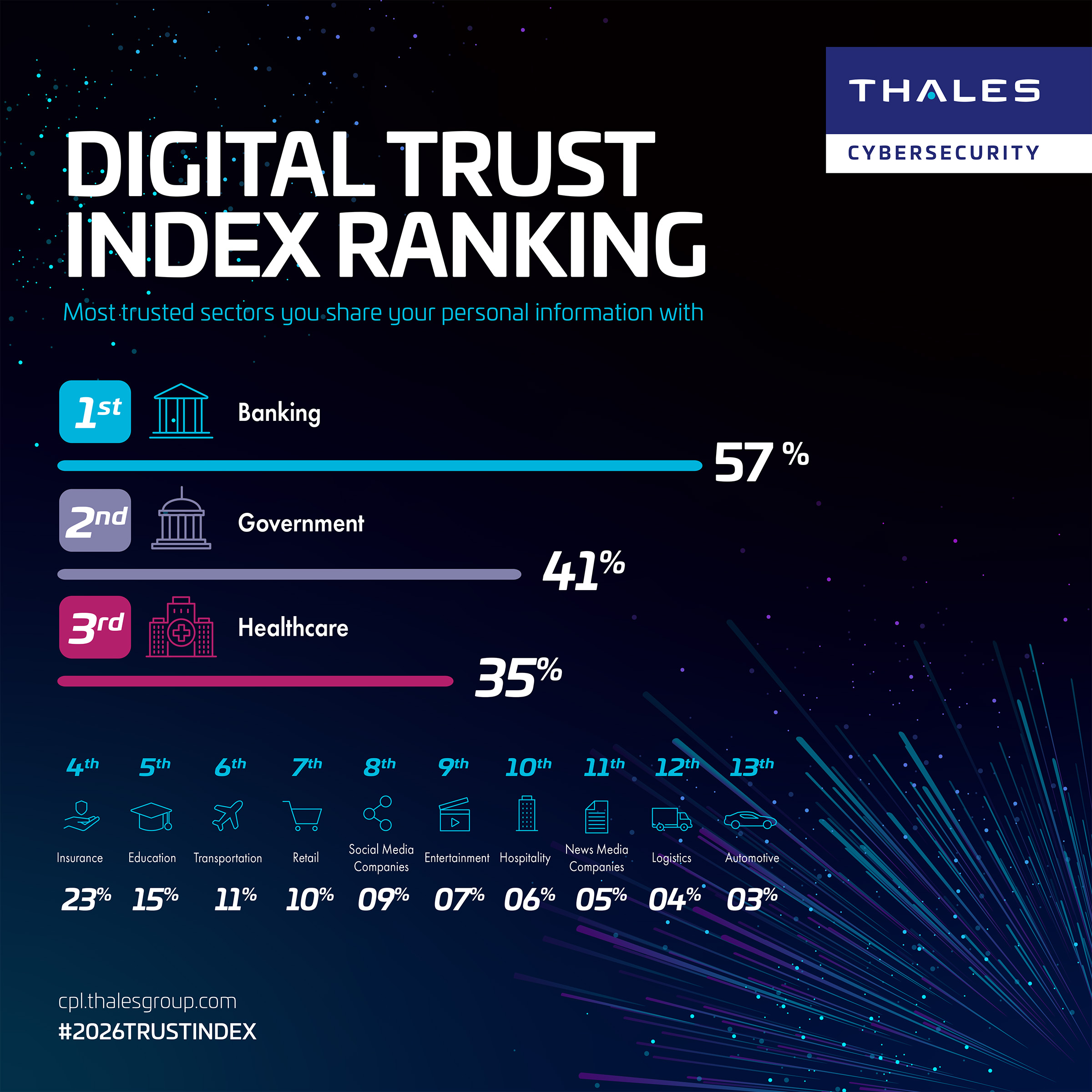
The 2026 Digital Trust Index shows the gap between the most trusted sectors and the rest widening sharply. Banking stands out as the clear trusted sector at 57% (up from 44% in 2025), making it the only industry where more than two in five consumers feel comfortable sharing personal information online. Most other sectors continue to operate in a trust deficit, where the disconnect between what organizations believe they deliver and what users actually experience drives abandonment, time-consuming workarounds, and increased risk.
Beyond banking’s clear lead, the rest of the sectors fall well behind in consumer confidence. Government services rank second at 40%, followed by healthcare at 35%. Trust declines sharply beyond these top sectors, with insurance (23%) and education (15%) forming a distant second tier. Consumer-facing industries score much lower, including retail (10%), social media (9%), entertainment (7%), and hospitality (6%), while news media (5%), logistics (4%), and automotive (3%) rank at the bottom. Overall, consumers place the greatest online trust in sectors responsible for managing sensitive personal data and essential services, while entertainment, media, and platform companies face lower confidence.
Friction Fuels Delays and Risk for Partners
For business partner users, access reliability directly affects project delivery and revenue. Onboarding remains inconsistent as only 22% receive login credentials immediately, and just 30% get full permissions on first access, creating delays that ripple across sales cycles and customer commitments. When official processes lag, risky workarounds emerge. Sixty-six percent admit to sharing or borrowing credentials, often because of slow provisioning, creating hidden security debt and increased breach risk.
IT Leaders See the Risk but Struggle to Close the Gap
The 2026 Digital Trust Index shows IT leaders recognize the importance of modern authentication. Eighty-seven percent say offering passkeys is important, yet only 49% currently do so. This gap represents both risk and opportunity as consumers expect stronger, seamless security.
“The 2026 Digital Trust Index shows that as AI adoption is accelerating, trust is struggling to keep pace,” said Danny DeVreeze, Vice President of Identity and Access Management at Thales. “When AI simply helps people work faster, confidence is high. But when AI starts acting autonomously and making decisions or interacting with systems on a user’s behalf, people begin asking harder questions about security, control, and accountability.”
Architecting Access as Business Strategy
The Digital Trust Index 2026 shows that identity and access management are commercial levers, not back-office functions. Trust improves when authentication and permissions are reliable, adaptive, and clearly explained. When they are slow or opaque, abandonment rises, credential sharing spreads, and revenue leaks. Organizations that modernize authentication, limit unnecessary data collection, provide permission visibility, and deploy AI transparently will be best positioned to compete in an increasingly digital and AI-driven economy.
Methodology
The research was conducted by Vanson Bourne in January–February 2026, surveying 14,300 consumers, 1,300 partner users and 200 IT decision makers across the USA, Canada, Mexico, Brazil, UK, France, Germany, Netherlands, the UAE, South Africa, Singapore, Japan and Australia.
About Thales
Thales (Euronext Paris: HO) is a global leader in advanced technologies for the Defence, Aerospace, and Cyber & Digital sectors. Its portfolio of innovative products and services helps address several major challenges: sovereignty, security, sustainability and inclusion.
The Group allocates €4.5 billion per year in Research & Development in key areas, particularly for critical environments, such as Artificial Intelligence, Cybersecurity, Quantum and Cloud technologies.
Thales has more than 85,000 employees in 65 countries. In 2025, the Group generated sales of €22.1 billion.
Contacts
Press
Thales, Media Relations
Security & Cybersecurity
Marion Bonnet
+33 (0)6 60 38 48 92
marion.bonnet@thalesgroup.com