

Virtana Introduces a New Class of AI-Native, System-Aware Application Observability, Rendering Legacy APM Obsolete
Virtana Introduces a New Class of AI-Native, System-Aware Application Observability, Rendering Legacy APM Obsolete
New Research Confirms Code-Centric APM Collapses Under Modern Enterprise Complexity, Leaving Half of Enterprise IT Practitioners Unable to Identify Root Cause
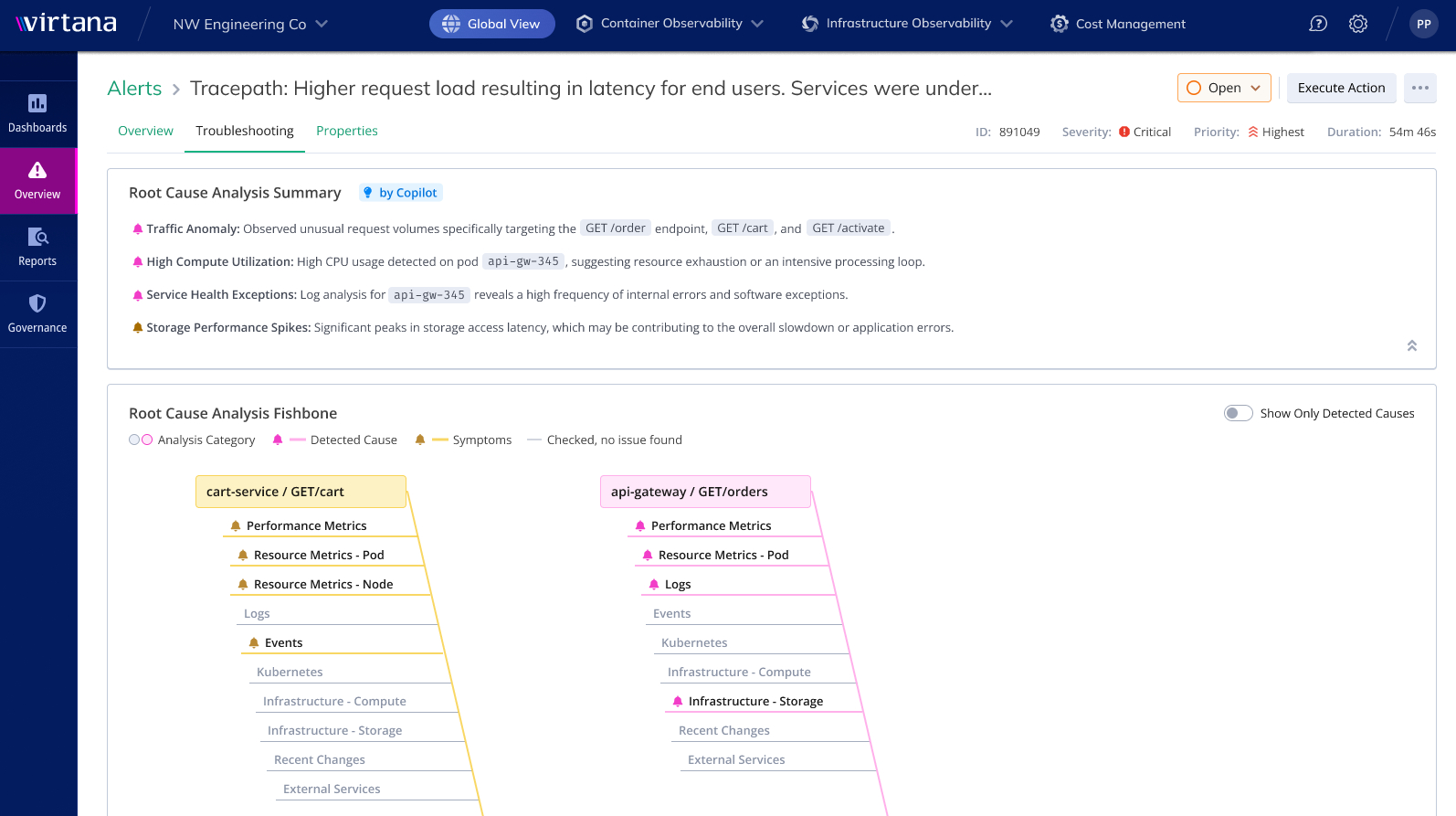
PALO ALTO, Calif.--(BUSINESS WIRE)--Virtana, provider of the deepest and broadest AI-powered observability platform, today launched a new Application Observability offering that achieves what legacy APM tools have failed to do: automatically trace performance failures from application code all the way down through infrastructure, networks, storage, and AI workloads to surface evidence-backed root cause without manual correlation. Built for autonomous operations at scale, the solution redefines the application as a system rather than software, automatically correlating performance issues across the full enterprise stack, from code and services to infrastructure, networks, storage, and AI platforms. By enabling operators and AI agents to identify the true limiting dependency across hybrid environments, organizations gain faster, more precise root cause analysis without sacrificing governance or control.
The announcement comes as new Virtana research, “AI Is Breaking Human-Managed Operations,” reveals 52% of IT practitioners report persistent visibility gaps and fragmented observability, despite median annual observability spending exceeding $800,000 per enterprise, according to Gartner's April 2025 report, Get Your Observability Spend Under Control. A subset of these enterprises spend more than $10 million annually on a single vendor. The findings highlight that more tools have not solved the problem. A different architecture is required.
APM Was Built for a World That No Longer Exists: Why Code-Centric Observability Is No Longer Sufficient
Legacy APM platforms still treat the application as the boundary of truth, identifying slow transactions and performance bottlenecks, but rarely where the real constraint resides. When performance is limited by storage behavior, network paths, Kubernetes resource pressure, noisy neighbors, or GPU contention, APM exposes symptoms while teams manually correlate cause across fragmented tools. Virtana replaces that workflow by unifying application, service, infrastructure, network, and AI signals into a single operational context so teams and autonomous AI agents can dynamically surface system-level root cause first, with evidence ready for action.
“Mission-critical applications such as airline reservation systems, payment processing systems, health care delivery systems, and emergency dispatch are no longer just code, but complex systems spanning software, services, infrastructure, and AI workloads,” said Paul Appleby, CEO of Virtana. “At this scale and complexity, legacy APM focused on code and human-only operations is no longer a credible way to understand how applications behave. Our research shows that this trajectory will accelerate as AI workloads, new dependencies, greater infrastructure strain, and failure modes that legacy tools cannot explain continue to multiply. The only viable path forward is open, agentic, system-level observability.”
New Application Observability Capability Delivers Automatic Infrastructure-to-Application Correlation Powered by Agentic AI
Virtana’s new Application Observability capability delivers visibility into request flows, service interactions, latency, and errors, and automatically correlates those signals to downstream dependencies across infrastructure, storage, network, and AI workloads. By unifying application telemetry with full-stack observability, Virtana fundamentally changes incident response by making it possible for teams to immediately determine whether performance issues originate in application code or downstream constraints such as storage contention, network congestion, infrastructure saturation, or platform instability.
“As a leading AI-powered technology solutions provider supporting more than 6,000 CIOs across public sector and enterprise organizations, we cannot operate with visibility that stops at the code,” said Doug Syer, Chief Engineer for AI Monitoring and Observability at NWN. “Modern applications are distributed systems, and performance constraints frequently originate in infrastructure, network, or platform layers that traditional APM was never designed to see. Virtana Application Observability offers true system-level visibility, correlating signals across the full stack, enabling the immediate transition from symptoms to evidence-backed root cause.”
The new Application Observability capability provides:
- AI-native, agentic investigation and automation enabling natural language analysis grounded in operational context through Virtana's MCP Server and compatible with leading AI assistants (ChatGPT, Claude, Gemini, Copilot).
- System Dependency Graph foundation that continuously maps relationships across applications, services, Kubernetes workloads, infrastructure, networks, storage, and AI platforms—providing the system-level context that enables automated reasoning and investigation.
- AI-powered root cause analysis that automatically identifies where latency, failures, or constraints originate across your entire stack and prioritizes the most likely limiting dependency with supporting evidence.
- Comprehensive observability across your application lifecycle—combining end-to-end transaction tracing, intelligent log correlation, and synthetic monitoring to detect user-impacting issues and trace root causes from user layer to infrastructure.
- Kubernetes-aware observability providing native visibility into clusters, workloads, nodes, and resource contention across your container environments.
“At modern scale, root cause rarely exists inside a single service or trace. It emerges from interactions between application runtime behavior, Kubernetes orchestration, infrastructure capacity, and network dynamics,” said Amitkumar Rathi, Chief Product Officer at Virtana. “Legacy observability was built for a world where applications were just code. Today’s systems are dynamic, distributed, and increasingly driven by AI, and fragmented tools cannot keep up. We built Virtana to see the entire system and correlate traces, logs, topology, and infrastructure telemetry into one operational context, allowing engineers and AI agents to act on it instead of chasing symptoms across disconnected signals.”
When an application issue appears, Virtana traces it across the full system, revealing how services, infrastructure, networks, and AI workloads interact to create the problem. Instead of debating symptoms, teams receive evidence-backed guidance grounded in real operational context, accelerating triage and minimizing downtime.
Availability
The new Virtana Application Observability capability is available immediately.
Additional Resources
- Request a demo with Virtana
- Access the "AI Is Breaking Human-Managed Operations" research report
- Read The Definition of the ‘Application’ Has Changed eBook
- Visit the Virtana Application Observability product page
- Follow Virtana on LinkedIn and X
About Virtana
Virtana delivers the deepest and broadest observability platform for hybrid and multi-cloud, with full-stack AI observability spanning applications, services, data pipelines, GPUs, CPUs, networks, and storage. Powered by high-fidelity data and agentic AI, Virtana provides unmatched visibility across end-to-end IT services and AI workloads, correlating health, performance, cost, and user impact in real time. With advanced event intelligence and autonomous insight generation, Virtana delivers clarity no other provider can match. Trusted by Global 2000 enterprises and public sector organizations, Virtana helps IT operations and DevOps teams reduce risk, strengthen resilience, improve efficiency, and modernize with confidence across multi-cloud, on-premises, and edge environments. Learn more at virtana.com.
Contacts
Media Contact
Stephanie Floyd
Bhava Communications for Virtana
virtana@bhavacom.com

