HRL Delivers Powerful Single-Phase Liquid Cooling to Data Center Scale
HRL Delivers Powerful Single-Phase Liquid Cooling to Data Center Scale
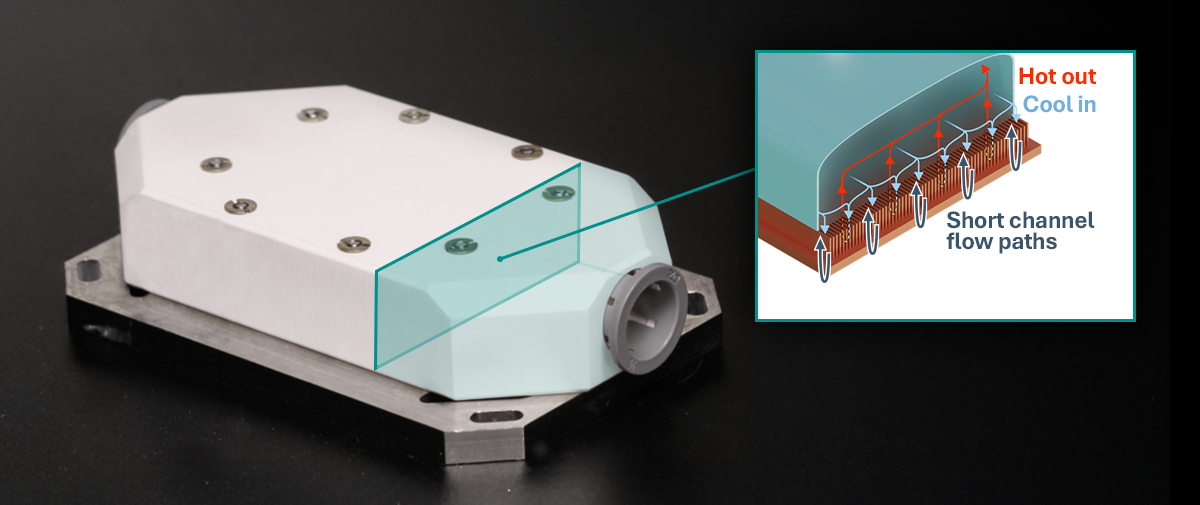
MALIBU, Calif.--(BUSINESS WIRE)--HRL Laboratories offers a breakthrough, single-phase, direct liquid cooling technology, called Low-Chill™, that enables unprecedented GPU and rack power densities in modern data centers without the cost and complexity of two-phase cooling systems and supports low-water usage cooling architectures.
“We designed this technology with real data center constraints in mind,” said Christopher Roper, principal investigator at HRL.
Share
Why it matters
Developed under U.S. Department of Energy’s ARPA-E COOLERCHIPS program, HRL’s revolutionary approach increases processor cooling capability by 40% or reduces pumping power by >10X. The approach extends the practical limits of single-phase liquid cooling for AI and high-performance computing data centers.
It also extends the viability of single-phase liquid cooling through next-generation data center roadmaps.
By enabling ultra-low thermal resistance at the processor level, the technology allows operators to run hotter coolant loops, reducing water use and enabling heat rejection through dry air coolers instead of evaporative systems, improving compatibility with water-constrained or dry climates.
This technology is ready to incorporate into next-generation data center cooling, and HRL is seeking development partners.
How it works
At the core of the technology is a novel cooling block architecture that uses an engineered 3D-printed manifold to distribute coolant through hundreds of short flow paths directly over the processor. By delivering coolant uniformly across the die, the design overcomes fundamental constraints of conventional cooling blocks, including long flow channels and friction losses.
What the data shows and enables
In testing, HRL demonstrated:
- Thermal interface resistance of 8.2 °C/kW
- Pressure drop below 1 psi per cooling block
- Pumping power requirements of less than 1 percent of rack IT power (block-level)
- Removes 40% more heat load compared to state-of-the-art cooling blocks under equivalent pumping power
- Warm and hot cooling (up to 70 °C coolant inlet temperatures)
These performance gains enable:
- Cooling of up to 3 kW for a single 750 mm2 die with a design scalable to much higher powers for larger multi-chip modules
- Support for heat fluxes up to 400 W/cm2
- Meeting NVIDIA’s anticipated Rubin and Feynman GPU cooling needs
This performance supports next-generation GPUs while serving as a drop-in replacement for existing data center cooling systems.
What’s to gain
For end users, the technology offers practical advantages:
- Higher density: Enables megawatt-scale racks using single-phase liquid cooling
- Lower energy use: Ultra-low-pressure drop minimizes pumping power
- Easy deployment: Drop-in compatibility with existing cooling infrastructure
- Lower risk: Avoids transition to costly two-phase systems
- Efficient cooling: Compatible with dry air chillers and standard coolant loops
- Water optionality: Enables elevated temperature cooling architectures compatible with dry air cooling and reduced water consumption
How it compares
Compared with current state-of-the-art commercial cooling blocks, HRL’s approach delivers higher rack power density for the same pumping power while maintaining uniform cooling across the processor surface. This method also allows data centers to avoid transitioning to high cost and complex two-phase cooling systems by extending the applicability of dependable single-phase liquid cooling well into the next decade.
Water use implications
Data center water consumption is driven primarily by heat rejection rather than on-chip cooling. When paired with hot-water coolant loops and dry air coolers, HRL’s Low-Chill™ approach can reduce water use by eliminating evaporative cooling. Results depend on the facility’s heat rejection architecture.
Ready to scale
The technology is designed for simple deployment using commercially available components or scalable 3D-printed components. With validated high-volume additive manufacturing for the cooling manifold and low capital requirements, the architecture aligns with existing and future data center liquid cooling standards.
“We designed this technology with real data center constraints in mind,” said Christopher Roper, principal investigator at HRL and technical lead for the COOLERCHIPS effort. “By rethinking how coolant is delivered at the block level, we can cool far more powerful processors using single-phase liquid cooling that fits within today’s data center architectures and operational risk profiles.”
HRL Laboratories continues to develop deployable technologies that enable scalable energy-efficient data center infrastructure as compute demands accelerate across AI, cloud and high-performance computing applications.
HRL Laboratories, LLC, California (www.hrl.com) pioneers the next frontiers of physical and information science. Delivering transformative technologies in automotive, aerospace and defense, HRL advances the critical missions of its customers. As a private company owned jointly by Boeing and GM, HRL is a source of innovations that advance the state of the art in profound and far-reaching ways.
Contacts
media@hrl.com
310-317-5000