Back-to-back Records: 26.2 Million U.S. Employees May Miss Work on Super Bowl Monday, According to UKG
Back-to-back Records: 26.2 Million U.S. Employees May Miss Work on Super Bowl Monday, According to UKG
Key Points
- Pre-approved days off, shift swapping, sick calls, and ghosting: 20 years of Super Bowl Fever workforce insights show what to expect and whether employees will once again treat the day like an unofficial floating holiday
- While millions are planning ahead, millions of others could still create labor disruptions, with up to $5 billion in lost work and productivity possible
- Super Bowl LX kicks off “The Year of Must-Watch Absence” as several cultural events could impact work
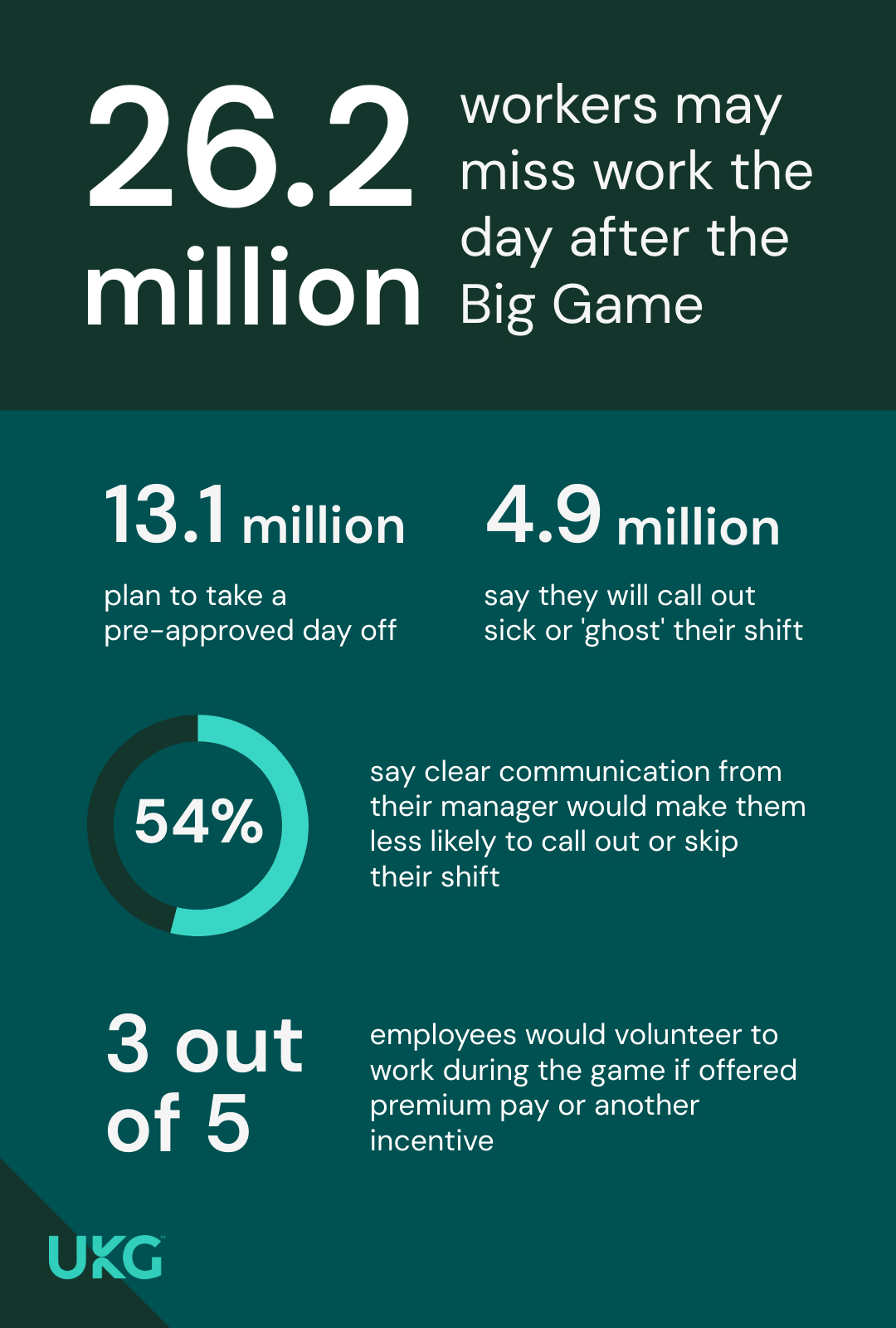
LOWELL, Mass.--(BUSINESS WIRE)--Super Bowl Monday will set a record for the second straight year for U.S. employees who plan to miss work, according to UKG’s annual Super Bowl Fever Absenteeism Survey. An estimated 26.21 million employed Americans say they will miss work the day after the big game, surpassing 2025’s record-setting 22.6 million employees and potentially costing upwards of $5.2 billion2 in lost work and productivity.
Since 2005, UKG, a leading global AI platform unifying HR, payroll, and workforce management, has commissioned The Harris Poll to conduct Super Bowl-related absenteeism research to provide organizations with workforce insights needed to effectively plan labor around the big game and other major worldwide events that can impact staffing and productivity.
In 20 years of studying the Super Bowl Fever phenomenon, UKG shows a silver lining for productivity: Americans are planning ahead, with many employees hoping their employer will proactively plan as well, ensuring everyone can win.
Here’s how some of the 26.2 million employed Americans who may miss work plan to do so:
- 13.1 million3 plan to take a pre‑approved day off, compared to 12.9 million in ’25 and 10 million in ‘24;
- 6.5 million4 plan to swap shifts with a co-worker, compared to 4.8 million in ‘25;
- 3.3 million5 intend to call out sick despite not being ill, similar to 3.2 million in ‘25; and
- 1.6 million6 plan to ‘ghost’ work without notifying their employer, compared to 3.2 million in ’25.
It doesn’t end at missing work, either: Approximately 4.9 million7 workers plan to go into work late without letting their manager know in advance.
“Last year’s record-breaking prediction preceded Super Bowl LIX being the most-watched program in the history of broadcast television — and data shows employees are not only planning ahead for it, but also hoping for an assist from their employer,” said Julie Develin, Senior Partner, HCM Advisory at UKG. “This year it appears that fewer employees plan to ghost work and others are proactively swapping shifts. That kind of workforce understanding and insights is a net positive because unplanned absences can quickly add up — potentially costing businesses more than $5 billion in lost productivity.”
Organizations and Leaders are Building Game-winning Playbooks for Super Bowl Absence
More than half of employees (56%) say if managers started coverage planning weeks before the Super Bowl, it would reduce last-minute call-outs at their workplace, and 54% say clear, early communication from their manager about Super Bowl coverage would make them less likely to call out or skip their shift.
Encouragingly, over two-thirds of employees (67%) agree their manager does a good job recognizing how pop culture events, holidays, and other external factors can affect work. In fact, nearly two-thirds of managers (63%) say they plan to ask employees directly about their Super Bowl time-off plans — compared to 56% in 2025.
Still, not everyone has made up their mind about what to do on Super Bowl Monday: 8.2 million employees8 say they will make a last-minute decision about what to do about work on Monday.
"That’s a lot of people waiting on the sidelines over their plans for Super Bowl Monday. There’s still time to drive active conversations with employees to ensure the business is covered,” said Develin.
Holiday or Not, Work Still Must get Done for Frontline-heavy Organizations
In a continuing upward trend, 48% of employees (up from 43% in 2025) agree Super Bowl Monday should be a national holiday — a wish they’ll get to test next year when Super Bowl LXI falls on Valentine’s Day and over Presidents’ Day weekend. This double-holiday weekend may actually pose more labor planning challenges.
“More than 80% of the workforce are in frontline roles where working holidays and weekends is the norm. Whether the Super Bowl is played on a holiday weekend or not, frontline-heavy organizations will need to employ creative staffing techniques,” said Develin. “Shift swaps are a practical reality for frontline teams — trading working Thanksgiving for Christmas, weekends for weekdays — yet other UKG research shows half9 (50%) of employees say it’s difficult to change shifts at the last minute.”
Many employees are letting a teammate treat the actual Super Bowl more like a holiday than a typical game day, actively swapping into a shift, but many more who want to watch will still be working:
- 6.6 million10 employees are swapping shifts Sunday with another co-worker who wants to watch the game;
- 18 million11 are planning to work their Sunday night shift but watch at least some of the game; and
- 3 in 5 employees (60%) saying they would volunteer to work during the Super Bowl if their organization offered premium pay or another incentive for working that shift.
The Year of Must-watch Absence
Super Bowl LX kicks off a year filled with must-watch moments that could impact work, with U.S. employees citing several events in the first half of 2026 alone that might impact attendance:
- Feb. 6-22, Winter Olympics: 26.2 million12 (16%);
- March 17-April 6, NCAA Men’s March Madness Tournament: 18 million13 (11%)
- June 11-July 19, FIFA World Cup: 36 million14 (22%); and
- Taylor Swift-Travis Kelce Wedding: 13 million15 (8%).
“The Super Bowl still holds the trophy for what could be the largest single day of potential work-related absence, yet these multi-week, must-watch moments can be even trickier to plan labor,” said Develin. “Organizations should set reminders several weeks ahead to start staffing conversations early. That kind of long-term workforce planning helps ensure work is covered and prevents last-minute staffing gaps.”
About UKG
UKG is a leading global AI platform for HR, pay, and workforce management. Unifying award-winning solutions with the world’s largest collection of workforce data and people-first AI, UKG delivers unrivaled insights into today’s workforce, helping organizations in every industry turn data into decisions that elevate productivity, culture, and the customer experience. Trusted by more than 80,000 organizations across 150 countries, tens of millions of employees — from small businesses to global enterprises — use UKG every day. To learn more, visit ukg.com.
| Survey Methodology: This survey was conducted online within the United States by The Harris Poll on behalf of UKG from January 15 - 20, 2026, among 1,288 adults ages 18 and older. The sampling precision of Harris online polls is measured by using a Bayesian credible interval. For this study, the sample data is accurate to within +/-3.4 percentage points using a 95% confidence level. For complete survey methodology, including weighting variables and subgroup sample sizes, please contact media@ukg.com. |
Footnote 1: Calculations based on U.S. Bureau of Labor Statistics December 2025 report that estimates there are 163,992,000 employed adults in the United States: 163,992,000 x 16% of employed adults who plan to not go to work on the Monday after Super Bowl LX = 26,238,720 |
Footnote 2: Conservative estimate based on U.S. Bureau of Labor Statistics Reports that state the average part-time shift is 5.34 hours, and the average hourly wage of U.S. workers is $37.02/hour. 5.34 hours of lost work x $37.02/hour x 26,238,720 million potential absences= $5.2 billion. Hours and wages vary by industry, geography, and employment type |
Footnote 3: Calculations based on U.S. Bureau of Labor Statistics December 2025 report that estimates there are 163,992,000 employed adults in the United States: 163,992,000 x 8% of survey respondents = 13,119,360 |
Footnote 4: Calculations based on U.S. Bureau of Labor Statistics December 2025 report that estimates there are 163,992,000 employed adults in the United States: 163,992,000 x 4% of survey respondents = 6,559,680 |
Footnote 5: Calculations based on U.S. Bureau of Labor Statistics December 2025 report that estimates there are 163,992,000 employed adults in the United States: 163,992,000 x 2% of survey respondents = 3,279,840 |
Footnote 6: Calculations based on U.S. Bureau of Labor Statistics December 2025 report that estimates there are 163,992,000 employed adults in the United States: 163,992,000 x 1% of survey respondents = 1,639,920 |
Footnote 7: Calculations based on U.S. Bureau of Labor Statistics December 2025 report that estimates there are 163,992,000 employed adults in the United States: 163,992,000 x 3% of survey respondents = 4,919,760 |
Footnote 8: Calculations based on U.S. Bureau of Labor Statistics December 2025 report that estimates there are 163,992,000 employed adults in the United States: 163,992,000 x 5% of survey respondents = 8,199,600 |
Footnote 9: UKG: "More Perspectives from the Frontline Workforce: A UKG Global Study on AI and the Employee Experience," Jan. 2026 |
Footnote 10: Calculations based on U.S. Bureau of Labor Statistics December 2025 report that estimates there are 163,992,000 employed adults in the United States: 163,992,000 x 4% of survey respondents = 6,559,680 |
Footnote 11: Calculations based on U.S. Bureau of Labor Statistics December 2025 report that estimates there are 163,992,000 employed adults in the United States: 163,992,000 x 11% of survey respondents = 18,039,120 |
Footnote 12: Calculations based on U.S. Bureau of Labor Statistics December 2025 report that estimates there are 163,992,000 employed adults in the United States: 163,992,000 x 16% of survey respondents = 26,238,720 |
Footnote 13: Calculations based on U.S. Bureau of Labor Statistics December 2025 report that estimates there are 163,992,000 employed adults in the United States: 163,992,000 x 11% of survey respondents = 18,039,120 |
Footnote 14: Calculations based on U.S. Bureau of Labor Statistics December 2025 report that estimates there are 163,992,000 employed adults in the United States: 163,992,000 x 22% of survey respondents = 36,078,240 |
Footnote 15: Calculations based on U.S. Bureau of Labor Statistics December 2025 report that estimates there are 163,992,000 employed adults in the United States: 163,992,000 x 8% of survey respondents = 13,119,360 |
Copyright 2026 UKG Inc. All rights reserved. For a full list of UKG trademarks, please visit ukg.com/trademarks. All other trademarks, if any, are property of their respective owners. All specifications are subject to change. |
Contacts
UKG Contact:
media@ukg.com