New England Donor Services Announces Record Number of Life-Saving Organ Transplants in 2025
New England Donor Services Announces Record Number of Life-Saving Organ Transplants in 2025
Despite national headwinds and federal regulatory uncertainty, leading OPO coordinated organ donations from 640 deceased donors across the New England region that resulted in a record 1,692 life-saving organ transplants
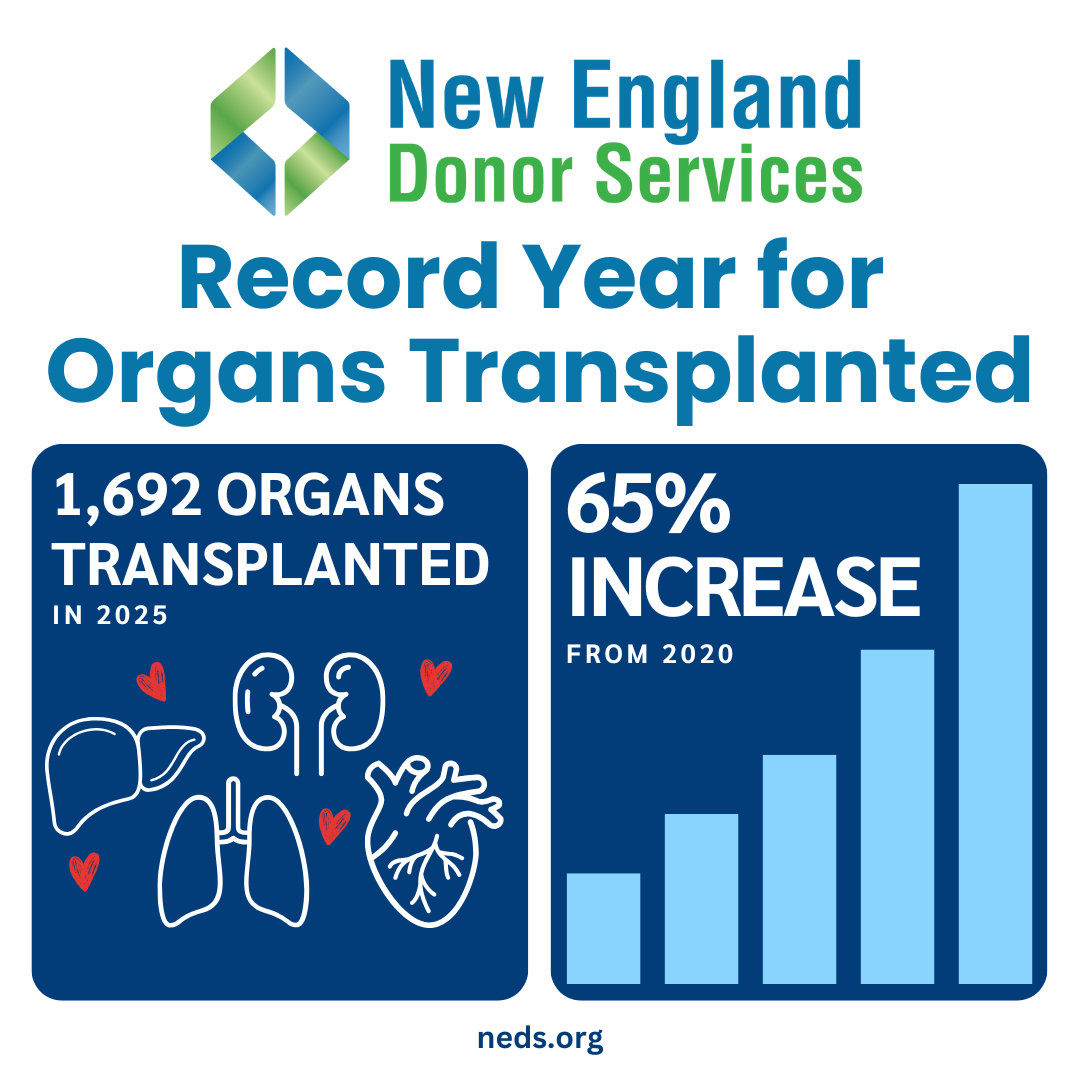
WALTHAM, Mass.--(BUSINESS WIRE)--New England Donor Services (NEDS) today announced a record number of life-saving organ transplants last year from deceased organ donors in New England. In 2025, NEDS coordinated organ donations from 640 deceased donors resulting in 1,692 life-saving transplants. This record number of organ transplants represents the fifth year of consecutive growth in transplants and places NEDS among the nation’s top three organ procurement organizations (OPOs) by donor and transplant volume. Since 2020, NEDS has increased the number of life-saving organ transplants from New England organ donors by a total of 65 percent.
In 2025, New England Donor Services (NEDS) coordinated organ donations from 640 deceased donors resulting in a record 1,692 life-saving organ transplants. Since 2020, NEDS has increased the number of organ transplants from New England organ donors by 65%.
Share
NEDS also coordinated the recovery of donated tissue from 1,861 donors, a record year for tissue donation in New England. Each donor can donate multiple tissues including cornea, bone, skin, heart valves, and other tissues used in necessary medical procedures to heal and transform lives. Tissue donated through NEDS is used in over 100,000 tissue transplants each year.
“Because of donors, courageous families, and the unwavering dedication of NEDS’ staff, generosity becomes legacy and hope lives on for thousands of transplant recipients – turning loss into healing and the gift of donation into life,” said Alexandra K. Glazier, President and CEO of New England Donor Services (NEDS).
While the number of organ donors remained steady during 2025 compared to the previous year, NEDS was nonetheless able to increase the number of life-saving transplants resulting from those donors by 8 percent. One reason was the expanded use of cutting-edge organ perfusion devices and techniques. The adoption of abdominal normothermic regional perfusion (A-NRP) – combined with transportable, ex vivo organ perfusion devices – improves the function of donated organs especially from older and/or more medically complex donors. Glazier noted, “Previously, these organs may not have been accepted for transplant, but now they are used routinely to the benefit of transplant patients and offers the opportunity for donation to more families.”
“My five-year-old son, Lincoln, now has a second chance at life thanks to his life-saving heart transplant,” said Ashley Stanger, a resident of East Haddam, CT, whose son spent 327 consecutive days at the hospital to be treated for dilated cardiomyopathy. “Lincoln received a new heart in March 2025, thanks to the generosity of his deceased donor. We extend our deepest gratitude to Lincoln’s donor. Thanks to this selfless choice, Lincoln is now able to attend kindergarten, spend time with his younger sister, and dreams of becoming a firefighter one day."
“I am incredibly grateful and humbled to have received the gift of life,” said Sean Moore, who lives in Grafton, MA, and received a kidney transplant in July 2025. “I am thankful beyond words to my deceased organ donor who selflessly saved lives by choosing to become a donor. My transplant has given me renewed health and the opportunity to spend many more years with my wife and three children.”
Looking forward to 2026 and the anticipated disruption of the donation and transplant system resulting from inaccurate and destructive performance metrics at the federal level, Glazier continued, “Poorly designed federal regulatory metrics may force the closure of up to half of the community-based non-profits coordinating organ donation for transplant in the United States with no clear plan for how the system will deliver services for these areas. Despite this looming uncertainty, NEDS is positioned to continue providing the stable, high-quality performance it is known for as a national leader in the field, which is necessary to ensure life-saving donation and transplants remain reliable in the New England region. We urge policymakers in Washington, D.C. to take the steps necessary to swiftly reform and modernize the current regulatory structure that could threaten patients that are on the organ donation wait list.”
One person can save up to eight lives as an organ donor and heal 75 people as a tissue donor.
Residents of New England can register as donors on their driver’s license, through the Apple iPhone health app or on the national Donate Life Donor Registry at www.RegisterMe.org.
About New England Donor Services (NEDS)
New England Donor Services is a leading nonprofit organization that coordinates organ and tissue donation in Connecticut, Maine, Massachusetts, New Hampshire, Rhode Island, the eastern counties of Vermont, and Bermuda. Co-founded in 1968 by Nobel Laureate Dr. Joseph Murray, who performed the world’s first successful organ transplant, today NEDS works with thousands of donors and donor families who have generously made the decision to give the gift of life. The organization’s highly skilled staff medically screen referrals for potential donations from more than 200 hospitals across the region and lead all donor authorization discussions with families. NEDS also allocates organs according to the national transplant waiting list and coordinates their transport to ensure the right organs get to the right patients at the right time. Learn more at https://neds.org/ or follow us on LinkedIn or on X at @NEDonorServices.
Contacts
Media Contacts
Sean Fitzpatrick, New England Donor Services
SFitzpatrick@neds.org
Travis Small, Slowey McManus Communications
617-538-9041 (cell), tsmall@sloweymcmanus.com