Deel Launches Deel Works Editorial Hub, Reveals North America's PTO Problem
Deel Launches Deel Works Editorial Hub, Reveals North America's PTO Problem
Former Stripe and Glassdoor economist joins to lead data journalism initiative, first study shows Canadians unexpectedly trail Americans in time off – and Europeans reign
SAN FRANCISCO--(BUSINESS WIRE)--Deel, the global HR platform serving 35,000+ companies worldwide, today launched Deel Works, its future of work editorial hub, alongside new research revealing stark disparities in how workers across the globe take time off. The inaugural study from Deel's newly appointed Economist, Lauren Thomas, features findings from over 159,000 approved time-off requests in 2025 from over 17,000 employees in Europe and North America. The data shows that European workers take a median of 23.5 days off annually, compared to just 14 days for North Americans, with Canadians taking the least time off globally.
Deel, the global HR platform serving 35,000+ companies worldwide, today launched Deel Works, its future of work editorial hub, alongside new research revealing stark disparities in how workers across the globe take time off.
Share
Europeans Maximize Unlimited PTO, But North Americans Leave Days on the Table
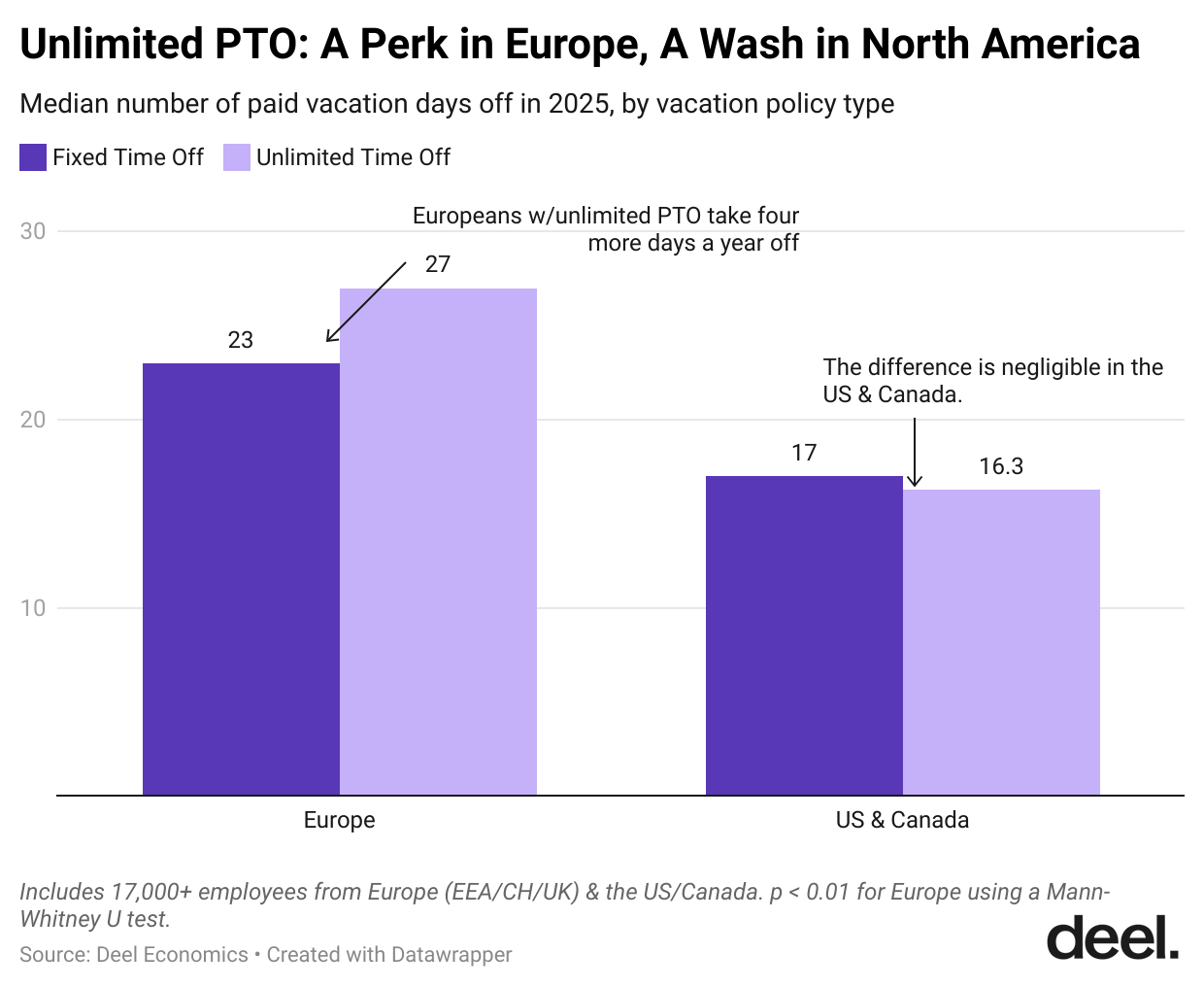
The study's most striking finding challenges conventional wisdom about unlimited paid time off (PTO) policies. While unlimited leave has become increasingly common in North America (US and Canadian employees are two-thirds more likely to have it), European workers are actually using these policies to their advantage.
"European workers with unlimited PTO take a median of four additional days off compared to those with fixed leave – a significant difference,” said Thomas. “Meanwhile, in the US and Canada, there's virtually no difference between unlimited and fixed policies. Cultural differences like these reflect more than just vacation plans. They reflect fundamental differences in how employees view the balance between their work and life."
Canada Comes Up Short on Vacation Days – And Swedes Lead
Despite Canada's government-mandated minimum vacation days, Canadian workers took the least time off among all the countries studied – a median of just 11 days annually. Their American counterparts took 16 days, and European leaders separated far from North America, in places like Sweden (28 days), France (27 days), and Germany (26 days).
The gap persists even within the same companies. When analyzing businesses with employees on both sides of the Atlantic, European workers took a median of 25 days off compared to just 15 days for their North American colleagues.
“The most flexible PTO policy imaginable fails without implicit or explicit permission to take it,” said Alice Burks, Director of People Success at Deel. “For flexible PTO policies to scale, companies need to create a globally consistent culture. To do so, HR leaders need to recognize and work with these regional nuances, so that policies have the impact they are designed to.”
Cultural Patterns Emerge in How Countries Take Breaks
Beyond the quantity of time off, Deel’s findings show distinct cultural patterns.
- Long-haul holidays: Germans and French favor extended breaks, with 1.8% and 1.3% of 2+ day time-off requests for leaves of 16+ days, compared to just 0.5% for Americans
- Christmas traditions: The UK and Ireland lead in holiday season time off, with 28.8% of Irish and 27% of British workers booking three or more days around Christmas
- Sick leave patterns: France stands out with 23% of sick leave requests lasting 11+ days, potentially linked to their requirement for medical certification for any sick leave
- North Americans muscle through it: Nearly 4 in 10 (39%) of European workers took sick leave in 2025, compared to only 29% of North American workers.
What To Expect From Deel Works
The launch of Deel Works represents Deel's investment in understanding and documenting the rapid transformation of global work. With access to real-time data from 1.5+ million workers across 150 countries, the hub provides insights unavailable through traditional government statistics or surveys. Topics to be explored include:
- Real-time analysis of AI's impact on hiring and workforce composition
- Immigration and relocation trends beyond government statistics
- Benefits and compensation patterns across demographics and geographies
- The true state of remote and global work outside the US
"There's a massive gap between the conversations happening about the future of work and the actual data supporting those discussions," said Cunningham. "We can finally bring rigorous analysis to questions about remote work, AI's impact on labor markets, and immigration trends that have been largely based on vibes rather than facts."
For more information about Deel Works and to access the full PTO study, visit www.deel.com/deel-works.
About Deel
Deel is the all-in-one payroll and HR platform for global teams. Built for the way the world works today, Deel combines payroll, HRIS, compliance, benefits, performance, and equipment management into one seamless platform. With AI-powered tools and a fully owned payroll infrastructure, Deel supports every worker type in 150+ countries—helping businesses scale smarter, faster, and more compliantly. Discover how Deel makes global work simple at deel.com.
Contacts