Wolters Kluwer Survey: Physician Assistant Workforce Steps up Amid Clinician Shortages, Fragmented Care Landscape, and Changing Patient Demands
Wolters Kluwer Survey: Physician Assistant Workforce Steps up Amid Clinician Shortages, Fragmented Care Landscape, and Changing Patient Demands
A new Wolters Kluwer survey highlights AI adoption, key challenges in practice, and educational gaps for the fast-growing PA profession
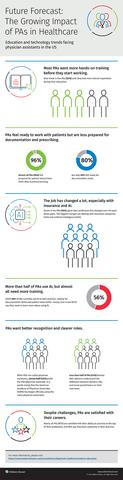
WALTHAM, Mass.--(BUSINESS WIRE)--According to new survey findings from Wolters Kluwer Health, AI is a fixture in clinical practice for physician assistants (PAs) – also referred to as physician associates – with 56% reporting daily use and 19% relying on AI extensively. The most popular use cases for AI are clinical documentation (61%) and ambient scribe technologies for patient interaction notetaking (48%).
Future Forecast: The Growing Impact of PAs in the Healthcare Ecosystem shows that even with this robust adoption, nearly nine in ten PAs (87%) acknowledge the need to learn more about AI, and 83% desire more formal, employer-led training. Additionally, 89% of respondents say that AI will be a force that dramatically changes PA practice. Yet only 32% report having clear workplace guidelines for safe AI usage – a gap that underscores the urgency for structured training, support, and policy in the face of rapid technological change.
The changing world of PAs
Seven in ten PAs (70%) say their profession has changed over the past three years – with the biggest changes in dealing with insurance companies (42%) and artificial intelligence (40%). PAs in practice for more than five years see even more changes when compared to more junior colleagues. These changes validate the need for PAs to adapt and acquire additional skills outside of their initial education, emphasizing the relevance of ongoing learning.
“With the number of PAs increasing nearly 74% since 2016, this exponential growth reflects their increasing importance in the healthcare workforce. PAs have become embedded members of patient care teams, addressing gaps in care delivery and supporting rapidly evolving healthcare demands on the front lines,” said Kelly Villella, Director of Medical Education & Practice, Wolters Kluwer Health. “Our new survey findings also shed light on the current PA education landscape, highlighting the areas that are ripe for disruption and areas needing the most support.”
Education’s role in preparing PAs and the transition to practice
As with any medical profession, the education requirements for PAs are robust and most respondents (95%) say their studies prepared them well enough to practice. However, when transitioning to patient care, there are certain areas such as documentation (23%) and prescribing medications (20%) where PAs said they felt less prepared.
Other key findings from the PA journey from education to practice, include:
- Clinical experience gaps: More than three in five (62%) wish they had more clinical experience during their education
- Lack of PA residency opportunities: Only 9% of respondents had a formal residency prior to entering the workforce
- Collaboration ready: PAs overwhelmingly felt ready for patient interactions (96%) and collaboration with doctors (95%) and medical assistants (90%)
- Best advice for PAs: When asked what advice they'd give to those studying to become a PA, the top response (20%) was to "keep learning proactively"
How do PAs feel about their role?
- Empowered to care: Nearly all PAs (97%) are satisfied with their ability to practice at the top of their license, and 96% say they have autonomy in their practice
- Title transitions: While 99% are called Physician Assistants, almost half (45%) prefer the title Physician Associate
- Care team confusion: Less than half of PAs (43%) believe their patients understand the difference between doctors, PAs, and nurse practitioners on their care team
While efforts are underway to replace “physician assistant” with “physician associate,” with three states already adopting legislation for this name change, more can be done. According to the American Academy of Physician Associates the shift in title reflects a better representation of the profession’s training, autonomy and ability to provide the excellent team-based care needed in today’s healthcare settings.
To see more findings and learn about the current state of the PA profession, download the Future Forecast: The Growing Impact of PAs in the Healthcare Ecosystem full report.
Wolters Kluwer commissioned Regina Corso Consulting to conduct a comprehensive survey of 203 practicing PAs across the United States. All participants are practicing PAs, including 100 who have been practicing for 5 years or less and 103 who have been practicing over 5 years. The survey took place online in September 2025.
For more information about Wolters Kluwer, please visit: www.wolterskluwer.com
About Wolters Kluwer
Wolters Kluwer (EURONEXT: WKL) is a global leader in information, software solutions and services for professionals in healthcare; tax and accounting; financial and corporate compliance; legal and regulatory; corporate performance and ESG. We help our customers make critical decisions every day by providing expert solutions that combine deep domain knowledge with technology and services.
Wolters Kluwer reported 2024 annual revenues of €5.9 billion. The group serves customers in over 180 countries, maintains operations in over 40 countries, and employs approximately 21,600 people worldwide. The company is headquartered in Alphen aan den Rijn, the Netherlands.
For more information, visit www.wolterskluwer.com, follow us on LinkedIn, Facebook, YouTube and Instagram.
Contacts
Media Contact
Josh DeStefano
Manager, External Communications
Wolters Kluwer Health
+1 (917) 408-5125
joshua.destefano@wolterskluwer.com