HSS Researchers Report Benefits of Robotic-Assisted Spine Surgery for Adolescent Athletes with Back Pain Due to Pars Fractures
HSS Researchers Report Benefits of Robotic-Assisted Spine Surgery for Adolescent Athletes with Back Pain Due to Pars Fractures

DENVER--(BUSINESS WIRE)--Spine surgeons at Hospital for Special Surgery (HSS) reported promising findings for adolescent athletes suffering from pars fracture, a common cause of adolescent back pain that may not always heal on its own and can result in chronic discomfort later in life. Minimally invasive robotic-assisted pars repair enabled most patients to return to sports in as little as six weeks. The findings were reported at the 40th Annual Meeting of the North American Spine Society, held November 14-16 in Denver.
A pars fracture — also called spondylolysis — is a break in the pars interarticularis, a narrow area of bone connecting two vertebrae in the spine. It typically occurs in the lumbar spine (lower back). About 7 percent of all adolescents experience a pars fracture, and that number can rise to as much as 50 percent among teens engaged in high-risk sports such as gymnastics, football, and soccer.
While these injuries can heal on their own after a six- to eight-week break from sports, one in five adolescents continues to experience a non-healing fracture (nonunion). The pain often returns after resuming activity, and some athletes have been told to quit sports entirely. "Nonunion can cause persistent back pain and, in certain cases, even require lumbar fusion later in life if the fracture results in a vertebral slip, where the vertebrae slip out of place," explained Austin Kaidi, MD, an orthopedic surgery resident at HSS and the study's lead author.
About seven years ago, HSS spine surgeon Sheeraz Qureshi, MD, Co-Chief of HSS Spine and the study's senior author, began using a spine surgery robot to plan the placement of surgical screws in novel ways. His work sparked a shift in the way the HSS surgeons approached pars fracture repairs.
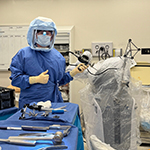
The new minimally invasive technique involves the placement of a single screw through a 1 cm incision — far smaller than traditional surgery to repair a pars fracture, which is performed through a larger incision and requires bone grafting. The robotic procedure is performed on an outpatient basis and is associated with an easier, shorter recovery.
Study: Robotic Pars Repair Allows Early Return to Activity for Adolescents with Symptomatic Spondylolysis: A Case Series
Dr. Kaidi, Dr. Qureshi, and their colleagues performed a retrospective review of nine adolescent patients with lumbar spondylolysis (mean age 16) who had robotic-assisted pars repair at HSS using the single-screw technique. Patients had endured back pain before the surgery for an average of 8 months. After surgery, they participated in an 8-week physical therapy program that started with walking and gradually re-introduced sports-specific exercises.
After a mean follow-up of 11.4 months, five patients had returned to the same or an even higher level of sports. One patient had residual back pain and did not return to sports. Three patients had CT scans at one year demonstrating union of the fracture. The athletes were able to return to activity in as little as six weeks. "Although nonsurgical treatment should always be tried before considering surgery, we were surprised by the effectiveness of this technique for enabling athletes to return to sport," said Dr. Kaidi.
HSS is a leader in robotic-assisted single-screw pars repair and one of only a handful of institutions worldwide who have published on this technique. This study is the largest series ever reported in these patients.
"This safe and effective procedure is changing the way the medical community thinks about these injuries. We are moving away from 'do nothing for 6 weeks' to a more elegant, proactive solution," concluded Dr. Qureshi. "Early minimally invasive spine surgery can prevent future complications. We're not only caring for patients while they are young, but also helping them in the long run."
Reference
Robotic Pars Repair Allows Early Return to Activity for Adolescents with Symptomatic Spondylolysis: A Case Series
Authors: Austin Kaidi MD, MSc, Michelle Zabat, MD, Amy Xu, MD, Adin Ehrlich, BS, Tomoyuki Asada, MD, PhD, Harvinder Sandhu, MD, Russel Huang, MD, Sravisht Iyer, MD, and Sheeraz Qureshi, MD, MBA
About HSS
HSS is the world’s leading academic medical center focused on musculoskeletal health. At its core is Hospital for Special Surgery, nationally ranked No. 1 in orthopedics (for the 16th consecutive year), No. 3 in rheumatology by U.S. News & World Report (2025-2026), and the best pediatric orthopedic hospital in NY, NJ and CT by U.S. News & World Report “Best Children’s Hospitals” list (2024-2025). In a survey of medical professionals in more than 20 countries by Newsweek, HSS is ranked world #1 in orthopedics for a fifth consecutive year (2025). Founded in 1863, the Hospital has the lowest readmission rates in the nation for orthopedics, and among the lowest infection and complication rates. HSS was the first in New York State to receive Magnet Recognition for Excellence in Nursing Service from the American Nurses Credentialing Center five consecutive times. An affiliate of Weill Cornell Medical College, HSS has a main campus in New York City and facilities in New Jersey, Connecticut and in the Long Island and Westchester County regions of New York State, as well as in Florida. In addition to patient care, HSS leads the field in research, innovation and education. The HSS Research Institute comprises 20 laboratories and 300 staff members focused on leading the advancement of musculoskeletal health through prevention of degeneration, tissue repair and tissue regeneration. In addition, more than 200 HSS clinical investigators are working to improve patient outcomes through better ways to prevent, diagnose, and treat orthopedic, rheumatic and musculoskeletal diseases. The HSS Innovation Institute works to realize the potential of new drugs, therapeutics and devices. The HSS Education Institute is a trusted leader in advancing musculoskeletal knowledge and research for physicians, nurses, allied health professionals, academic trainees, and consumers in more than 165 countries. The institution is collaborating with medical centers and other organizations to advance the quality and value of musculoskeletal care and to make world-class HSS care more widely accessible nationally and internationally. www.hss.edu.
Contacts
Rachael Rennich / Tracy Hickenbottom
mediarelations@hss.edu
(212) 606-1197