Tariffs Add New Pressure to Commercial Construction Budgets
Tariffs Add New Pressure to Commercial Construction Budgets
Cushman & Wakefield projects a 9% rise in materials costs and a 4.6% increase in total project costs due to tariffs, with data centers most impacted
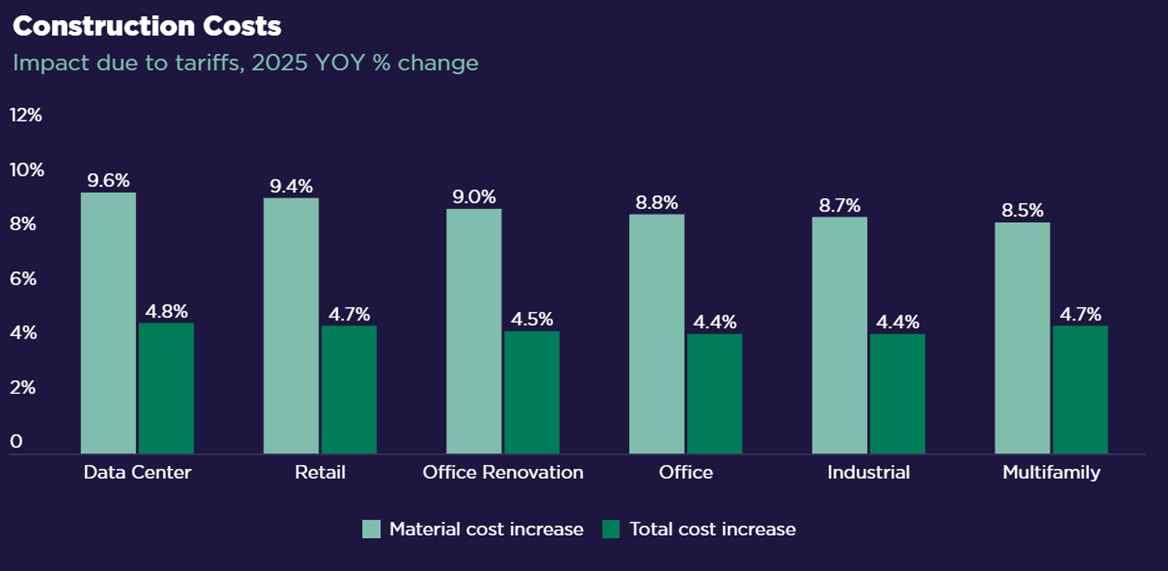
NEW YORK--(BUSINESS WIRE)--Shifting U.S. trade policy is creating new challenges for the commercial real estate (CRE) construction sector, according to new research from Cushman & Wakefield (NYSE: CWK). The firm’s latest analysis finds that tariffs on imported building materials are expected to increase construction materials costs by an average of 9% in 2025, leading to a 4.6% increase in total project costs in Q4 2025 compared to Q4 2024.
(Figures represent isolated impact of current tariff policy as of September 30 on construction costs. Analysis does not account for other market driven shifts in costs such as labor, materials substitution, supply/demand fundamentals, etc.)
Metals are seeing the steepest cost increases. Steel, aluminum, and copper are subject to tariff rates of up to 50%, with copper-intensive projects like data centers facing the largest impact. Some facilities require as much as 50,000 tons of copper per site, making them particularly exposed to tariff-driven inflation.
“Construction pipelines were already thinning due to high interest rates, cautious lending, and supply/demand fundamentals,” said James Bohnaker, Senior Economist. “Tariffs add another layer of uncertainty, amplifying cost pressures and complicating decisions for developers, contractors and occupiers.”
Key findings from the report include:
- Materials cost increases range from 8.5% to 9.6% depending on property type.
- Total project costs are projected to rise 4.4% to 4.8%, assuming no changes to labor and other building costs.
- Metals account for up to two-thirds of tariff-driven increases.
Approximately 40% of CRE construction materials are imported, with Canada, Mexico, and the EU representing the largest sources.
Tariff pass-through to end-users is estimated at 75%, meaning most of the costs will ultimately be absorbed by contractors, developers and tenants.
While domestic sourcing offers limited relief, U.S. production capacity cannot currently meet demand for key inputs like copper and aluminum. New facilities would take years to build, leaving construction stakeholders to navigate a volatile pricing environment.
Cushman & Wakefield advises developers to adopt proactive strategies, including diversifying procurement channels, considering prefabricated systems, and engaging project management experts to mitigate cost overruns.
“Trade policy uncertainty is proving just as disruptive as the tariffs themselves,” Bohnaker added. “Developers need to plan strategically, manage risks aggressively, and build flexibility into project underwriting.”
Cushman & Wakefield’s full analysis is available here.
About Cushman & Wakefield
Cushman & Wakefield (NYSE: CWK) is a leading global commercial real estate services firm for property owners and occupiers with approximately 52,000 employees in nearly 400 offices and 60 countries. In 2024, the firm reported revenue of $9.4 billion across its core service lines of Services, Leasing, Capital markets, and Valuation and other. Built around the belief that Better never settles, the firm receives numerous industry and business accolades for its award-winning culture. For additional information, visit www.cushmanwakefield.com
Contacts
MEDIA CONTACT:
Michael Boonshoft
michael.boonshoft@cushwake.com