

Gartner Says That in the Age of GenAI, Preemptive Capabilities, Not Detection and Response, Are the Future of Cybersecurity
Gartner Says That in the Age of GenAI, Preemptive Capabilities, Not Detection and Response, Are the Future of Cybersecurity
Preemptive Cybersecurity Technologies Will Account for over 50% of IT Security Spending by 2030, Up from Less Than 5% in 2024
STAMFORD, Conn.--(BUSINESS WIRE)--By 2030, preemptive cybersecurity solutions will account for 50% of IT security spending, up from less than 5% in 2024, replacing standalone detection and response (DR) solutions as the preferred approach to defend against cyberthreats, according to Gartner, Inc., a business and technology insights company.
Preemptive cybersecurity technologies use advanced AI and machine learning (ML) to anticipate and neutralize threats before they materialize. It includes capabilities such as predictive threat intelligence, advanced deception and automated moving target defense.
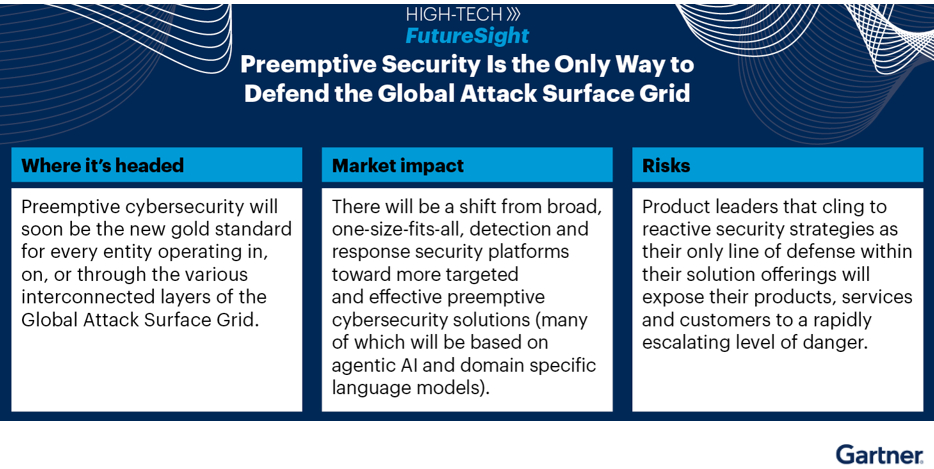
“Preemptive cybersecurity will soon be the new gold standard for every entity operating on, in, or through the various interconnected layers of the global attack surface grid (GASG),” said Carl Manion, Managing Vice President at Gartner. “DR-based cybersecurity will no longer be enough to keep assets safe from AI-enabled attackers. Organizations will need to deploy additional countermeasures that act preemptively and independently of humans to neutralize potential attackers before they strike.
“Ignoring the shift brought by AI-driven cyberthreats poses a significant and escalating risk to product and innovation leaders (see Figure 1). By clinging to reactive security strategies as their primary line of defense, they will expose their products, services and customers to a new, rapidly escalating level of danger.”
Due to the rapid growth of the GASG, Gartner predicts that by 2030 there will be over 1 million documented cybersecurity Common Vulnerabilities and Exposures (CVEs), up 300% from approximately 277,000 in 2025.
Autonomous Cyber Immune System (ACIS)
The future of a secure digital world hinges on the commitment to embrace the transformative potential of the Autonomous Cyber Immune System (ACIS) – the ultimate evolution of preemptive cybersecurity for the complex, rapidly growing, GASG.
“The relentless expansion and increasing sophistication of the GASG render traditional, reactive cybersecurity measures obsolete. Though early in its development, the proactive and adaptive power of the ACIS, is unequivocally the future of digital defense,” said Manion. “The development and deployment of intelligent, decentralized, tactical ACIS frameworks are not merely aspirational goals, but an eventual absolute imperative for safeguarding our increasingly interconnected world.”
The Shift from One-Size Fits All
There will be a shift from broad, one-size-fits-all DR security platforms toward more targeted and effective preemptive cybersecurity solutions, many of which will be based on agentic AI and domain-specific language models (DSLMs). This focus on niche areas will present many opportunities for new and existing security vendors to carve out distinct market segments by deeply understanding the unique security challenges of:
- Specific verticals, such as healthcare, finance and manufacturing
- Particular application types, such as industrial control systems, cloud-native applications and AI/ ML pipelines
- Specific threat actor methodologies, such as ransomware targeting critical infrastructure and supply chain attacks on SaaS platforms
“This emphasis on specialization will drive increased collaboration and integration within the cybersecurity ecosystem. Because no single vendor can effectively address the entirety of the GASG, partnerships and interoperability between specialized solutions will become even more crucial,” Manion said.
“For instance, a vendor specializing in preemptive cybersecurity for IoT devices in the healthcare sector might need to integrate with a platform focused on securing cloud-based electronic health records,” Manion added. “Such interdependencies will create opportunities for technology alliances, joint go-to-market strategies, and the development of standardized APIs and data formats to facilitate seamless interaction between disparate security solutions.”
Additional information is available to Gartner clients in the report, Tech FutureSight: Preemptive Cybersecurity Is the Only Way to Secure Emerging AI Attack Surfaces. Non-clients can read more in the Gartner article, Don’t Delay in Building Preemptive Cybersecurity Solutions, and view the complimentary webinar on-demand, Preemptive Cybersecurity – A Top 5 Disruptive Trend in Cybersecurity for 2025.
About Gartner AI Use Case Insights
Gartner AI Use Case Insights is an interactive tool that helps technology and business leaders efficiently discover, evaluate, and prioritize AI use cases to potentially pursue. Clients can search over 500 use cases (applications of AI in specific industries) and over 380 case studies (real world examples) based on industry, business function, and Gartner’s assessment of potential business value. Clients can access the interactive tool at https://tools.gartner.com/use-case-insights.
Gartner IT Symposium/Xpo
At Gartner IT Symposium/Xpo, CIOs and IT executives will learn how to become agents of change in their organizations and harness AI for successful digital transformation. Follow news and updates from the conferences on X and LinkedIn using #GartnerSYM, and on the Gartner Newsroom.
About Gartner for High Tech Leaders and Providers
Gartner for High Tech Leaders and Providers equips tech leaders and their teams with role-based best practices, industry insights and strategic views into emerging trends and market changes to achieve their mission-critical priorities and build the successful organizations of tomorrow. Additional information is available at www.gartner.com/en/industries/high-tech.
Follow news and updates from Gartner for High Tech on X and LinkedIn using #GartnerHT. Visit the Gartner Newsroom for more information and insights.
About Gartner
Gartner, Inc. (NYSE: IT) delivers actionable, objective business and technology insights that drive smarter decisions and stronger performance on an organization’s mission-critical priorities. To learn more, visit gartner.com.
Contacts
Matt LoDolce
Gartner
matt.lodolce@gartner.com
Meghan Moran
Gartner
meghan.moran@gartner.com