Gartner Identifies Top 12 Early-Stage Technology Disruptions that Will Define the Future of Business Systems
Gartner Identifies Top 12 Early-Stage Technology Disruptions that Will Define the Future of Business Systems
Technologies Addressing GenAI-Enabled Code Architecture, Disinformation Security and Surface Asset Management Will Be Widely Adopted by 2030
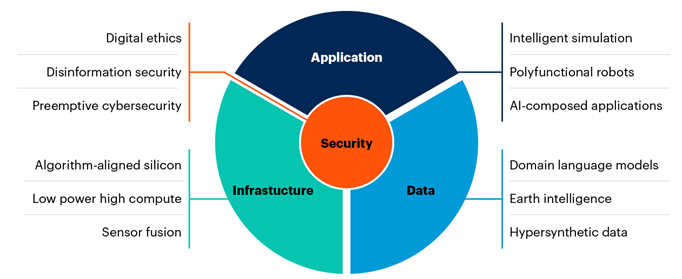
STAMFORD, Conn.--(BUSINESS WIRE)--Gartner, Inc. has identified 12 emerging technology disruptions that will define the future of business systems. Technology leaders must prioritize these over the next five years, as they present competitive opportunities in the near term and will eventually grow to become standard throughout businesses.
“Technology leaders must take action now to gain a first-mover advantage with these technologies,” said Bill Ray, Distinguished VP Analyst at Gartner. “Innovative advancements like generative AI (GenAI)-enabled code architecture, disinformation security and Earth intelligence will provide the differentiation needed to help enterprises pull ahead of the pack in terms of data and product offerings.”
The 12 early-stage technology disruptions are highlighted in Figure 1. Each disruptor is significant in its own right, but in combination they start to define broader emerging solutions to new business practices. For example, advancing GenAI technologies will spawn new solutions around Earth intelligence and business simulation, spur the expansive growth of domain-specific language models, and lead to higher functioning tools.
Additional insights into some of these technology market disruptors are highlighted below:
GenAI-Enabled Code Architecture Will Enable Dynamic Composable Applications
GenAI solutions systems using free-form text and multimedia inputs/outputs will displace the conventional form-oriented sequential UI in established enterprise applications and enable new user scenarios.
“To remain competitive, traditional enterprise application software vendors will need to refactor applications to serve composable GenAI solutions that are invoked on demand via textual and multimodal prompts,” said Ray Valdes, VP Analyst at Gartner.
Because of this, Gartner predicts that by 2029, more than 50% of user interactions linked to enterprise business processes will leverage large language models to bypass the UI layer in traditional enterprise applications, up from less than 5% today.
Products and Services to Address Disinformation Security
Disinformation security is an emerging discipline focused on threats from outside the corporate-controlled network. It includes a suite of technologies, such as deepfake detection, impersonation prevention and reputation protection, which can address disinformation to help enterprises discern trust, protect their brand and secure their online presence.
Gartner predicts that by 2030, at least half of enterprises will have adopted products or services to address disinformation security, up from less than 5% in 2024.
“Disinformation attacks use external infrastructure like social media and originate from areas with limited legal oversight,” said Alfredo Ramirez IV, Senior Director Analyst at Gartner. “Tech leaders must add 'disinformation-proofing' to products by using AI/machine learning for content verification and data provenance tracking to help users discern the truth.”
Earth Intelligence
Gartner predicts that by 2028, 80% of major Earth surface assets globally will be monitored by active satellites.
Earth intelligence uses AI to analyze satellite, aerial, and ground data to monitor Earth's assets and activities, providing insights for decision-making.
“That doesn't mean maps and charts. Earth intelligence is delivering numbers on global nickel production, theme park revenue and the health of wheat crops, to name just a few,” said Ray.
Given the breadth of applications, Earth intelligence is applicable to all industries and enterprises. Defense has been the first adopter, but improvements in quality of data, and analysis techniques, have rapidly expanded the use cases. The Earth intelligence market is now divided between those who capture the data, those who interpret and analyze it, and those who generate industry-specific insights.
“Earth intelligence applies to every business,” said Ray. “Enterprises can gain an early advantage by creatively and strategically applying Earth intelligence to significantly enhance specific functionalities of existing systems or to compete via net new capabilities.”
Gartner clients can read more in “Emerging Tech Disruptors: Top 12 Early Trends Redefining the Future of Business.”
Learn more about how these 12 technologies will transform how companies operate over the next five years and beyond in the complimentary, on-demand Gartner webinar “12 Emerging Technologies That Will Redefine the Future of Business.”
About Gartner for High Tech
Gartner for High Tech equips tech leaders and their teams with role-based best practices, industry insights and strategic views into emerging trends and market changes to achieve their mission-critical priorities and build the successful organizations of tomorrow. Additional information is available at www.gartner.com/en/industries/high-tech.
Follow news and updates from Gartner for High Tech on X and LinkedIn using #GartnerHT. Visit the Gartner Newsroom for more information and insights.
About Gartner
Gartner, Inc. (NYSE: IT) delivers actionable, objective insight to executives and their teams. Our expert guidance and tools enable faster, smarter decisions and stronger performance on an organization’s mission-critical priorities. To learn more, visit gartner.com.
Contacts
Matt LoDolce
Gartner
matt.lodolce@gartner.com
Meghan Moran
Gartner
meghan.moran@gartner.com