19 Million TPA of Drop-in Chemicals Synthesised from Captured CO2 by 2045, Forecasts IDTechEx
19 Million TPA of Drop-in Chemicals Synthesised from Captured CO2 by 2045, Forecasts IDTechEx
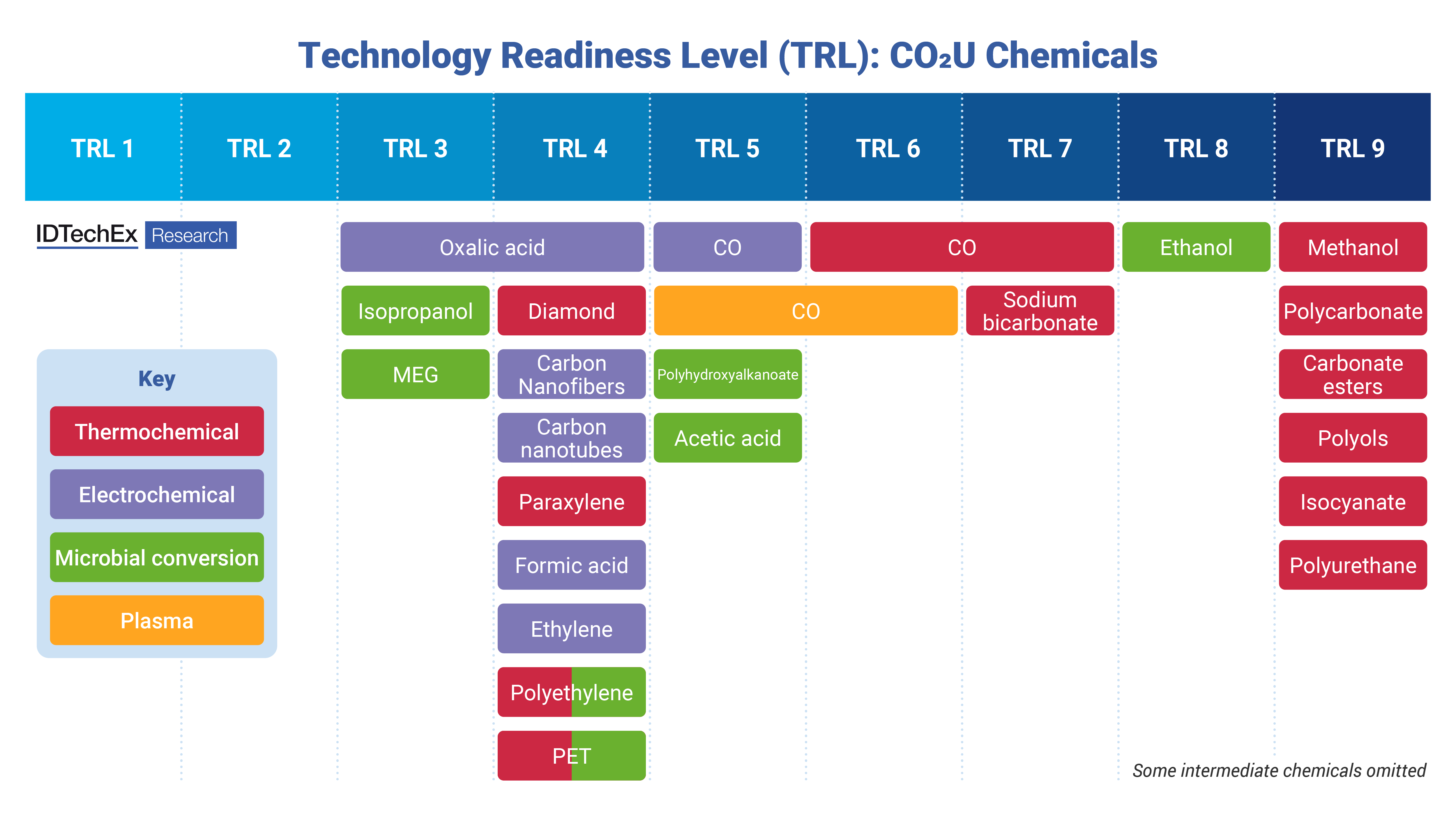
BOSTON--(BUSINESS WIRE)--The chemicals industry depends heavily on finite fossil fuel feedstocks and is responsible for 2% of global anthropogenic CO2 emissions. A new report from market intelligence firm IDTechEx explores how captured CO2 could be utilized as a feedstock for hundreds of different chemicals instead, providing an economic and environmental incentive to capture carbon dioxide and create a circular economy.
Captured CO2 could be utilized as a feedstock for hundreds of different chemicals, providing an economic and environmental incentive to capture carbon dioxide and create a circular economy.
Share
Carbon capture is viewed as an essential technology for lowering global carbon dioxide emissions as it can decarbonize hard-to-abate sectors. However, carbon capture technologies are expensive. If captured carbon can be utilized to make profitable chemical products, this revenue stream can provide an economic incentive to accelerate the uptake of CCUS (carbon capture, utilization, and storage) technologies until stronger legislation that promotes CO2 storage emerges.
While many CO2-derived chemicals do not represent net-negative or net-zero products, they do still represent reductions in emissions compared to the fossil fuel-based status quo and should not be overlooked as a decarbonization tool.
Millions of different compounds contain carbon. Examples include fuels such as gasoline and methanol, as well as everyday plastics. Recycling captured CO2 and combining it with low-carbon hydrogen provides a new route to these carbon-containing chemicals. Because carbon dioxide is a thermodynamically stable molecule, an energy input is needed for reactions to occur. Currently, the most mature synthesis pathways for CO2-derived chemicals are thermocatalytic – where heat and catalysts yield favourable reaction kinetics. However, there is considerable interest in synthetic routes that can be performed at ambient temperatures and pressures, with reduced energy demand and cost.
Chemicals are already being made by recycling captured CO2 at a large scale. Players are now focused on extending production to new CO2-derived chemicals and alternative synthesis pathways. Biological conversion and electrochemistry for CO2 utilization are championed by start-ups and show particular promise, although these routes may need to be combined with additional thermocatalytic steps to achieve the most economical synthesis. By 2045, IDTechEx forecasts 19 million tonnes per annum of drop-in chemicals will be synthesised from captured CO2.
“Carbon Dioxide Utilization 2025-2045: Technologies, Market Forecasts, and Players”, a new market report from IDTechEx, offers further insights. Visit www.IDTechEx.com/CO2U for more.
IDTechEx is offering the opportunity to learn more about the future of the decarbonization market directly from industry experts at the upcoming IDTechEx Hydrogen & CCUS Technology Briefing in Hamburg, Germany on October 22nd 2024. The briefing is free to attend but spaces are limited - please contact research@IDTechEx.com to find out more.
About IDTechEx
IDTechEx provides trusted independent research on emerging technologies and their markets. For more information, contact research@IDTechEx.com or visit www.IDTechEx.com.
Contacts
Charlotte Martin
Subscriptions Marketing Manager
press@IDTechEx.com
+44(0)1223 812300